Learning sharks-Share Market Institute


Rajouri Garden  8595071711 7982037049  Noida 8920210950 , and  Paschim Vihar  7827445731  

Fee revision notice effective 1st April 2025; No change for students enrolled before 15th May 2025

Download “Key features of Budget 2024-2025here

The Financial Ratio

learning sharks stock market institute

A note on Financial Ratios

Firstly, We have learned how to interpret financial statements throughout the course of the last few chapters. Now, we’ll concentrate on examining these financial accounts. Studying the “Financial Ratios” is the most excellent technique to assess financial statements. Benjamin Graham, the founder of fundamental analysis, popularised the theory of financial ratios. Financial ratios assist in interpreting the results and facilitating comparisons with prior years and businesses in the same sector as well, A typical financial ratio calculates its value using information from the financial statement. We must be familiar with a few characteristics of financial ratios before we can begin to grasp them.

Definitely, The financial ratio of a corporation by itself tells us very little about that business. How helpful do you believe it is to know that Ultratech Cements Limited has a profit margin of 15%, for example? Really not much, though. Although a 15% profit margin is good, how can I tell if it is the best?

Let’s assume that you determine ACC Cement’s profit margin to be 12 percent. It makes sense to compare the profitability now that we are contrasting two similar businesses. Undoubtedly, Ultratech Cements Limited appears to be the more successful business of the two. I’m trying to make the point that Financial Ratios on their own are frequently fairly meaningless. However, Only when you compare the ratio with another business of like size or when you examine the trend in financial ratios does the ratio make sense. To achieve the best inference, the ratio must be studied after it has been computed (either through comparison or by monitoring the ratio’s historical trend).

Additionally, you should be aware of this while calculating ratios. Companies and financial years may use different accounting policies. Before calculating the financial ratio, a fundamental analyst should be aware of this aspect and change the data appropriately as well.

Financial Ratios

Financial ratios can be “rather informally” divided into the following groups:

  1. Ratios of Profitability

  2. Ratios of Leverage

  3. Ratios of Valuation

  4. Running Ratios

Firstly, The analyst can assess the company’s profitability with the use of the profitability ratios. The ratios demonstrate how effectively the business can produce profits. Along with this, The competitiveness of the management is also indicated by a company’s profitability. A company’s profitability is a key factor since the profits are required for corporate expansion and to pay dividends to its shareholders.

In fact, The company’s long-term ability to maintain its ongoing business operations is measured by the leverage ratios, often known as solvency ratios or gearing ratios. The degree to which a corporation uses debt to support its expansion is indicated by its leverage ratios. Keep in mind that the business must fulfill its responsibilities in order to continue operating.

Solvency ratios put the company’s commitment in perspective and allow us to determine its long-term viability.

Generally, To determine how inexpensively or expensively the stock is trading, valuation ratios compare the company’s stock price with either its profitability or its overall value. This ratio enables us to determine whether the present share price of the company is regarded as high or low. In plainer terms, the valuation ratio contrasts the price of a security with the benefits of its ownership as well.

Beyond, The operating ratio commonly referred to as the “activity ratio,” gauges how effectively a company can turn its assets—both current and noncurrent—into income. This ratio enables us to assess the effectiveness of the company’s management.

In essence, ratios (regardless of the category to which they belong) communicate a message, typically one that is relevant to the financial status of the organization. For instance, the “Profitability Ratio” might communicate the effectiveness of the business, which is often assessed by calculating the “Operating Ratio”. Perhaps, These overlaps make it challenging to categorize these ratios. As a result, the ratios are categorized “rather loosely.

The Profitability Ratios

Under “The Profitability  Ratio,” we shall examine the following ratios:

  1. The margin of EBITDA (Operating Profit Margin)

  2. EBITDA Increase (CAGR)

  3. APT Margin

  4. Growth PAT (CAGR)

  5. Income from Equity (ROE)

  6. Income from Assets (ROA)

  7. Capital Employed Return (ROCE)

The margin of EBITDA:

It should be noted, The EBITDA margin, also known as earnings before interest, taxes, depreciation, and amortization measures management effectiveness. It reveals the effectiveness of the business’s operational strategy. The EBITDA Margin reveals the company’s operating profitability (in percentage terms). To determine how effectively the management controls expenses, it is usually advisable to compare the company’s EBITDA margin to that of its rivals.

We must first determine the EBITDA in order to compute the EBITDA Margin.

Operating revenues minus operating expenses is EBITDA.

Total Revenue – Other Income = Operating Revenues

Total Expense – Finance Cost – Depreciation and Amortization = Operating Expense

Total Revenue – Other Income] / EBITDA is known as the EBIDTA margin.

Using Amara Raja Batteries Limited as an example, the EBITDA Margin calculation for FY14 is as follows:

EBITDA is initially calculated, and it is calculated as follows:

Total Revenue minus Other Income minus Total Expense minus Finance Cost minus Depreciation & Amortization

It should be noted Income from investments and other non-operational activity is referred to as other income. Other income would undoubtedly bias the results if it were included in the EBITDA calculation. This forces us to subtract Other Income from Total Revenues.

[3482 – 46] – [2942 – 0.7 – 65]

= [3436] – [2876]

= 560 billion

the EBITDA Margin is as follows:

560 / 3436

equals 16.3%

At this point, I’d want to ask you two questions:

  1. What do Rs. 560 crores in EBITDA and a 16.3% EBITDA margin mean?

  2. How favorable or unfavorable is a 16.3% EBITDA margin?

The first query is quite straightforward. A company with an EBITDA of Rs. 560 Crs. has kept Rs. 560 Crs. from its operating income of Rs. 3436 Crs. This also indicates that the corporation paid Rs. 2876 Cr. toward expenses out of a total of Rs. 3436 Cr. The corporation kept 16.3 percent of its revenue at the operating level for its operations while paying out 83.7 percent of its income in expenses.

Now for the second question, to which you, ideally, should not have a response.

First and foremost, Keep in mind that we did touch on this subject earlier in the chapter. A financial ratio by itself tells us virtually nothing. We should either look at the trend or evaluate it in relation to similar items to make sense of it. With this in mind, a 16.3% EBITDA margin provides very little insight.

Surely, It seems as though ARBL has kept its EBITDA at an average of 15%, and closer inspection reveals that the EBITDA margin is rising. This is encouraging since it demonstrates the management’s operating capabilities are reliable and effective.

EBITDA increased from Rs. 257 Cr. in 2011 to Rs. 560 Cr. in 2014. Accordingly, there will be a 21% CAGR in EBITDA over the next four years.

Please note that module 1 of our discussion included the CAGR formula.

It is obvious that the EBITDA margin and EBITDA growth both seem to be fairly excellent. But we’re still unsure if it’s the best. Compare these figures against those of its rivals to see if it is the best. It would be Exide batteries Limited in the instance of ARBL. I’d advise you to apply the same strategy to Exide and contrast the outcomes.

The margin of PAT:

Moreover, The Profit After Tax (PAT) margin is determined at the level of ultimate profitability, whereas the EBITDA margin is calculated at the operating level. Only operating costs are taken into account at the operating level; other costs, such as depreciation and financing charges, are not considered.

There are tax expenses in addition to these costs. To determine the company’s total profitability, we subtract all costs from Total Revenues before calculating the PAT margin as well.

[PAT/Total Revenues] = PAT Margin

PAT is mentioned in the Annual Report in explicit terms. On a total revenue of Rs. 3482 Cr., ARBL’s PAT for FY14 is Rs. 367 Cr (including other income). The PAT margin as a result is:

= 367 / 3482

equals 10.5%

We can plainly notice a margin expansion, hence the PAT and PAT margin trend appears outstanding. The 4-year CAGR growth is 25.48 percent, which is once more respectable. It goes without saying that it is always a good idea to compare ratios with the company’s rivals.

ROI (Return on Equity):

The Return on Equity (RoE) ratio is important because it enables investors to evaluate the return that shareholders receive for each unit of invested capital. Importantly, RoE gauges an organization’s capacity to make money off of the investments of its shareholders. Likewise, In other words, RoE demonstrates the effectiveness of the business in producing profits for its shareholders. Clearly, It goes without saying that the better it is for the shareholders, the higher the RoE.

In actuality, this is one of the crucial statistics that aid the investor in determining the company’s investable qualities. To give you some context, the average RoE of the best Indian companies is from 14 to 16 percent. Personally, I favor investing in businesses with RoEs of 18 percent and more.

This ratio is evaluated in comparison to other businesses operating in the same sector and is tracked over time.

Additionally, keep in mind that if the RoE is strong, the company is producing a sizable amount of cash. As a result, there is less need for outside funding. Therefore, a greater ROE denotes better managerial performance.

In case, Using the formula [Net Profit / Shareholders Equity* 100], RoE may be determined.

Without a doubt, RoE is a crucial ratio to compute, but like many financial ratios, it also has some limitations. Think about this hypothetical situation to help you comprehend its downsides.

Let’s say Vishal owns a pizzeria. Vishal wants an oven, which will cost him Rs. 10,000. The oven is beneficial to Vishal’s company. He does not seek external debt and pays for the oven out of his own pocket. You would agree that according to his balance sheet, he has an asset worth Rs. 10,000 and shareholder equity of Rs.

Let’s say Vishal makes $2500 in profit in his first year of business. How does he rate? It’s not difficult to calculate this:

RoE = 2500/10000*100

equals 25 percent.

Let’s now alter the narrative a little. With only Rs. 8000, Vishal borrows Rs. 2000 from his father to buy an oven that costs Rs. 1000. What would his balance sheet look like, in your opinion?

In terms of liability, he would have:

Equity of Shareholders = Rs. 8000

Debt = 2000 Rupees

Vishal now owes a total of Rs. 10,000. He possesses an asset worth Rs. 10,000 to balance this out on the asset side. Check out his RoE right now:

RoE = 2500 / 8000*100

equals 31.25 percent

When there was an additional loan, the RoE increased considerably. What if Vishal had only 5000 rupees and borrowed another 5000 from his father to purchase the oven? His balance sheet would seem as follows:

In terms of liability, he would have:

Shareholder Equity is equal to Rs.

debt equals 5000

The entire amount owed by Vishal is Rs. 10,000. He possesses an asset worth Rs. 10,000 to balance this out on the asset side. Check out his RoE right now:

RoE = 2500 / 5000 *100

50 percent

The RoE is undoubtedly higher the more debt Vishal seeks to fund his asset, which is necessary to produce profits. A high RoE is fantastic, but not at the expense of a large debt load. The issue is that running a business becomes extremely dangerous when there is a large quantity of debt since the cost of financing skyrockets. Because of this, carefully reviewing the RoE becomes crucial. Implementing a method known as the “DuPont Model” is one way to do this.
‘DuPont Model’ is also called DuPont Identity.

RoE is calculated as Net Profit / Shareholder Equity multiplied by 100.

However, by breaking down the RoE formula, we were able to acquire an understanding of three different business-related areas. Let’s examine the three elements that make up the RoE formula according to the DuPont model:

  • Net Profit Margin = Net Profits / Net Sales * 100

Importantly, The ability of the business to make money is expressed by this first component of the DuPont Model. Simply put, this is the PAT margin that we discussed earlier in this chapter. Low net profit margins are a sign of rising costs and heightened competition.

  • Asset turnover is calculated as Net Sales / Average Total Asset.

The asset turnover ratio is a measure of the effectiveness with which a corporation generates revenue by using its assets. A higher ratio indicates that the company is utilizing its resources more effectively. A lower ratio could be a sign of management or production issues. The outcome is expressed as occurring multiple times annually.

  • Average Total Assets / Shareholders’ Equity = Financial Leverage

We can answer the question, “How many units of assets does the company have for every unit of shareholders’ equity,” with the use of financial leverage. For instance, if the financial leverage is 4, the corporation may finance assets worth Rs. 4 for every Rs. 1 in equity. A corporation that is highly leveraged will have more financial leverage as well as higher debt levels, thus an investor should proceed with caution. The outcome is expressed as occurring multiple times annually.

As you can see, the DuPont model divides the RoE formula into three separate parts, each of which provides information on the operating and financial capacities of the company.

Now, let’s use the DuPont Model to get Amara Raja’s RoE for FY 14. We must determine the values of the individual components in order to do this.

As I have said, the net profit margin is the same as the PAT margin. According to our earlier calculations, ARBL’s Net Profit Margin is 9.2%.

Asset Turnover is calculated as Net Sales / Average Total Assets.

According to the FY14 Annual Report, ARBL’s net sales total Rs. 3437 Cr.

The average total assets in the denominator can be found on the balance sheet, as is known. However, what does the word “Average” mean?

The entire asset for FY14, according to ARBL’s financial sheet, is Rs. 2139 crores. The given figure pertains to the Financial Year 2014, which began on April 1, 2013, and ended on March 31, 2014. This suggests that the company must have started operating with assets carried forward from the previous financial year at the beginning of the financial year 2014 (April 1, 2013). (FY 2013). The company added to its existing portfolio of assets during the current fiscal year (FY 2014), bringing the total to Rs. 2139 crores.

Whether There is no doubt that the company’s asset value changed significantly from the beginning to the end of the financial year.

In light of this, which asset value should I use as the denominator when calculating the asset turnover ratio? Should I take into account the asset value at the start of the year or the asset value at the end? The standard procedure is to average the asset values from the previous two fiscal years to prevent confusion.

Do keep in mind this method of averaging line items since we will apply it to other ratios.

From the annual report of ARBL, we learn:

FY14’s net sales were Rs. 3437 crores.

In FY13, total assets were Rs. 1770 Cr.

FY14’s total assets were Rs. 2139 crore.

Assets on Average = (1770 + 2139) / 2

= 1955

Turnover of Assets = 3437 / 1955

= 1.75 times

This indicates that the company is making Rs. 1.75 in profits for every Rs. 1 in deployed assets.

The financial leverage, the final factor, will now be calculated.

Average Total Assets / Average Shareholder Equity is financial leverage.

We know that Rs. 1955 is the average amount of assets. Simply examine the equity of the shareholders. We shall take into account “Average Shareholder equity” rather than just current year shareholder equity for similar reasons as why we took into account “Average Assets” rather than just current year assets.

For FY13, shareholders’ equity was Rs. 1059 billion.

Owners’ Equity for the Fiscal Year 2014 was Rs. 1362 Cr.

Rs. 1211 crores are the average shareholder equity.

Money Leverage = 1955 divided by 1211

= 1.61 times

Financial Leverage of 1.61 is really good given ARBL’s low debt level. According to the figure above, ARBL can support Rs.1.61 worth of assets for every Rs.1 in equity.

Now that we have all the information necessary to calculate RoE for ARBL, we will do so:

RoE is calculated as Net Profit Margin X Asset Turnover X Financial Leverage.

9.2 percent times 1.75 times 1.61

25.9% of the total. I must admit, it’s quite remarkable!

Surely, I am aware that this method of calculating RoE is time-consuming, but it may be the ideal method because it allows us to gain important business insights. The DuPont model provides answers to both the quantity and the quality of the return.

However, you can use the following method to quickly calculate the RoE:

RoE equals Net Profits / Average Shareholder Equity

According to the annual report, the PAT for FY14 is Rs. 367 Cr.

RoE = 367 / 1211

equals 30.31 percent

ROI (Return on Asset):

If you are familiar with the DuPont Model, comprehending the next two ratios should be easy. Return on Assets (RoA) measures how successfully an entity can use its assets to generate profits. Investments in non-productive assets are constrained in a well-managed business. Ron thus represents how effectively management uses its resources. It goes without saying that the ROA should be higher.

Ron is equal to [Net income plus interest*1-tax rate]. Average Total Assets

The Annual Report informs us that:

Rs.367.4 Cr. was the net income for FY 14.

Additionally, we know that the Total Average Assets (FY13 and FY14) = Rs. 1955 Cr. from the Dupont Model.

What does interest * (1- tax rate) actually mean? Well, if you give it some thought, the company’s loan is also used to fund the assets, which are then utilized to produce profits. Therefore, in a way, the debtholders (individuals or organizations who have loaned money to the company) are also a part of the business. According to this viewpoint, an investor in the company also owns the interest that is paid out. The corporation gains from a “tax shield,” which allows it to pay less in taxes when interest is paid out.

For these reasons, when computing the ROA, we must include interest (by taking into account the tax shield).

Taking into account the tax benefit it would be, the interest cost (financing cost) is Rs. 7 Cr.

= 7* (32 percent – 1)

= 4.76 Cr. Please be advised that the average tax rate is 32%.

ROA would therefore be –

Ron = [367.4 + 4.76] / 1955

~ 372.16 / 1955

19,03 percent

RCE: Return on Capital Employed

While, Taking into account the total amount of capital the company uses, the Return on Capital Employed shows how profitable the business is.

Both equity and debt are included in total capital (both long-term and short-term).

Profit before Interest and Taxes / Total Capital Employed is known as ROCE.

Equity + Long-Term Debt + Short-Term Debt equals Total Capital Employed.

In the Annual Report of ARBL, we learn:

Profit before Interest and Taxes: 537.7 crores rupees

Capital Used Overall:

debt due soon: Rs. 8.3 Cr.

Long-term Debt: Rs. 75.9 Cr.

Equity of Shareholders = Rs.1362 Cr.

Total capital employed: 1446.2 Crs (8.3 Crs + 74.9 Crs + 1362).

ROCE = 537.7 / 1446.2

equals 37.18 percent0

The Leverage Ratios

In our discussion of Return on Equity and the DuPont analysis, we briefly touched on the subject of financial leverage. The usage of leverage (debt) has two sides to it.

Well-run businesses look to borrow money if they anticipate a scenario in which they may use the cash in a way that creates a greater return than the interest payments they must make to service their debt. Do keep in mind that using debt to finance assets wisely also boosts the return on equity.

However, if a business takes on excessive amounts of debt, the interest paid to pay the debt reduces the shareholders’ profit share. Thus, the line dividing good debt from bad debt is quite thin. Leverage ratios primarily address the total amount of debt held by the company and aid in our understanding of its financial leverage.

The following leverage ratios will be examined:

  1. The ratio of Interest Coverage

  2. The ratio of Debt to Equity

  3. The ratio of Debt to Assets

  4. The ratio of Financial Leverage

Amara Raja Batteries Limited (ARBL) has served as our example up to this point, but in order to better grasp leverage ratios, let’s look at a business that has a significant amount of debt on its balance sheet. I’ve selected Jain Irrigation Systems Limited (JISL), however, you are welcome to compute the ratios for any business you choose.

The ratio of Interest Coverage:

The debt service ratio or debt service coverage ratio are other names for the interest coverage ratio. The interest coverage ratio enables us to gauge how much the company is making in comparison to its interest expense. This ratio aids in determining how readily a business can make interest payments. For instance, if the company’s interest expense is Rs. 100 and its income is Rs. 400, it is obvious that it has enough money to pay its debts. However, a low-interest coverage ratio may indicate a heavier debt load and a larger risk of insolvency or default.

The interest coverage ratio is calculated using the following formula:

[Earnings before Tax/Interest Payment]

EBIT stands for “Earnings before Interest and Tax.”

EBITDA – Amortization and Depreciation

Applying this ratio to Jain Irrigation Limited will be helpful.

EBITDA is calculated as [Revenue – Expenses].

We subtract the finance cost ($467.64Cr) and the depreciation and amortization cost ($204.54Cr) from the total expenses ($5730.34Cr).

EBITDA is therefore equal to Rs. 5828.13 – 5058.15 Cr.
EBITDA = 769.98 crore rupees

We are aware that EBITDA is equal to EBIT less (D&A).

= Rs.769.98 – 204.54

= Rs. 565.44

The finance Cost is known to be Rs. 467.64.

Consequently, interest coverage is:

= 565.44/ 467.64 = 1.209x

The number above has an “x” that stands for a multiple. 1.209x should therefore be read as 1.209 “twice.”

An interest coverage ratio of 1.209x indicates that Jain Irrigation Limited is producing an EBIT of 1.209 times for each Rupee that is due in interest payments.

The ratio of Debt to Equity

This ratio is quite simple to understand. The Balance Sheet contains both of the necessary inputs for this calculation. It calculates how much total loan capital there is in relation to total equity capital. A ratio with a value of 1 indicates that debt and equity capital are distributed equally. One should exercise caution because a larger debt-to-equity ratio (more than 1) suggests increased leverage. A ratio of less than 1 denotes a considerably larger equity basis in comparison to debt.

[Total Debt/Total Equity] is the formula used to compute the debt-to-equity ratio.

Please take note that the total debt shown here includes both short- and long-term debt.

Total debt equals long-term debt plus short-term debt, which adds up to 1497.663 + 2188.915 = 3686.578 crore rupees.

There are Rs. 2175.549 billion in equity.

As a result, the debt-to-equity ratio will be calculated using the formula: = 3686.578 / 2175.549 = 1.69.

The ratio of Debt to Assets:

This ratio aids in our comprehension of the company’s asset financing strategy. It informs us of the percentage of total assets that are financed by debt.

Total Debt / Total Assets is the calculation method to determine the same.

We are aware that JSIL owes a total of Rs. 3686.578000.

We may estimate the total assets at Rs. 8204.447 Cr. from the balance sheet:

As a result, the debt-to-asset ratio is 3686.578/8204.44, which equals 0.449 or 45 percent.

This means that debt capital or creditors account for nearly 45 percent of the assets held by JSIL (and therefore 55 percent is financed by the owners). It goes without saying that the investor would be more concerned the greater the proportion, as it signifies higher leverage and risk.

The ratio of Financial Leverage
When discussing Return on Equity in the last chapter, we had a quick glance at the financial leverage ratio. The financial leverage ratio shows us how much equity is being used to support the assets.

The Financial Leverage Ratio is calculated as follows: Average Total Asset / Average Total Equity.

I am aware that the average total assets are Rs. 8012.615, according to JSIL’s FY14 balance sheet. The typical amount of equity is Rs. 2171.75. Consequently, the financial leverage ratio, sometimes known as the “leverage ratio,” is equal to 3.68: 8012.615 / 2171.755.

Accordingly, JSIL supports Rs. 3.68 worth of assets for each dollar worth of equity. Keep in mind that the higher the figure, the greater the company’s leverage.

Operating Ratios

Undoubtedly, Operating ratios, often known as “activity ratios” or “management ratios,” show how effectively a company’s operational activity is doing. The operational ratios in some ways also show how effective the management is. These ratios are known as asset management ratios because they show how well the organization is using its assets.

Popular operating ratios include:

  1. The ratio of Fixed Asset Turnover

  2. The ratio of Working Capital Turnover

  3. The ratio of Total Asset Turnover

  4. The ratio of Inventory Turnover

  5. Inventory Days in Stock

  6. The ratio of Receivables Turnover

  7. days with outstanding sales (DSO)

The P&L statement and balance sheet data are combined in the aforementioned ratios. Calculating these ratios for Amara Raja Batteries Limited will help us grasp what they mean.

The operational ratios of a company must be compared to those of its peers and competitors, or these ratios should be compared over time for the same company, to truly understand how good or terrible they are.

Turnover of Fixed Assets

The ratio calculates how much revenue is produced in relation to the amount invested in fixed assets. It reveals how efficiently the business utilizes its facilities and tools. Property, plant, and equipment are examples of fixed assets. A higher ratio indicates that the organization is managing its fixed assets successfully and efficiently.

Operating Revenues / Total Average Asset = Fixed Assets Turnover

The assets taken into account for determining the fixed assets turnover should be assets that are net of accumulated depreciation, which is nothing more than the company’s net block. It should also contain any ongoing capital projects. For the same reasons as in the previous chapter, we also use the average assets.

= (767.864 + 461.847)/2
= Rs.614.855 Cars

Since the operational revenue for FY14 was estimated to be Rs. 3436.7 Crs, the fixed asset turnover ratio is as follows:
= 3436.7 / 614.85
=5.59

Do bear in mind the company’s stage as you evaluate this ratio. A really well-established business could not be using its cash to invest in fixed assets.

However, a developing business may invest in fixed assets, leading to annual growth in the value of those assets. This is also true for ARBL, where the fixed asset value for FY13 was Rs. 461.8 Crs. and the FY14 fixed asset value was Rs. 767.8 Crs.

Capital-intensive sectors mostly utilize this ratio to assess how successfully a company is using its fixed assets.

Turnover of working capital

Working capital is the term used to describe the funds needed by a business to carry out its daily activities. The business needs specific types of assets to perform its daily operations. These assets often include cash, receivables, inventory, and so forth. If you’re aware that these are recent assets.

Current liabilities are used to finance current assets in a well-managed business. We can calculate the company’s working capital by dividing current assets by current liabilities.

Current Assets – Current Liabilities equals Working Capital.

A positive working capital figure indicates that the business has excess working capital and can easily manage its daily operations. The corporation, however, has a working capital deficit if the working capital is negative. When a business has a working capital shortfall, they typically ask its bankers for a working capital loan.

Working capital management is a broad topic in corporate finance in and of itself. Inventory management, cash management, debtor management, etc. are all included. The Chief Financial Officer (CFO) of the organization makes an effort to effectively manage working capital. Of course, we won’t discuss this because we would be deviating from our main point.

Net sales to working capital is another name for the working capital turnover ratio. The company’s revenue per unit of working capital is measured by the working capital turnover. If the ratio is 4, it means that for every rupee of working capital the company generates $4 in revenue.

The working capital turnover calculation formula is as follows:

Revenue / Average Working Capital Equals Working Capital Turnover.

Let’s put the identical plan into action for Amara Raja Batteries Limited. First, we must determine the working capital for the FY13 and the FY14, and then we must determine the average

We are aware that ARBL generates Rs. 3437 Cr. in operating revenue. As a result, the working capital turnover ratio is equal to 5.11 times (3437 divided by 672.78).

According to the figure, the company is making Rs. 5.11 in revenue for every Rs. 1 in working capital. The higher the working capital turnover ratio, the better; this shows that the company is making more money from sales than it is spending on funding those sales.

Asset Turnover in Total

Likewise, This ratio is fairly simple to understand. It shows how much revenue the business can make with the available resources. Both fixed and current assets are included in the assets in this situation. When compared to historical data and competition data, a company’s total asset turnover ratio is higher, indicating that its assets are being effectively utilized to increase sales.

Operating Revenue / Average Total Assets equals Total Asset Turnover.

Following are the average total assets for ARBL:

The total assets for the fiscal years 2013 and 2014 were respectively 1770.5% and 2139.4%. The average asset size would therefore be Rs. 1954.95 Cr.

In FY 14, operating income was Rs. 3437 Cr. As a result, Total Asset Turnover is equal to 3437 / 1954. 95 = 1.75 times

The ratio of Inventory Turnover

Moreover, The finished goods that a business keeps in its store or showroom with the hope of selling them to potential customers are referred to as inventory. The business typically keeps some additional units of finished items in its warehouse in addition to the goods it keeps in the store.

In case, If a business sells well-liked goods, the inventory will be depleted quickly and will need to be replenished frequently. This process is known as “Inventory turnover.”

Consider a bakery that sells warm bread as an illustration. The baker presumably knows how many pounds of bread he will likely sell each day if the bakery is well-known.

He might, for instance, sell 200 pounds of bread each day. This requires him to keep a daily inventory of 200 pounds of bread. Therefore, the rate of inventory replenishment and turnover is extremely high in this instance.

Particularly, This might not apply to all businesses. Consider a car company, for example. Evidently, selling cars is more difficult than selling bread. If a producer makes 50 automobiles, it can take some time before he can sell them all. Assume he needs three months to sell 50 cars, which is the capacity of his inventory. This indicates that he changes his inventory every three months. As a result, he changes his inventory four times a year.

Finally, a particularly well-liked product would have a high inventory turnover rate. The “Inventory Turnover Ratio” clearly demonstrates this.

To determine the ratio, use the following formula:
Inventory turnover is calculated as [Cost of Goods Sold/Average Inventory].

The cost incurred in producing the finished good is known as the cost of goods sold. This information is available from the company’s P&L Statement. Let’s put this into practice for ARBL.

Materials used to cost Rs. 2101.19 crores, and stock-in-trade acquisitions cost Rs. 211.36 crores. The cost of products sold is directly correlated with these line items. Along with this, I’d like to look through the “Other Expenses” section to see if there are any expenses connected to the cost of the goods sold.

There are two costs that are directly associated with production: the cost of power and fuel, which is Rs. 92.25 Crs., and the cost of stores and spare parts, which is Rs. 44.94 Crs.

Thus, the cost of goods sold is calculated as follows: cost of materials consumed + cost of the stock purchased + cost of stores & spare parts + cost of fuel & electricity.

= 2101.19 plus 211.36 plus 44.94 plus 92.25 COGS = Rs. 2449.74 crore

The numerator is now taken care of. We just use the average inventory for FY13 and FY14 as the denominator. According to the balance sheet, inventory was Rs. 292.85 crores in FY13 and Rs. 335.00 crores in FY14. The median comes to Rs. 313.92 Crs.

The ratio of inventory turnover is:

= 2449.74/313.92, which is 7.8 or 8.0 times annually.

This indicates that Amara Raja Batteries Limited changes its inventory eight times a year, or once every 1.5 months. It goes without saying that one should compare this statistic to the numbers of its competitors in order to truly understand how excellent or awful it is.

Inventory Days Counted

The “Inventory number of Days” reveals how long the firm needs to turn its inventory into cash, in contrast to the Inventory turnover ratio, which indicates how frequently the company “replenishes” its inventory. The shorter the period of time, the better. A low number of days with an inventory suggests that the company’s goods are in high demand. The formula to determine the number of days in an inventory is as follows:

Inventory Turnover / Inventory Days = 365

The number of inventory days is typically computed annually. As a result, the number 365 in the formula above denotes the number of days in a year.

For ARBL, divide 365 by 7.8 to arrive at 46.79 47.0 days.

This indicates that ARBL needs around 47 days to turn its inventory into cash. In order to gauge how well a firm’s products are selling, it goes without saying that the inventory days of the company should be compared to those of its rivals.

Now, I want you to consider the following situation. What would you think about it?

The inventory turnover ratio of one particular business is high.
The inventory number of days is extremely low due to a high inventory turnover ratio.

On the surface, this company’s inventory management appears to be effective. A good indicator of swift inventory replenishment is a high inventory turnover ratio for the company. A low inventory number of days along with a high inventory turnover show that the business can swiftly turn its items into cash. This demonstrates excellent inventory control once more.

What happens, then, if a business has a fantastic product that sells quickly but a meager capacity for production? Even under this scenario, there will be a high inventory turnover and few inventory days. However, a low production capacity can be concerning because it calls into doubt the company’s ability to produce:

  1. Why can’t the business boost its production?

  2. Do they lack the resources necessary to enhance production?

  3. Why can’t they apply for a bank loan if they need money?

  4. Have they tried to get a loan from a bank but have been unsuccessful?

  5. Why can’t they raise a loan, if they can’t?

  6. What if the management has a poor track record, which is why the banks are hesitant to offer a loan?

  7. Why can’t the corporation raise output if money isn’t an issue?

  8. Is it tough to find raw materials? Is the required raw material subject to governmental regulation? (like Coal, power, Oil, etc).

  9. Is the business unscalable if raw materials are difficult to access?

As you can see, investing in the company may not be wise if any of the aforementioned statements are true. The fundamental analyst should read the annual report from beginning to end, paying particular attention to the management discussion & analysis report, in order to completely comprehend the production concerns (if any).

This means constantly double-checking the production information whenever you observe great inventory statistics.

The ratio of Accounts Receivable Turnover
Knowing the receivable turnover ratio should be simple after understanding the inventory turnover ratio. The ratio of accounts receivable to total revenue shows how frequently a given period is filled with cash inflows from consumers and debtors. Naturally, a bigger number means that the business receives payments more frequently.

To calculate the same, use the following formula:

Receivables Accounts Revenue divided by Average Receivables is the turnover ratio.

We are aware of the balance sheet

Trade Receivable: Rs.380.67 Cr. for the FY13

Trade Receivable: Rs. 452.78 Cr. for FY14

For FY13, the average Receivable was Rs. 416.72

Operating Income for the Fiscal Year 2014: Rs. 3437 Cr.

In light of this, the Receivable Turnover Ratio is equal to: = 3437 / 416.72 = 8.24 times annually 8.0 times

Accordingly, ARBL receives money from its clients once per month and a half, or 8.24 times a year.

Average Collection Period, Days Sales in Receivables, and Days Sales Outstanding (DSO)

The ratio of days sales outstanding shows the typical cash collection time or the interval between invoicing and collection. The efficiency of the company’s collecting department is demonstrated by this calculation. The money can be used for other purposes more quickly the sooner it is recovered from the debtors. To calculate the same, use the following formula:

Days Sales Outstanding divided by the Receivable Turnover Ratio (365)

Calculating for ARBL, the answer is = 365 / 8.24 = 44.29 days.

This indicates that it takes ARBL around 45 days from the moment an invoice is raised until it can collect payment on the invoice.

The DSO and Receivables Turnover both show the company’s credit policy. A well-run business should find the ideal balance between its credit policies and the credit it gives to its clients.

The Valuation Ratio

In general, valuation refers to the estimation of something’s “value.” The price of a stock is referred to as “something” in the context of investments. Regardless of how appealing a business first seems, the valuation of the company is ultimately what counts when making an investment decision. The amount you pay to acquire a business is determined by valuations. When compared to an exciting company with a sky-high valuation, a mediocre business with an absurdly low valuation can be a fantastic investment opportunity.

We may get a sense of how market players evaluate the stock price using the valuation ratios. These ratios aid in our comprehension of how appealing the stock price is from an investment standpoint. The purpose of valuation ratios is to evaluate a stock’s price in relation to its advantages. The value ratios of a company should be examined with the company’s rivals, just like all the other ratios we had looked at.

The share price of the company divided by some measure of its financial success is how valuation ratios are often calculated. The following three crucial valuation ratios will be examined:

Price to Sales Ratio (P/S)

The ratio of Price to Book Value (P/BV) and

Price-to-Earnings Ratio (P/E)

Let’s use the Amara Raja Batteries Limited (ARBL) example to put these ratios into practice and observe how ARBL does. One crucial element in the valuation ratio calculations is the stock price of ARBL. As of October 28, 2014, while I am writing this chapter, ARBL is trading at Rs. 661 per share.

To calculate the aforementioned ratios, we also need to know how many shares of ARBL are currently outstanding. If you recall, we calculated a similar amount in chapter 6. There are 17,08,12,500 shares outstanding in total, or 17.081Crs.

Price to Sales Ratio (P/S)

Investors frequently value their investments using sales rather than profitability. The earnings amount could not be accurate because some businesses might be going through an earnings cycle low. Additionally, because of the significant write-offs that are relevant to that business, certain accounting standards may make a prosperous company appear to have no earnings at all. Investors would thus choose to utilize this ratio.

This ratio evaluates the company’s stock price in relation to its share-based revenue. The P/S ratio is calculated using the following formula:

Current Share Price / Sales Per Share is the price-to-sales ratio.

Let’s compute the equivalent for ARBL. We’ll start with the numerator:

Total Revenues / Total Shares equals Sales per Share.

The P&L report for ARBL informs us that:

Revenues totaled Rs. 3482 Cr.

Shares Outstanding: 17.081 billion

Sales per share = 3482 divided by 17.081

Thus, the sales per share are equal to Rs. 203.86.

This indicates that ARBL makes sales totaling Rs.203.86 for each outstanding share.

Price to Sales Ratio is equal to 661/203.86.

= 3.24 times, or 3.24

A P/S ratio of 3.24 means that the stock is worth 3.24 times more than 1 rupee in sales. It goes without saying that the firm is valued more the greater the P/S ratio. In order to accurately determine how expensive or inexpensive the stock is, one must compare the P/S ratio with those of its rivals.

You should keep the following in mind while calculating the P/S ratio. Consider that Company A and Company B are competing to sell the same product. Each of the two businesses brings in Rs. 1000. However, Company A keeps Rs. 250 in PAT, whereas Company B keeps Rs. 150. In this instance, Company A has a profit margin of 25% while Company B has a profit margin of 15%.

Therefore, Company A’s sales are worth more than Company B’s sales. In light of this, Company A may be trading at a higher P/S. Every rupee of revenue that Company A generates results in a bigger profit being retained, hence the value might be justified.

Remember to look at the profit margin whenever you feel that a certain company is trading at a higher price from the P/S ratio perspective.

The ratio of Price to Book Value (P/BV)

We must first comprehend what the phrase “Book Value” means in order to comprehend the Price to Book Value ratio.

Think of a scenario where the business must shut down and all assets must be sold. What is the bare minimum that the company will get when it is liquidated? This can be answered by looking at the “Book Value” of the firm.

The money that is still on the table after a corporation settles its debts is simply its “Book Value.” Think of the company’s book value as its salvage value. If a firm has a book value of Rs. 200 crores, then this is the amount of money the company may anticipate receiving after selling everything and paying off its obligations. The book value is typically stated as a per-share figure. For instance, if the book value per share is Rs. 60, the shareholder might anticipate receiving Rs. 60 per share if the firm decides to liquidate. Following are the steps to calculate the “Book Value” (BV):

BV is calculated as [Share Capital + Reserves (excluding revaluation reserves)/Total Shares].

Let’s compute the equivalent for ARBL:

From the balance statement of ARBL, we learn:

Share Capital = 17.1 crore rupees

Reserves are Rs. 1345.6 billion.

Reserves for Revaluation = 0

17.081 shares total.

The Book Value per Share is, therefore, equal to [17.1+1345.6-0] / 17.081.

= 79.8 rupees per share

This indicates that the shareholders might expect to get Rs. 79.8 per share if ARBL were to liquidate all of its assets and settle its debt.

Moving forward, we can calculate the price to the company’s book value by dividing the stock’s current market price by its book value per share. The P/BV shows how often stock is trading above and beyond a company’s book value. It is obvious that the stock is more expensive the greater the ratio.

Let’s figure this out for ARBL. We are aware of:

The share price of ARBL is Rs.661 at the moment.

ARBL’s BV is 79.8 per share.

P/BV = 661/79.8

= 8.3 times, or 8.3

This indicates that ARBL is trading at more than 8.3 times its book value.

A high ratio could be a sign that the company is overvalued in comparison to its equity or book value. An undervalued corporation in relation to equity or book value may be indicated by a low ratio.

Price to Earnings Ratio (P/E)

The most well-known financial ratio is probably the price-to-earnings ratio. Everyone enjoys looking at a stock’s P/E ratio. Because of its widespread use, the P/E ratio is frequently referred to as the “financial ratio superstar.”

By dividing the current stock price by the Earnings Per Share, one can determine a stock’s P/E ratio (EPS). Let’s first define “Earnings per Share” (EPS) so that we can better comprehend the PE ratio.

On a per-share basis, EPS calculates a company’s profitability. Assume, for instance, that a corporation with 1000 outstanding shares makes a profit of Rs. 200 000. If so, the following would be the earnings per share:

=200000 / 1000

= 200 rupees each share.

Consequently, the EPS gives us an idea of the earnings produced on a per-share basis. Obviously, the better it is for its shareholders, the greater the EPS.

We may calculate the Price to Earnings ratio by dividing the current market price by the EPS. The P/E ratio gauges how many market participants are ready to pay for a stock for each dollar of profit it makes. For instance, if a company’s P/E is 15, it simply means that the market participants are willing to pay 15 times as much for every unit of profit the company generates. The stock is more expensive the higher the P/E.

Let’s figure out the P/E for ARBL. From its annual report, we learn that

PAT = 367 Rupees

17.081 billion shares total.

EPS is calculated as PAT divided by the total number of shares.

= 367 / 17.081

= Rs.21.49

ARBL’s current market price is 661.

P/E is therefore 661 / 21.49.

= 30.76 times.

This indicates that market players are willing to pay Rs.30.76 to purchase a share of ARBL for every unit of profit made by the company.

Imagine that ARBL’s price increases to Rs. 750 but the EPS stays at Rs. 21. 49. In this case, the new P/E would be:

= 750/21.49

= 34.9 times

The stock’s P/E increased while the EPS, at Rs. 21.49 per share, remained unchanged. What caused this, in your opinion?

Since we know that a company’s stock price rises when expectations for the company rise, it is obvious that the P/E Ratio increased as a result of the increase in stock price.

Keep in mind that the denominator of the P/E Ratio is ‘earnings’. Keep in mind the following important aspects when examining the P/E ratio:

  1. P/E provides information about the stock’s current trading price. Never invest in stocks that are being valued highly. Regardless of the business or industry to which it belongs, I personally wouldn’t say that I prefer to invest in companies that are selling for more than 25 or, at most, 30 times their annual earnings.

  2. The earnings, which are the P/E ratio’s denominator, are manipulable.

  3. Make sure the company is not frequently altering its accounting practices because this is one way it tries to influence its profits.

  4. Be mindful of how depreciation is handled. Earnings may increase if less depreciation is provided.

  5. Something is definitely wrong if the company’s earnings are rising but not its cash flows or sales.

The Index Valuation

The P/E, P/B, and Dividend Yield ratios are used to determine the value of stock market indices like the BSE Sensex and the CNX Nifty 50. The daily index valuation is typically published by stock exchanges. We can tell how pricey or inexpensive the market is trading by looking at the index valuations. The National Stock Exchange adds up the market capitalization of all 50 stocks and divides that total by their combined earnings to arrive at the CNX Nifty 50 P/E ratio. Monitoring the Index P/E ratio provides insight into how market participants currently evaluate the state of the market.

Several significant observations can be drawn from the P/E chart above, including:

  1. Early in 2008, when the Index reached its highest valuation of 28x, there was a significant meltdown in the Indian markets.

  2. The valuation was reduced by the revisions to roughly 11x (late 2008, early 2009). The Indian market’s current valuation was the lowest it had ever been.

  3. Typically, the P/E ratio for Indian indices is between 16 and 20, with an average of 18x.

  4. We are trading at roughly 22x as of today (2014), which is higher than the typical P/E ratio.

These observations allow for the following inferences to be made:

  1. When the market’s P/E valuations are above 22x, one must exercise caution when investing in stocks.

  2. Historically, when values are 16x or less, that is when it is best to invest in the markets.

By accessing the National Stock Exchange (NSE) website, one can quickly learn the Index P/E valuation each day.

Click on Products > Indices > Historical Data > P/E, P/B & Div > Search on the NSE homepage.

You can find the most recent P/E valuation of the market by typing today’s date into the search area. Please take note that the NSE refreshes this data every day at 6:00 PM.

Clearly, the Indian market is trading near the higher end of the P/E range as of today (November 13); history shows that we should exercise caution when making investment decisions at this level.

CONCLUSION

  1. A valuable financial indicator for a corporation is its financial ratio. The ratio provides very little information on its own.

  2. To form a judgment, it is best to research the ratio’s most recent trend or contrast it with that of the company’s competitors.

  3. Profitability, leverage, valuation, and operating ratios are subcategories of financial ratios. Each of these groups provides the analyst with a distinct perspective on the company’s operations.

  4. EBITDA is the amount of profit a business makes after deducting its operating costs from operating revenue.

  5. EBITDA margin represents the company’s operating-level profitability as a percentage.

  6. PAT margin measures the company’s overall profitability.

  7. The Return on Equity (ROE) ratio is highly valued. It shows the shareholders’ rate of return on their initial investment in the business.

  8. It’s not a good sign to have a high ROE and large debt.

  9. Definitely, The DuPont Model assists in breaking down the ROE into distinct pieces, with each element shedding insight into various business-related topics.

  10. The DuPont technique is perhaps the most effective way to determine a company’s ROE.

  11. Return on Assets (ROA) measures how effectively a company uses its assets.

  12. Undoubtedly, Return on Capital Employed (ROCE) measures the entire profit the business makes after accounting for both stock and debt.

  13. The ratios must be compared to those of other businesses in the same industry in order to be useful.

  14. Additionally, ratios should be examined both as a single moment in time and as a sign of longer-term trends.

  15. Interest Coverage, Debt to Equity, Debt to Assets, and Financial Leverage Ratios are all examples of leverage ratios.

  16. The primary purpose of the leverage ratios is to analyze the company’s debt in relation to its capacity to pay down long-term debt.

  17. The ability of the corporation to earn money (at the EBIT level) in relation to its financing costs is measured by the interest coverage ratio.

  18. The debt to equity ratio calculates how much equity capital there is in comparison to debt capital. The debt to equity ratio of 1 indicates that debt and equity are equal.

  19. The debt to asset ratio enables us to comprehend how the organization finances its assets (especially with respect to the debt)

  20. The financial leverage ratio enables us to determine how much owner equity is used to finance the assets.

  21. The Fixed Assets Turnover, Working Capital Turnover, Total Assets Turnover, Inventory Turnover, Inventory Days, Receivables Turnover, and Day Sales Outstanding Ratios are among the Operating Ratios, often known as Activity Ratios.

  22. Measured by the fixed asset turnover ratio, revenue is compared to the amount invested in fixed assets to determine how much revenue was created.

  23. The working capital turnover ratio reveals how much profit the business makes for each working capital unit.

  24. The company’s potential to create profits with the specified number of assets is indicated by its total asset turnover.

  25. The inventory turnover ratio reveals how frequently the business refreshes its inventory each year.

  26. The inventory number of days indicates how long it takes the business to turn its inventory into cash.

1. A fantastic combination is one with a high inventory turnover and, thus, a low inventory number of days.

2. Make sure, though, that this does not result in a reduction in productivity.

27. The Receivable turnover ratio reveals how frequently a company receives money from its clients and customers throughout a specific time frame.

28. The Days Sales Outstanding (DSO) ratio represents the gap between billing and collection, or the average cash collection period.

29. In general, valuation refers to the estimation of something’s “value.”

30. P&L statements and balance sheet inputs are used in valuation ratio calculations.

31. The price-to-sales ratio contrasts the share price of the company with its earnings per share.

  • Simply dividing the sales by the number of shares results in the sales per share.

32. Sales made by a business with a larger profit margin are worth more than sales made by a business with a lower profit margin.

33. A company’s “Book Value” in a bankruptcy situation is just the money that is still available after all debts have been settled.

34. Typically, book value is expressed as a percentage of shares.

35. The Price/BV metric shows how often the stock price exceeds the company’s book value.

36. EPS calculates a company’s profitability on a per-share basis.

37. Keeping the company’s earnings in perspective, the P/E ratio shows how much the market is ready to pay for a stock.

38. When assessing the P/E ratio, one must exercise caution to avoid earning manipulation.

39. The P/E, P/B, or dividend yield ratios can be used to determine the valuation of the indices.

40. When the Index is trading at a valuation of 22x or above, it is advised to use caution.

41. An appealing value is one where the index is trading at 16x or less.

42. Daily index valuations are posted on the NSE website.

Put ration back spread

Background of Bear call ladder

Basics of stock market

• Induction
• Bull call spread
• Bull put spread
• Call ration Back spread
Bear call ladder
• Synthetic long & Arbitrage
• Bear put spread

• Bear call spread
put ration back spread
• Long straddle
• Short straddle
• Max pain & PCR ratio
• Iron condor

learning sharks stock market institute

4.1 – Background of Bear call ladder

In this module’s chapter 4, we covered the “Call Ratio Back spread” strategy in great detail. Similar to the Call ratio back spread, the Put ratio back spread is used by traders who are bearish on the market or a particular stock.

This is essentially what will happen when you use the Put Ratio Back Spread.

  1. Unlimited profit if the market goes down
  2. Limited profit if the market goes up
  3. A predefined loss if the market stays within a range

Simply put, you profit whether the market moves up or down. Of course, the strategy is more advantageous if the market declines.

The Put Ratio Back Spread is typically used for a “net credit,” which means that money starts to arrive in your account as soon as you execute the strategy. In contrast to what you anticipate, the “net credit” is what you earn if the market rises (i.e market goes down). On the other hand, if the market does indeed decline, you will profit indefinitely.

This should also clarify why purchasing a plain vanilla put option is preferable to the put ratio back spread.

learning sharks stock market institute

4.2 – Strategy Notes

As it involves purchasing two OTM Put options and selling one ITM Put option, the Put Ratio Back Spread is a three-legged option strategy. This is the standard 2:1 combination. The put ratio back spread must actually be executed in a 2:1 ratio, which means that two options must be purchased for every one option sold, or three options must be purchased for every two options sold, and so on.

Let’s use the Nifty Spot at 7506 as an example. You predict that Nifty will reach 7000 by expiration. This is unmistakably a pessimistic expectation. The Put Ratio Back Spread should be used if:


  1. Sell one lot of 7500 PE (ITM)
  2. Buy two lots of 7200 PE (OTM)

Make sure –

  1. The Put options belong to the same expiry
  2. Belong to the same underlying
  3. The ratio is maintained

The trade set up looks like this –

  1. 7500 PE, one lot short, the premium received for this is Rs.134/-
  2. 7200 PE, two lots long, the premium paid is Rs.46/- per lot, so Rs.92/- for 2 lots
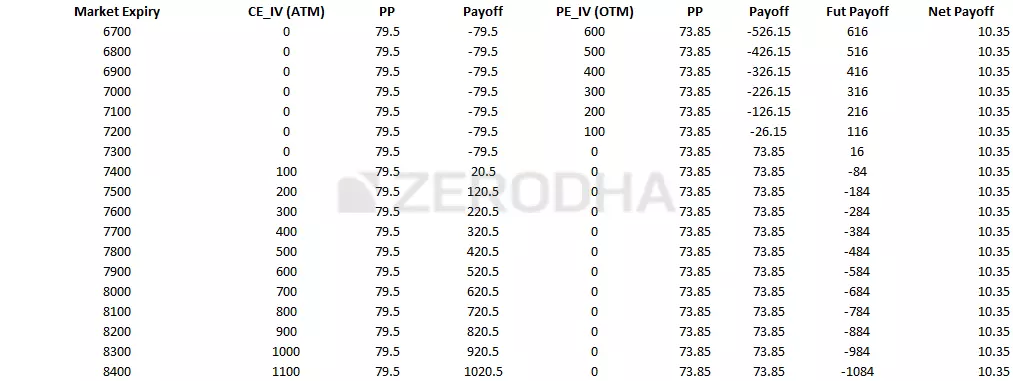
  3. Net Cash flow is = Premium Received – Premium Paid i.e 134 – 92 = 42 (Net Credit)


Situation 1: The market closes at 7600 (above the ITM option)

Both Put options would expire worthless at 7600. Following are the intrinsic value of options and the ultimate strategy payoff:

7500 PE would also expire worthless, but we have written this option and received a premium of Rs.134, which in this case can be retained back. 7200 PE would also expire worthless, but since we are long 2 lots of this option at a cost of Rs.46 per lot, we would lose the entire premium of Rs.92 paid.
134 – 92 = 42 is the strategy’s net payoff.
Keep in mind that the strategy’s net payoff at 7600 (higher than the ITM strike) is equal to the net credit.


The market expires in scenario 2 at 7,500. (at the higher strike i.e the ITM option)


Both options would expire worthless at 7500 because neither would have any intrinsic value. As a result, the reward would be comparable to the reward we discussed at 7600. As a result, the net strategy payoff would be Rs. 42. (net credit).


In actuality, as you might have guessed, the strategy’s payoff at any point above 7500 equals the net credit.


The market expires in scenario 2 at 7,500. (at the higher strike i.e the ITM option)


Both options would expire worthless at 7500 because neither would have any intrinsic value. As a result, the reward would be comparable to the reward we discussed at 7600. As a result, the net strategy payoff would be Rs. 42. (net credit).


In actuality, as you might have guessed, the strategy’s payoff at any point above 7500 equals the net credit.


The entire premium paid, or $92, will be lost because the 7200 PE has no intrinsic value.
Therefore, we would lose 92 on the 7200 PE while making 92 on the 7500 PE, resulting in no loss and no gain. As a result, one of the breakeven points is 7458.


Scenario 4 – Market expires at 7200 (Point of maximum pain)

This is the point at which the strategy causes maximum pain, let us figure out why.

  • At 7200, 7500 PE would have an intrinsic value of 300 (7500 – 7200). Since we have sold this option and received a premium of Rs.134, we would lose the entire premium received and more. The payoff on this would be 134 – 300 = – 166
  • 7200 PE would expire worthless as it has no intrinsic value. Hence the entire premium paid of Rs.92 would be lost
  • The net strategy payoff would be -166 – 92 = – 258
  • This is a point where both the options would turn against us, hence is considered as the point of maximum pain


learning sharks stock market institute

5.3 – Strategy Generalization

Based on the scenarios discussed above, we can draw a few conclusions:


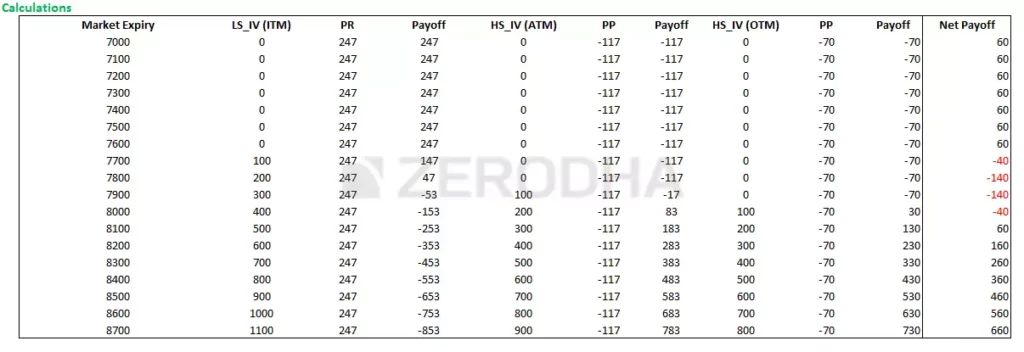
Technically speaking, this is a ladder and not a spread. The first two option legs, however, produce a traditional “spread” in which we sell ITM and buy ATM. It is possible to interpret the spread as the difference between ITM and ITM options. It would be 200 in this instance (7800 – 7600).
Net Credit equals Premium collected from ITM CE minus Premium paid to ATM and OTM CE
Spread (difference between the ITM and ITM options) – Net Credit equals the maximum loss.
When ATM and OTM Strike, Max Loss occurs.
When the market declines, the reward equals Net Credit.
Lower Strike plus Net Credit equals Lower Breakeven.
Upper Breakeven is equal to the sum of the long strike, short strike, and net premium.


Take note of how the strategy loses money between 7660 and 8040 but ends up profiting greatly if the market rises above 8040. You still make a modest profit even if the market declines. However, if the market does not move at all, you will suffer greatly. Because of the Bear Call Ladder’s characteristics, I advise you to use it only when you are positive that the market will move in some way, regardless of the direction.


In my opinion, when the quarterly results are due, it is best to use stocks (rather than an index) to implement this strategy.


5.4 – Effect of Greeks

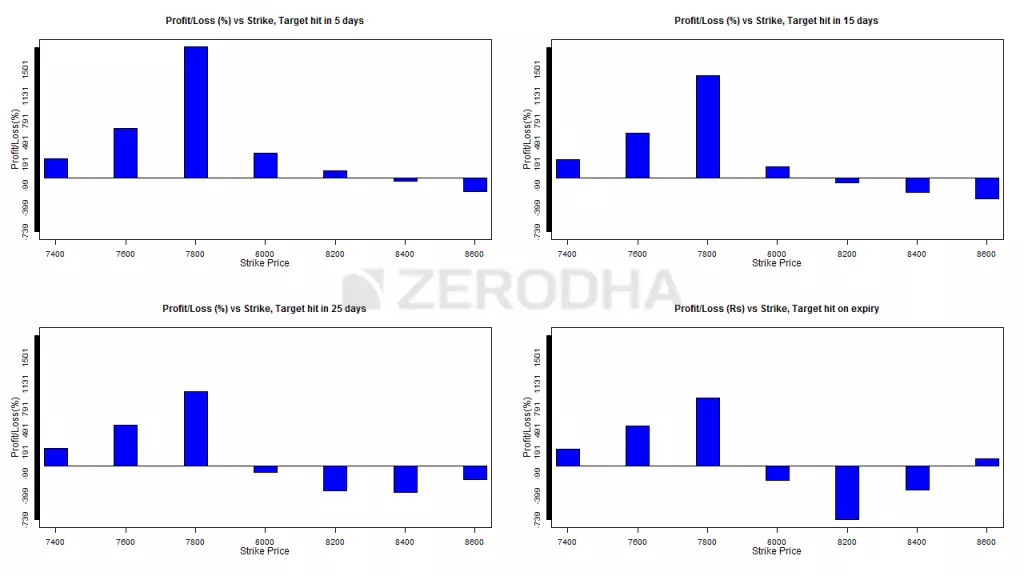
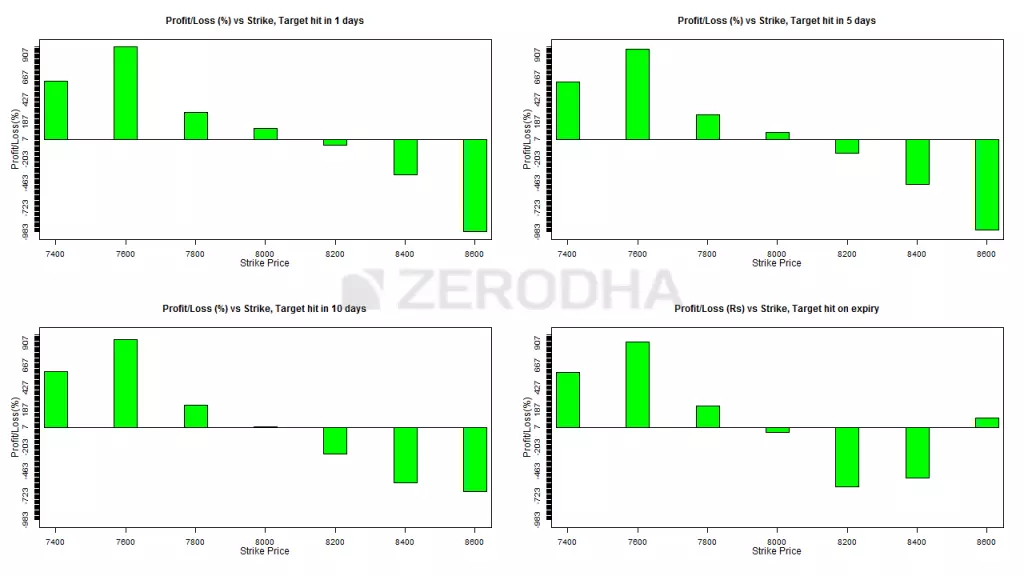
I assume you are already familiar with these graphs. The following graphs demonstrate the profitability of the strategy taking into account the time until expiration; as a result, these graphs assist the trader in choosing the appropriate strikes.


The best strikes to choose are deep ITM and slightly ITM, i.e., 7600 (lower strike short) and 7900, if you expect the move during the second half of the series and you expect it to happen within a day (or within 5 days, graph 2). (higher strike long). Please take note that this is an ITM and ITM spread rather than the traditional combination of an ITM + OTM spread. In actuality, none of the other combinations work.


Graphs 3 (bottom right) and 4 (bottom left): The best strategy is to use these graphs if you anticipate a move during the second half of the series and that it will occur within 10 days (or on the expiry day, graph 4).Deep ITM and slightly ITM strikes, such as 7600 (lower strike short) and 7900, are the best options (higher strike long). This is in line with what graphs 1 and 2 indicate.


learning sharks stock market institute

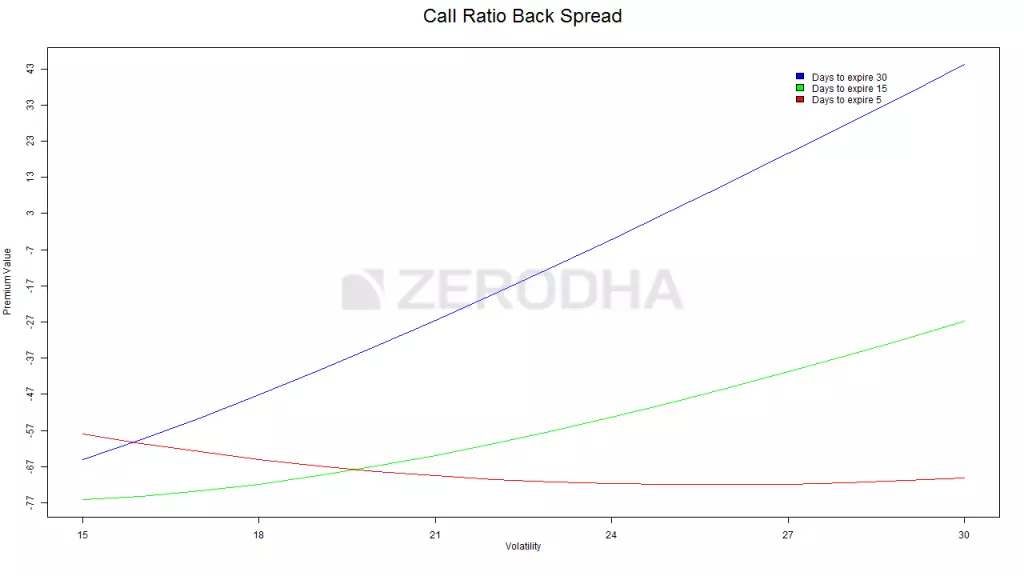
The relationship between the change in “premium value” and the change in volatility is shown by three coloured lines. These lines make it easier for us to comprehend how an increase in volatility affects the strategy while keeping the time until expiration in mind.


Green line – This line suggests that, although not as much as in the preceding case, an increase in volatility is advantageous when there are roughly 15 days until expiration. As we can see, when volatility rises from 15% to 30%, the strategy payoff increases from -77 to -47.


Red line: Clearly, the premium value is not significantly affected by an increase in volatility as time approaches expiration. This indicates that when expiration is approaching, you should only be concerned with directional movement and not much with volatility variation.

For Visit: Click here to know the directions.

Bear call spread

Bear Call Spread

Basics of stock market

• Induction
• Bull call spread
• Bull put spread
• Call ration Back spread
• Bear call ladder
• Synthetic long & Arbitrage
• Bear put spread

• Bear call spread
• put ration back spread
• Long straddle
• Short straddle
• Max pain & PCR ratio
• Iron condor

learning sharks stock market institute

8.1 – Choosing Calls over Puts

The Bear Call Spread is a two-legged option strategy that is used when the market outlook is “moderately bearish,” similar to the Bear Put Spread. In terms of payoff structure, the Bear Call Spread is comparable to the Bear Put Spread, but there are some differences in terms of strategy execution and strike choice. The Bear Call spread entails using call options rather than put options to create a spread (as is the case in bear put spread).


At this point, you might be asking yourself why one would choose a bear call spread over a bear put spread when the payouts from both spreads are comparable.

learning sharks stock market institute

Strategy Notes

To be honest, a lot will depend on how appealing the premiums are. The Bear Call spread is executed for a credit, as opposed to the Bear Put spread, which is executed for a debit. Therefore, if the market is at a point where –


  1. The markets have rallied considerably (therefore CALL premiums have swelled)
  2. The volatility is favorable
  3. Ample time to expiry


Invoking a Bear Call Spread for a net credit instead of a Bear Put Spread for a net debit makes sense if you have a moderately bearish outlook for the future. Personally, I favour strategies that offer net credit over those that offer net debit.


learning sharks stock market institute

8.2 – Strategy Notes 2.0

The Bear Call Spread is a two leg spread strategy traditionally involving ITM and OTM Call options. However you can create the spread using other strikes as well. Do remember, the higher the difference between the two selected strikes (spread), larger is the profit potential.The Bear Call Spread is a two leg spread strategy traditionally involving ITM and OTM Call options. However you can create the spread using other strikes as well. Do remember, the higher the difference between the two selected strikes (spread), larger is the profit potential.


Using the bear call spread requires:

  1. Buy 1 OTM Call option (leg 1)
  2. Sell 1 ITM Call option (leg 2)

Ensure –

  1. All strikes belong to the same underlying
  2. Belong to the same expiry series
  3. Each leg involves the same number of options

Let us take up example to understand this better –

Date – February 2016

Outlook – Moderately bearish

Nifty Spot – 7222

Bear Call Spread, trade set up –


Pay Rs. 38 as a premium to purchase a 7400 CE; keep in mind that this is an OTM option. This is a debit transaction because money is being taken out of my account.


Selling the 7100 CE will earn you Rs. 136 as premium; keep in mind that this is an ITM option. This is a credit transaction because I receive money.


Since the net cash flow is positive (136 – 38 = +98), my account has a net credit as a result of the difference between the debit and credit.


A bear call spread is also known as a “credit spread” because, generally speaking, there is always a “net credit” in them. The market may move in any direction and expire at any level after we place the trade. In order to understand what would happen to the bear put spread at various levels of expiry, let’s consider a few scenarios.


The market expires in scenario 1 at 7,500. (above the long Call)


Given that we paid a premium of Rs. 38 for 7400 CE, which has an intrinsic value of 100, we would be in the black by the amount of 100 minus 38, or 62.
The intrinsic value of 7100 CE would be 400, and since we sold this option at Ra.136, we would have suffered a loss of 400 – 136 = -264.
A net loss of -264 + 62 = -202 would result.


The market expires at 7400 in scenario two (at the long call)


The 7100 CE would have intrinsic value at 7400 and would therefore expire in the money. The value of the 7400 CE would expire.


  • 7400 CE would expire worthless, hence the entire premium of Rs.38 would be written of as a loss.
  • 7100 CE would have an intrinsic value of 300, since we have sold this option at Ra.136, we would incur a loss of 300 – 136 = -164
  • Net loss would be -164 -38 = – 202


Be aware that the loss at 7400 and 7500 are comparable, indicating that the loss is capped at 202 above that point.


The market expires in scenario 3 at 7198. (breakeven)

7198 is regarded as a breakeven point because at this price, the trade is neither profitable nor unprofitable. Let’s look at how these numbers turn out.


The 7100CE would terminate at 7198 with an intrinsic value of 98. Since we sold the option for Rs. 136, we get to keep a portion of the premium, or 136 – 98 = +38. 7400 CE would expire worthless, so we would forfeit the premium, or 38.
This demonstrates unequivocally that at 7198, the strategy is neutrally profitable.


Situation 4: The market closes at 7100 (at the short call)

Both of the Call options would expire worthless at 7100, making them both worthless and out of the money.


7100 will also have no intrinsic value, so the entire premium received, or Rs. 136, will be retained back. 7400 will have no value, so the premium paid will be a complete loss, or Rs. 38.
136 – 38 = 98 would be the net profit.


It is obvious that the strategy generates a profit as and when the market declines.

8.3 – Strategy Generalization

We can generalise the strategy’s key trigger points based on the aforementioned payoff:

Spread: 7400 minus 7100, or the difference between the strikes, is 300.
Net Credit is calculated as Premiums Paid – Premiums Received (136 – 38 = 98).
Lower strike plus Net Credit 7100 + 98 = 7198 to reach breakeven.
Net Credit = Maximum Profit
Maximum Loss: Spread – Net Credit (300 – 98) = 202


At this point, we can sum the Deltas to determine the overall position delta and determine how sensitive the strategy is to directional movement.


I obtained the following Delta values from the BS calculator:

7400 CE has a delta of +0.32 and is an OTM option.
Since we are short 7100 CE, the delta is -(+0.89) = -0.89 since 7100 CE is an ITM option with a delta of +0.89.
Position delta overall is = +0.32 + (-0.89) = -0.57.
The strategy’s negative delta means that it makes money when the underlying value decreases and loses money when the value increases.

learning sharks stock market institute
8.4 – Strike Selection and impact of Volatility

The graph above explains how the premium varies with respect to variation in volatility and time.

  • The blue line suggests that the cost of the strategy does not vary much with the increase in volatility when there is ample time to expiry (30 days)
  • The green line suggests that the cost of the strategy varies moderately with the increase in volatility when there is about 15 days to expiry
  • The red line suggests that the cost of the strategy varies significantly with the increase in volatility when there is about 5 days to expiry


It is obvious from these graphs that when there is enough time before expiration, one shouldn’t be overly concerned about changes in volatility. However, between the series’ midpoint and its expiration, one should have an opinion on volatility. The bear call spread is best avoided if you anticipate a decrease in volatility; otherwise, it is advised to use it only when an increase is anticipated.

Support and Resistance

Technical analysis

Technical analysis
• Introduction
• Types of charts
• Candlesticks
• Candle sticks patterns
• Multiple candlestick Patterns
• Trading – get started
• Trading view

• Support  & resistance
• Volume trading
• News and Events
• Moving averages
• Indicators
• Fibonacci Retracements
• Notes

We learned about entry and stop loss points while analyzing candlestick patterns. However, the goal price was not discussed. This topic will be covered in this chapter.


The best technique to determine the target price is to identify the support and resistance areas. The support and resistance (S&R) levels on a chart are predicted to attract the most buying or selling. The support price is the price at which there are more buyers than sellers. Similarly, the resistance price is the price at which more sellers are expected than buyers.


Traders can utilize S&R to discover trading entry points on their own.


The Resistance

Resistance, as the name implies, is something that prevents the price from growing further. The resistance level is a price point on the chart where traders expect the stock/index to have the most supply (in terms of selling). The resistance level is always higher than the market price.

The chances of the price increase to the resistance level, consolidating, absorbing all supply, and then falling are considerable. In a rising market, one of the essential technical analysis tools that market players look at is resistance. Resistance is frequently used as a sell trigger.

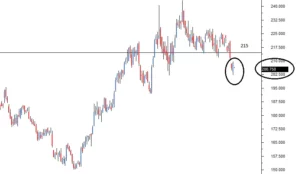
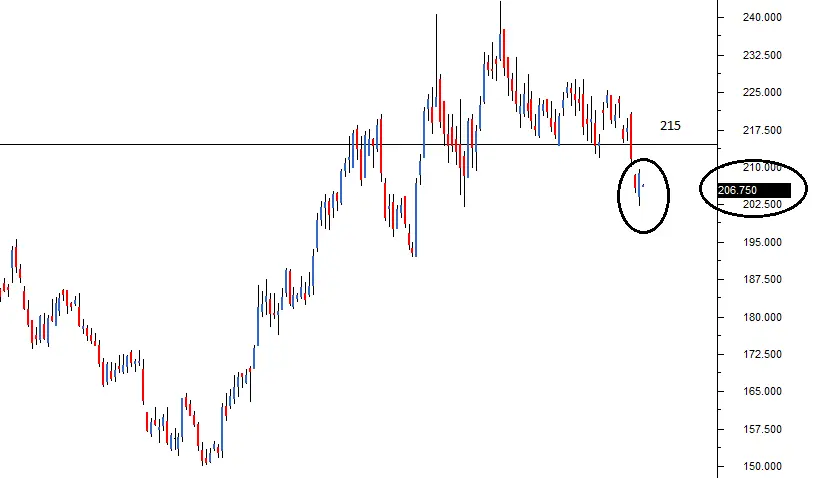
Ambuja Cements Limited’s chart is shown below. The horizontal line on the chart, which coincides with Rs.215, is Ambuja Cements’ resistance level.

learning sharks


I purposefully compressed the chart to contain more data points, for reasons I will explain momentarily. But first, there are two things you should keep in mind while looking at the following chart:

  1. A horizontal line indicates that the resistance level is greater than the current market price.

  2. The current candle is at 206.75, while the resistance level is at 215. For your convenience, the current candle and its matching price level are surrounded.

Consider Ambuja cement at Rs.206 making a bullish marubuzo with a low of 202. We know this is a signal to start a long trade and that the stop loss for this trade is set at 202. With our newfound resistance knowledge, we can now set 215 as a feasible objective for this deal!


You may be wondering why 215? The reasons are straightforward: –

  1. The resistance of 215 indicates that there is a possibility of excess supply.

  2. Excess supply adds to the selling pressure.

  3. Prices tend to fall as a result of selling pressure.

As a result, when a trader is long, he can look for resistance points to create targets and exit points for the transaction.

Furthermore, now that the resistance has been identified, the long trade may be completely designed as follows:


206 is the entry point, 202 is the stop loss, and 215 is the target.


The next apparent question is, how do we determine the level of resistance? It is quite simple to identify price points as either support or resistance. The process of identifying support and opposition is the same. If the current market price is less than the identified point, it is referred to as a resistance point; otherwise, it is referred to as a support point.


Because the approach is the same, let us begin by understanding’ support,’ and then proceed to the procedure for identifying S&R.


The support

After learning about resistance, determining the level of support should be simple and intuitive. Support, as the name implies, is something that prevents the price from falling further. The support level is a price point on the chart at which the trader anticipates the most demand (in terms of buying) for the stock/index. When the price falls below the support line, it is likely to rebound. The support level is always lower than the market price.


The price could decrease until it reaches support, then consolidate and absorb all of the demand before beginning to rise. In a declining market, one of the crucial technical levels that market players seek is support. The support is frequently used as a buy trigger.


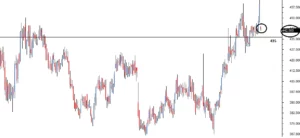
Cipla Limited’s chart is shown below. Cipla’s support level is marked on the chart by the horizontal line at 435.


learning sharks

A few things to take note of in the chart above:

  1. The horizontal line represents a support level that is lower than the current market price.

  2. The current candle is at 442.5, while the support level is at 435. For your convenience, the current candle and its matching price level are surrounded.

As we did with resistance, imagine a bearish pattern forming – possibly a shooting star at 442 with a high of 446. With a shooting star, the call is overly short Cipla at 442, with a stop loss of 446.


We can set the aim at 435 because we know 435 is the immediate support.


A few things to take note of in the chart above:

  1. The horizontal line represents a support level that is lower than the current market price.

  2. The current candle is at 442.5, while the support level is at 435. For your convenience, the current candle and its matching price level are surrounded.

As we did with resistance, imagine a bearish pattern forming – possibly a shooting star at 442 with a high of 446. With a shooting star, the call is overly short Cipla at 442, with a stop loss of 446. We can set the aim at 435 because we know 435 is the immediate support.


So, what makes the Rs.435 target worthwhile? The decision is supported by the following reasons:


  1. Support at 435 indicates that excess demand is most likely to emerge.

  2. Excess demand increases purchasing pressure.

  3. Buying demand tends to drive up the price.

As a result of the foregoing, when a trader is short, he can use support levels to define targets and exit points for the transaction.


Furthermore, with the identification of the support, the short trade is now fully designed.

442 is the entry point, 446 is the stop loss, and 435 is the goal.


Construction/Drawing of the support and resistance level.

Here is a four-step approach to help you locate and build the support and resistance lines.


Step 1) Stress data points – If the goal is to identify short-term S&R load, at least 3-6 months of data points should be loaded. Load at least 12 – 18 months of data points if you want to find long-term S&R. When you load a large number of data points, the chart appears compressed. This also explains why the two charts above appear squished.


Swing trading can benefit from long-term S&R.


S&R short term – beneficial for intraday and BTST trading.

I’ve imported 12 months of data points onto this chart.


learning sharks


Step2) Determine at least three price action zones – A price action zone is defined as “sticky points” on the chart when the price has demonstrated at least one of the following behaviors:
After a brief uprise, I was hesitant to move up any farther.
After a brief down move, hesitating to proceed lower.
Sharp price reversals at a specific price point
Here is a set of graphics that identify the three points mentioned above in the same order:
The circular points in the chart below suggest price is hesitant to climb higher after a quick up rise:


learning sharks


The circular points in the chart below reflect the price hesitant to advance lower after a quick downtrend:


learning sharks


The ringed points in the chart below show strong price reversals:


learning sharks


Step3) Align the price action zones. Many price action zones can be seen when looking at a 12-month chart. The secret, though, is to find at least three price action zones at the same price level.


Here’s an example of a chart with two price action zones that aren’t at the same price point.


learning sharks


Look at the chart below; I’ve circled three price action zones that are all around the same price points:


learning sharks


It is vital to ensure that these price action zones are well-spaced in time. This means, if the first price action zone is found in the second week of May, it will be important to identify the second price action zone at any moment after the fourth week of May. (well-spaced in time). The greater the distance between two price action zones, the more powerful the S&R identification.


Step 4) Draw a horizontal line connecting the three price activity zones. Based on where this line falls about the current market price, it becomes either support or resistance.


Analyze this graph.


learning sharks

From left to right:

  1. The first circle denotes a price action zone with a sharp price reversal.

  2. The second circle denotes a price action zone in which the price is sticky.

  3. The third circle denotes a price action zone with a sharp price reversal.

  4. The fourth circle denotes a price action zone in which the price is sticky.

  5. The fifth circle represents Cipla’s current market price of 442.5.

In the above chart, all four price movement zones are located near the same price point, 429. The horizontal line is well below the current market price of 442.5, indicating that 429 is an immediate support price for Cipla.


Please keep in mind that whenever you perform a visual exercise in Technical Analysis, such as detecting S&R, you run the danger of approximation. As a result, always leave space for error. The price level is typically represented as a range rather than a single price point. It is a zone or area that provides support or resistance.


Following the argument outlined above, I would be content to view a price range of 426 to 432 as a support region for Cipla. There is no set guideline for this range; I simply deducted and added 3 points to 429 to achieve my support price range!


Here is another chart for Ambuja Cements Limited that shows both S&R.

learning sharks


Ambuja’s current price is 204.1, with support at 201 (below the current market price) and resistance at 214. (above current market price). So, if one is too short Ambuja at 204, the target can be 201 based on support. This would most likely be a good intraday trade. Based on resistance, 214 can be a plausible target expectation for a trader going long at 204.


There are at least three price action zones identified at the price level at both the support and resistance levels, all of which are well-spaced in time.


Reliability of S&R

The support and resistance lines are just indicators of a probable price reversal. They should never be taken for granted. Like anything else in technical analysis, the potential of an event occurring (based on patterns) should be weighed in terms of probability.


For example, according to the Ambuja Cements –

204 is the current market price.

214 = resistance


The anticipation is that if Ambuja cement moves up at all, it will run with resistance at 214. That is, at 214, sellers may arise, potentially dragging down prices. What guarantee do you have that the sellers will come in at 214? In other words, what is the resistance line’s dependence? To be honest, your guess is just as good as mine.


However, it can be observed in the past that anytime Ambuja reached 214, it reacted unusually, resulting in the development of a price action zone. The price activity zone is widely spread over time, which is reassuring. This means that 214 is a time-tested price action zone. Keeping the first rule of technical analysis in mind, “History tends to repeat itself,” we proceed with the expectation that support and resistance levels will be fairly honored.


S&R points that are effectively constructed are usually well respected in my trading experience.


Optimization of checklist

Perhaps we have arrived at the most critical point in this module. We will begin by learning a few optimization techniques that will assist us in identifying high-quality deals. Remember that when you pursue quality, quantity is always sacrificed, but this is a worthwhile sacrifice. The goal is to find high-quality trading signals rather than numerous but worthless trades.


In general, optimization is a strategy for fine-tuning a process to achieve the best potential results. In this case, the procedure is about identifying transactions.


Let us return to candlestick patterns, perhaps to the very first one we learned – bullish marubuzo. A bullish marubuzo indicates a long trade near the marubuzo’s close, with the low of the marubuzo acting as the stop loss.


Assume the bullish marubuzo has the following credentials:

Close = 448, Open = 432, High = 449, Low = 430

As a result, the entry point for the long trade is around 448, with 430 as the stop loss.


What if the marubuzo’s low also corresponds with reliable time-verified support? Do you notice a surprising intersection of two technical notions here?


To go far, we have a double confirmation. Consider it in the following terms:


  1. A recognized candlestick pattern (bullish marubuzo) indicates that the trader should begin a long transaction.

  2. Support at the stop loss price indicates to the trader that there is substantial buying demand near the bottom.

A well-crafted trading setup is essential when dealing with a fairly unpredictable environment such as the markets. The occurrence of the two conditions mentioned above (marubuzo + support at the low) implies the same action, which is to begin a long trade in this case.


This brings us to an essential point. What if we had a checklist (or, if you prefer, a framework) for every deal we considered? Before starting a trade, the checklist would serve as a guideline. The trade must adhere to the parameters outlined in the checklist. If it does, we accept the deal; otherwise, we reject it and hunt for another trade opportunity that meets the checklist.


They claim that discipline accounts for 80% of a trader’s performance. The checklist, in my opinion, forces you to be disciplined; it helps you avoid making rash and foolish trading decisions.


To begin with, we have the checklist’s first two important factors:


  • The stock should have a distinct candlestick pattern. a) In this subject, we learned some of the most prominent patterns. To begin, you can only use these patterns to complete the checklist.

  • S&R should confirm the transaction. The stop-loss price should be in the vicinity of S&R.

    1. The low of the pattern should be near the support for a long trade.

    2. For a short trade, the pattern’s high should be near the resistance.

From now on in this module, as and when we learn new TA concepts, we will build this checklist. But to quench your curiosity, the final checklist will have 6 checklist points. When we have the grand 6 checklist points, we will weigh down each one of them. For example, checklist point number 4 may not be as important as point number 1, but it is more important than 100 other factors that distract the trader.


Conclusion

  • S&R are price points on the chart

  • Support is a price point below the current market price that indicates buying interest.

  • Resistance is a price point above the current market price that indicates selling interest.

  • To identify S&R, place a horizontal line in such a way that it connects at least 3 price action zones, well-spaced in time. The more number of price action zones (well spaced in time) the horizontal line connects, the stronger is S&R

  • S&R can be used to identify targets for the trade. For a long trade, look for the immediate resistance level as the target. For a short trade, look for the immediate support level as the target.

  • Lastly, comply with the checklist for optimal trading results


How to withdraw money from ATM?

Do you need to make an ATM withdrawal? When it comes to withdrawing cash quickly, a little cabin with a machine inside, known as an Automated Teller Machine (ATM), may be the best option.

The banks where we have bank accounts provide us with an ATM/debit card so that we may conveniently withdraw cash from ATMs.

Let us now look at the steps to withdraw money from an ATM.

Step 1: Insert ATM Card:

Insert your ATM Card in the ATM machine in the slot as marked in the above diagram.

Step 2: Select Language

Select your language from the language options appearing on the display screen (shown in the diagram above).

Step 3: Enter 4-Digit ATM Pin:

Use the Keypad(as marked in the diagram) to enter your 4 digit ATM Pin Number.

Do not ever share your ATM Pin with anyone. Ensure that nobody is watching you, while you enter the Pin.

Be careful while entering the Pin, as a wrong PIN may lead to the blockage of the ATM card.

Step 4: Select the type of Transaction:

On the ATM screen, you will be able to see different types of transaction options such as Deposit, Transfer, Withdrawal of Money, etc.

For cash withdrawal, you will have to select the Withdrawal Option.

Step 5: Select the Type of Account:

After selecting the cash withdrawal option, the screen will display different account types, select your account type.

As an individual banker, you should be choosing a savings account, as current accounts are a special type of accounts used by businesses.

Some ATMs offer you a choice to add a line of credit to your account. This can help a banker when they need excessive money in an emergency.

Step 6: Enter the withdrawal amount

Now, enter your withdrawal amount.

Make sure that you do not enter a withdrawal amount more than the balance in your account.

Now press enter.

Step 7: Collect the Cash:

Now collect the cash from the lower slot of the machine (as shown in the picture above).

Step 8: Take a printed receipt, if needed:

After you collect the cash, you will get an option of whatever you want a printed receipt of the transaction. If you want a printed receipt, click yes and close the transaction.

Step 9: Another Transaction:

If you want to undertake another transaction then select that option.

Withdrawals from an ATM card debit amount from any existing bank account (either savings or current), so when you wish to withdraw, ensure that you have sufficient balance in the account.

why is learning sharks considered to be the best stock market institute? Let’s hear from the counsellor now

Are you a beginner or an intermediate? we get students who happen to be a noobie. We recommend starting from the basics of the stock market. This 2 day’s class not only covers what is NSE and BSE? or what is stock market knowledge and words. It includes all the stock market topics you need to be aware of. These topics will be covered by an expert cum trader.

Derivative analysis course

Further, we have Financial derivatives. This covers the options, futures, and strategies like a bull call spread, bear call ladder and so on. The derivative analysis course will be taken by a separate mentor cum full-time trader. He has experience in trading all the strategies. He is not only a mentor but a long-time profitable trader.

Technical analysis course

learning shakrs

Later comes the Technical analysis module. This is known to be the backbone of the course. This includes over 25+ trading strategies, 35+ Chart patterns, Types of candles and so much more. This course is also taken by a separate mentor cum trader. He is a full-fledged technical analyst and has an experience in trading profitably. He introduces live trading from the first class.

Psychology and risk management

Last but not the least, we have psychology and risk management. This module is the Most Important &covers over 100+ topics including what to expect, risks and so much more.

Once you complete this 2 months course, there is a paid internship. Where you sit down with your batch mates and take 100 trades. You can take trades in the classroom or after it. You will be assigned with a trading buddy ( who has an experience in trading for years) and he will guide you through. He knows how to handle an inexperienced trader. After all, he himself was a noobie once.

Apart from the batch mates, and teachers, he will be the best trading friend. You can share your trades with him through. He reports to all the mentors and will stop you from putting loss-making trades. While encouraging you with a green flag when the trade is right.

Is that all? well one more surprise, since you read till the end. We provide students with funds up to 10 lac. During your internship, you get to trade with our money and practise as much. If you manage to stay profitable, you get to keep the 70% profit. If you lose, it’s all on us. It’s all real money btw.

How does that sound now? Too good to be true, right? oh well. Now you know why ” learning sharks” is considered to be the best stock market institute.

Need time to decide? if you still want to learn “how to trade” in the stock market from us? Take all the time in the world.No rush.

Just so you know

The Indian stock market is full of opportunities and is not going anywhere. However, your mind will.

Feel like speaking to the counsellor, who is a trader himself/herself? Go ahead, Dial us at 8595071711 or drop your questions at support@learningsharks.in

Until then, see you on the trading floor !!!!

#stockmarketInstitute #learningsharks #sharemarket #courses

The Cash Flow

Before we understand the cash flow statement, it is important to understand ‘the activities’ of a company. If you think about a company and the various business activities, you will realize that the company’s activities can be classified under one of the three standard baskets. We will understand this in terms of an example. Imagine a business, maybe a very well established fitness centre (Talwalkars, Gold’s Gym etc.) with a sound corporate structure.
Source: the retail doctor

8.1 – Overview

A crucial financial statement that shows how much cash the business is actually generating is the cash flow statement. You could wonder whether this information is not stated in the P&L statement. So, there are two possible answers: yes and no.

Think about the situation that follows.

Consider a little coffee shop that serves just coffee and light fare. The majority of the shop’s sales are made in cash, so if a customer wants a cup of coffee and a snack, he must have enough money to buy them. Let’s say the shop sells Rs. 2,500 worth of coffee and Rs. 3,000 worth of snacks on a certain day. The store made Rs. 5,500/- on that particular day. P&L reports revenues of Rs. 5,500, and there is no ambiguity with this.

Consider another laptop-selling company now. Let’s say for the purpose of simplicity that the store only sells 1 type of laptop at a standard fixed price of Rs. 25,000 per laptop. Assume the store sells 20 of these computers on a particular day. Obviously, the shop’s revenue would be Rs. 25,000 multiplied by 20 to equal Rs. 500,000. What if five of the twenty laptops were purchased on credit? When a buyer purchases anything on credit, they agree to pay for it in full at a later date. The numbers in this scenario would be as follows:

Cash sale: 15 * 25000 = Rs.375,000/-

Credit sale: 5 * 25000 = Rs.125,000/-

Total sales: Rs.500,000/-

Definitely, The P&L account for this shop would show a total income of Rs. 500,000, which on the surface may appear like a lot of money. It is unclear how much of this Rs. 500,000 is actually in the company’s bank account. What if this business needed to repay a debt of Rs. 400,000/- right away? Despite having a sale of Rs. 500,000, the company only has Rs. 375,000 in its account. As a result, the business is under a cash constraint and unable to pay its debts.

Firstly, This data is shown in the cash flow statement. The financial statements of an entity should always include a statement of cash flows. Therefore, in this context, a cash flow statement’s appraisal is crucial since it shows, among other things, the company’s actual cash situation.

In conclusion, every company’s financial performance is more genuinely based on liquidity or cash flows than it is on the profits generated during a specific time period.

8.2 – Activities of a company

It is crucial to comprehend “the activities” of a corporation before we can understand the cash flow statement. When you consider a company and its numerous business endeavors, you will see that they can all be grouped into one of the three conventional baskets. We’ll make sense of this via an illustration.

Consider a company with a strong corporate structure, such as a very reputable fitness center (Talwalkars, Gold’s Gym, etc.). What regular business operations do you anticipate a gym having? I’ll start by listing a few company activities:

  1. Using display ads to draw in new clients

  2. Employ fitness professionals to assist consumers with their workout

  3. Replace worn-out equipment with new fitness-related items.

  4. Obtain a short-term loan from a bank.

  5. To raise money, issue a certificate of deposit.

  6. To raise new funds for growth, distribute new shares to a select group of well-known friends (also called preferential allotment)

  7. Invest in a young company developing novel exercise regimens.

  8. Place any surplus funds in fixed deposits.

  9. Invest in a new construction site in the area to create a new fitness center in the future.

  10. Improve the sound system to make working out more enjoyable.

As you can see, the business-related tasks listed above are fairly different but all have some connection to the firm. These activities can be categorized as:

  1. Operational Activities (OA): Operational Activities (OA) are activities that are involved in the regular core business operations. Sales, marketing, manufacturing, technology upgrades, resource hires, etc. are examples of typical operating activities.

  2. Investment activities (IA): Activities involving investments that the business does with the hope of profiting from them in the future. Examples include keeping money in interest-bearing instruments, purchasing equity shares, purchasing real estate, machinery, and other non-current assets such as intangibles.

  3. Financial activities (FA): Activities pertaining to all business-related financial transactions, such as paying dividends, paying interest on debt, taking on new debt, issuing corporate bonds, etc.

Any activity that a respectable business carries out falls into one of the aforementioned three categories.

Importantly, We shall now group each of the aforementioned three activities into three categories or baskets while keeping the aforementioned three activities in mind.

  1. Use display ads to draw in new clients – OA

  2. Employ fitness instructors to assist clients with their workouts – OA

  3. Purchase new exercise gear to replace worn-out gear – OA.

  4. Ask lenders for a short-term loan – FA

  5. To raise money, issue a certificate of deposit (CD) – FA

  6. Issue new shares to a select group of well-known friends to raise additional funds for growth (also known as preferential allotment) – FA

  7. Invest in a young company developing novel exercise regimens – IA

  8. Place any extra funds in a fixed deposit – IA

  9. Invest in new construction in the area to open a fitness center there in the future – IA

  10. OA says the sound system should be upgraded for a better workout.

In fact, Think about the company’s cash flow now and how it affects the cash balance. Cash is impacted by all of the company’s activities. As an illustration, the phrase “Upgrade the sound system for a better training experience” suggests that the business must contribute funds toward the purchase of a new sound system. As a result, the cash balance drops. It’s also noteworthy that the brand-new sound system will be regarded as a corporate asset.

The top table has been color-coded:

  1. Blue is the color code for money increases.

  2. The drop in money is highlighted in red.

  3. Assets have a green and blue color coding.

  4. The purple color scheme signifies liabilities.

When you start comparing the “Cash Balance” and “Asset/Liability” columns in the table, you will see that:

1. The company’s cash balance increases along with a growth in liabilities.

  1. In other words, if the obligations decline, the cash balance does too.

2. The cash balance falls whenever the company’s asset value rises.

  1. Accordingly, if the value of the assets falls, the cash balance rises.

The crucial idea when creating a cash flow statement is the one stated above. If you take this further, you will see that each company’s operational, financing, and investment activities either enhance (net increase in cash) or decrease (net reduction in cash) the company’s cash.

Consequently, the company’s overall cash flow will be as follows:

Net cash flow from operating operations plus Net cash flow from investment activities plus Net cash flow from financing activities is the company’s cash flow.

8.3 – The Cash Flow Statement

Now that you have a basic understanding of the cash flow statement, you can see why it’s important to evaluate the cash flow statement when evaluating the organization.

To explicitly indicate how much cash the company has generated across the three business activities, corporations typically divide their cash flow statement into three categories when presenting it. Here is the cash flow statement for Amara Raja Batteries Limited (ARBL), continuing with our former chapter’s example:

Since most of them are self-explanatory, I won’t go through each line item. Please note, though, that operating activities at ARBL have brought in Rs. 278.7 Cr. Keep in mind that a company’s positive cash flow from operating activities is always an indication of its financial health.

You can see that ARBL spent Rs. 344.8 Cr. on its investment operations. This makes sense because investing involves spending money, after all. Additionally, keep in mind that solid investing activity indicates to the investor that the company is committed to growing its clientele. Of course, as we move through this lesson, we will comprehend how much is regarded as healthy and how much is not.

ARBL spent Rs. 53.1 crores on its financing operations. If you look closely, the majority of the funds were used to pay dividends. Additionally, if ARBL takes on additional debt in the future, the cash balance would rise (remember the increase in liabilities, increases the cash balance). The balance sheet reveals that ARBL did not incur any new debt.

This indicates that over the fiscal years 2013–2014, the company spent a total of Rs. 119.19 Cr. in cash. Okay, but what about the money from the prior year? As we can see, the business made Rs. 179.986 Cr. from all of its operations in the prior year.

Examine the area that is marked in green (for the year 2013-14). The beginning balance for the year is listed as being Rs. 409.46Cr. Where did they obtain this from? It just so happens that this is the year’s final balance (refer to the arrow marks). The entire cash position of the company is Rs. 292.86 Cr. when current year cash equivalents (Rs. 119.19 Cr.) and a little currency exchange differential (Rs. This indicates that the business squandered money.

Observe that the opening balance for the fiscal year 2014–15 will now be the balance at the end of 2013–14. When ARBL releases its cash flow statistics for the year ended March 31, 2015, keep an eye out for this.

Let’s now go over some thought-provoking queries and responses:

  1. What exactly does Rs. 292.86 Crs. mean?

1. This demonstrates in stark terms the amount of money ARBL has in its numerous bank accounts.

2. What is money?

  1. Cash is made up of demand deposits and cash on hand. This is undoubtedly a liquid asset for the business.

3. Describe liquid assets.

  1. Assets that are readily convertible into cash or cash equivalents are referred to as liquid assets.

4. Similar to the “current items” we examined in the balance sheet, are liquid assets?

  1. You can, indeed.

5. If cash is an asset and it is current, shouldn’t it be listed under current assets on the balance sheet?

  1. Yes, it is, and it is here. Look at the excerpt of the balance sheet below.

Now it is obvious that the balance sheet and cash flow statement interact with one another. This is consistent with what we previously discussed, which is that all three financial accounts are interrelated.

8.4 – A brief on the financial statements

The P&L statement, the balance sheet, and the cash flow statement of the company have been covered in detail over the course of the last few chapters. The Balance Sheet is prepared on a flow basis, while the Cash flow and P&L statement are prepared on a standalone basis (showing the financial status for the given year).

The P&L statement compares the amount of revenue the company generated with the amount of expense growth. Retained earnings, often known as the company’s surplus, are carried forward to the balance sheet. The depreciation amount is included in the P&L as well. The balance sheet includes the depreciation that was reported in the P&L statement.

The assets and liabilities of the business are described in the balance sheet. The corporation stands in for the shareholders’ money on the liabilities side of the balance sheet. The balance sheet is said to be balanced when the assets are equal to the liabilities. The firm’s cash and cash equivalents are one of the most important items on the balance sheet. This figure reveals how much money the business has on hand in its checking account. The cash flow statement provides us with this figure.

In fact, The cash flow statement reveals a company’s ability to produce cash and cash equivalents as well as its cash requirements to those who will be using the financial statements.

So far, we’ve examined how to interpret financial statements and what to anticipate from each one. How to analyze these numbers is still something we have not explored. Last, Calculating a few crucial financial ratios is one method of financial data analysis. In reality, the financial ratios will be the main topic of the following chapters.

CONCLUSION

  1. The cash flow statement paints a picture of the company’s actual financial position.
  2. Operating, investing, and financing operations make up the three primary functions of a lawful business.
  3. Every activity either brings in money for the business or costs it money.
  4. The total of the business’s operating, investing, and financing activities is its net cash flow.
  5. Investors ought to pay close attention to the company’s operating cash flow.
  6. Cash level rises as obligations rise, and vice versa.
  7. The level of cash declines as assets rise and vice versa.
  8. The balance sheet also includes the annual net cash flow figure.
  9. Because it provides information about a company’s cash flow, the Statement of Cash Flow is a helpful complement to its financial statements.

Balance sheet

Fundamental Analysis

• Introduction
• Investor’s mindset
• Annual report reading
• P&L statement
• Balance sheet
• The cash flow

• The financial ratio
• Investment due diligence
• Equity research
• DCF primer
• Notes

learning sharks stock market institute

The Balance sheet equation

The Balance sheet contains data on the company’s assets, liabilities, and shareholders’ equity, while the P&L statement provides information on the company’s profitability. As you noted, the P&L statement discusses the profitability for the relevant financial year. Therefore, it is accurate to assert that the P&L statement is independent. The balance sheet, on the other hand, was created on a flow basis and contains financial data about the business going back to the moment of incorporation. The balance sheet, on the other hand, discusses how the company has changed financially over time, whereas the P&L discusses how the company did in a certain financial year.

The balance sheet includes information about the assets, liabilities, and equity, as you can see.

Assets were covered in the previous chapter. The firm is the owner of all assets, material and intangible alike. A resource that is under the company’s control and is anticipated to have economic value in the future is called an asset. Assets frequently include things like factories, machinery, money, names and brands, and patents. We shall examine the two different categories of assets—current and non-current—later in the chapter.

Alternatively, liability is the company’s obligation. The business accepts the requirement because it thinks it will have long-term economic benefits. Simply put, liability is the borrowing that the business has accepted and is required to repay. Borrowing for the short term, borrowing for the long term, payments that are due, etc. are common examples of obligations. There are two categories of liabilities: current and non-current. The various obligations will be covered in more detail later in the chapter.

In a standard balance sheet, the total assets and total liabilities of the business should be equal. Hence,

Assets=liabilities

The balance sheet equation or accounting equation is the name given to the previous equation. The concept that the balance sheet should always be balanced is really illustrated by this equation. To put it another way, the company’s assets and liabilities should be equal. This is so because all of a company’s assets must be acquired either with capital from the owner or liabilities.

The difference between assets and liabilities is known as owners’ capital. It is also known as “Net worth” or “Shareholders Equity.” An equation for this might look like this:

Shareholders equity = Assets – Liabilities

A quick note on shareholders’ funds

As we all know, the assets and liabilities make up the balance sheet’s two main divisions. As you are aware, the liabilities are the company’s debt. The shareholders’ fund, is essential to the liabilities side of the balance sheet.


If you think about it, we are talking about liabilities here, which are the company’s obligations. On the other hand, we talk about the shareholders’ fund, which is a representation of the wealth of the shareholders. This seems really counterintuitive, don’t you think? How are shareholders’ funds and liabilities both included on the balance sheet’s “Liabilities” side? After all, the shareholder’s money is what the company’s shareholders actually own, making them an asset rather than a burden.


Now consider the financial statement while keeping this new viewpoint in mind. You will understand that the financial statements are a statement that the firm (which is a separate legal entity) publishes to inform the public about its financial health.


Additionally, this implies that the corporation does not legitimately own the funds of its shareholders, who are the true owners of the funds. Therefore, from the company’s point of view, the shareholders’ funds constitute a debt due to shareholders. The liabilities side of the balance sheet, therefore, displays this.


The liability side of the balance sheet

All of the company’s liabilities are listed on the liabilities side of the balance sheet. The shareholders’ fund, non-current liabilities, and current liabilities are the three sub-sections that make up liabilities. The funds for the stockholders are in the first segment.

Consider a hypothetical business that is issuing shares for the first time to gain an understanding of share capital. Consider that Company ABC issues 1000 shares at a face value of Rs. 10 apiece. The share capital in this scenario would be Rs. 10 x 1000 = Rs. 10,000/- (Face value X number of shares).

The share capital for ARBL is Rs. 17.081 Crs. (as stated in the Balance Sheet), and each share has an Rs. 1-value.

The number of outstanding shares can be determined using the FV and share capital value. We are aware of:

Share Capital = FV * Number of shares

Therefore,

Number of shares = Share Capital / FV

Hence in the case of ARBL,

Number of shares = 17,08,10,000 / 1

= 17,08,10,000 shares

Reserves and Surplus are the following line item on the liability side of the balance sheet. Reserves are often sums of money set aside by the business for particular uses. All of the company’s profits are kept in excess. For ARBL, the reserves and surplus are Rs. 1,345.6 Cr. An associated note with the reserves and surplus is note number 3.

As you can see from the memo, the corporation has allocated money to three different categories of reserves:

  1. Capital reserves: Typically used for long-term initiatives. It is clear that ARBL does not have much at this point. The stockholders are entitled to this money, yet it cannot be given to them.

  2. The securities premium reserve or account is where the premium over the shares’ face value or par value is kept. ARBL has a debt of Rs.31.18 billion.

  3. All accrued corporate profits that have not yet been dispersed to shareholders are kept in the general reserve. The cash here might serve as a safety net for the business. As you can see, ARBL has general reserves worth Rs. 218.4 Cr.

The surplus is covered in the subsequent section. The gains made throughout the year are kept in the surplus, as was previously explained. There are a few noteworthy facts to consider:

As per the last year’s (FY13) balance sheet, the surplus was Rs.829.8Crs. This is what is stated as the opening line under a surplus.

  1. The ending balance of surplus from the prior years is increased by FY14’s profit of Rs. 367.4 Crs. Here are a few things to remember:

1. Take note of the relationship between the balance sheet and the P&L statement. This draws attention to an important fact: the interdependence of the three financial accounts.

2. Take note of how the balance sheet number from last year is added to the number from this year. This demonstrates how the balance sheet is created using a flow basis and that carrying forward amounts are added year after year.

2. The total of the prior year’s balance plus this year’s profit is Rs. 1197.2 Crs. The corporation has the option of allocating this money to several uses.

  1. A company’s initial action is to shift some funds from the excess to general reserves so they would be available for usage in the future. For this, they have transferred a little over Rs. 36.7 Cr.

  2. After transferring to general reserves, they disbursed Rs. 55.1 crores in dividends, of which they must pay Rs. 9.3 crores in dividend distribution taxes.

  3. The company’s closing balance is Rs.1095.9 Cr. in surplus after the necessary distributions have been made. This will serve as the starting sum for the surplus account for the next year (FY15), as you could have anticipated.

  4. Capital reserve, securities premium reserve, general reserve, and surplus for the year are added together to form the total reserves and surplus. The FY14 figure is Rs.1345.6 Cr., compared to the FY13 figure of Rs.1042.7 Cr.

Share capital, reserves, and excess are all included in the total shareholders’ money. This sum is referred to as “shareholders funds” since it represents the money owned by shareholders on the liabilities side of the balance sheet.

.

Non-Current Liabilities

Non-current liabilities are long-term debts that the corporation expects to pay off or settle after 365 or 12 months from the balance sheet date. These debts are recorded for a number of years. Liabilities that are not current are typically settled a year following the reporting period.

Here is a glimpse of Amara Raja Batteries Ltd.’s non-current liabilities.

Let’s look at each of the three categories of non-current liabilities the corporation has.

The first line item under “non-current obligations” is the long-term borrowing (connected to note 4). Given that it shows how much the company has borrowed from various sources, long-term borrowing is one of the most significant lines on the overall balance sheet.

It is abundantly evident from the note that the “Long Term Borrowings” consist of “Interest-Free Sales Tax Deferment.” The following message from the corporation explains interest-free sales tax deferment in more detail (I have highlighted the same in a red box). It appears to be some kind of state government tax incentive. The corporation intends to pay this sum over a 14-year period.

You’ll discover that many businesses don’t have long-term borrowings (debt). Although it is encouraging to learn that the business is debt-free, you must also wonder why. Is it a result of the banks’ refusal to lend money to the business?

Or perhaps it’s because the business isn’t making any efforts to grow its activities. Of course, we will discuss the balance sheet’s analytical portion later in the lesson.

Do not forget that when we examined the P&L statement, we looked at the line item “Finance Cost.” The cost of financing will also be expensive if the company has a high level of debt.

“Deferred Tax Liability” is the following line item under the non-current liability. In essence, the deferred tax liability is a reserve for future tax obligations. The corporation has set aside some money for this reason because it anticipates a scenario in which it may need to pay higher taxes in the future. Why do you believe the business would put itself in a position where it eventually had to pay higher taxes for the current year?

This occurs as a result of the distinction between the Company’s Act and Income Tax’s treatment of depreciation. We won’t discuss this point because doing so would take us away from our goal of learning how to use financial statements. But keep in mind that delayed tax duty does occur.

The “Long term provisions” is the last line item under the non-current liability. Usually, long-term provisions refer to monies set aside for employee perks like gratuities, paid time off, provident funds, etc.

Current Liabilities

Current liabilities are debts that must be repaid by a business within a year (less than 1 year). When an obligation is described as “Current,” it means that it will be paid off within a year. Considering such, it is obvious that “non-current” refers to responsibilities that are longer than a year.

Consider it this way: You certainly want to pay back your credit card company within a few months if you purchase a mobile phone on an EMI (using a credit card). Your “current liability” is now this. However, if you obtain a 15-year mortgage from a housing finance firm to purchase an apartment, the unit becomes your “non-current liability.”

As you can see, the current obligations are divided into 4 line items. The first is borrowings for a limited period of time. These are, as the name implies, short-term liabilities that the corporation often takes on to meet its daily cash needs (also called working capital requirements).

As you can see, the State Bank of India and Andhra Bank are offering these short-term loans to help with the need for working capital. It’s noteworthy to observe that just Rs. 8.3 crores are borrowed on a short-term basis.

Trade Payable, commonly known as Account Payable, is the following line item and is worth Rs. 127.7 Crs. These are debts owed to suppliers that provide goods and services to the business.

The suppliers of raw materials, service providers of utilities, stationery manufacturers, etc., could be the vendors.

“Other current obligations” is the following line item, and it is worth Rs. 215.6 Cr. Typically, “Other Current Liabilities” refer to debts owed to satisfy legal responsibilities and debts unrelated to the business’s operations.

Current liabilities’ final line item is “Short term provisions,” which totals Rs. 281.8 Cr. Long-term provisions, which deal with saving money for employee benefits like gratuities, leave encashment, provident funds, etc., are very similar to short-term provisions in this regard. It’s interesting to observe that the notes for “Short-term Provisions” and “Long term Provisions” are identical.

Note 6 fills multiple pages since it contains both long- and short-term provisions; hence, for this reason, I will not represent an extract of it.

The FY14 Annual report for Amara Raja Batteries Limited is available on pages 80, 81, 82, and 83 for those who are interested in learning more.

However, all you need to know from the viewpoint of a user of a financial statement is that these line items (short and long-term provisions) deal with the employee and associated perks. Please be aware that the linked remark should always be read carefully for complete details.

We have now examined the portion of the balance sheet known as the liabilities side or roughly speaking, half of the balance sheet.

Clearly,

Total Liability = Shareholders’ Funds + Non Current Liabilities + Current Liabilities

= 1362.7 + 143.03 +  633.7

Total Liability = Rs.2139.4 Cars

The Assets side of Balance Sheet

In the previous chapter, we looked at the liability side of the balance sheet in detail. We will now understand the 2nd half of the balance sheet, i.e. the Asset side of the balance sheet. The Asset side shows us all the company’s assets (in different forms) right from its inception. Assets in simple terms are the resources held by a company, which help in generate revenues. 


As you can see, there are two main sections on the Asset side: Current assets as well as non-current assets. There are multiple line items (and related remarks) in both of these sections. We shall investigate each of these subheadings.

Non-current assets (Fixed Assets)

Similar to what we discovered in the previous chapter, non-current assets refer to the assets of the company from which the economic advantage is derived over an extended period of time (beyond 365 days). Keep in mind that a company expects an asset it owns to bring the company financial benefits during the course of the asset’s useful life.

You’ll see that there is a section labeled “Fixed Assets” with numerous line items under it under the non-current assets. Fixed assets are possessions of the corporation, both tangible and intangible, that are difficult to convert to cash or liquidate. Examples of fixed assets include land, equipment, cars, buildings, etc. Because they provide benefits to businesses over a long period of time, intangible assets are also regarded as fixed assets.

The first line item ‘Tangible Assets’ is valued at Rs.619.8Crs. Tangible assets consist of assets that have a physical form. In other words, these assets can be seen or touched. This usually includes plant and machinery, vehicles, buildings, fixtures, etc.

Likewise, the next line item reports the value of Intangible assets valued at Rs.3.2 Crs. Intangible assets are assets that have an economic value but do not have a physical nature. This usually includes patents, copyrights, trademarks, designs, etc.

Remember, when we discussed the P&L statement we discussed depreciation. Depreciation is a way of spreading the cost of acquiring an asset over its useful life. The value of the assets depletes over time, as the assets lose their production capacity due to obsolescence and physical wear and tear. This value is called the Depreciation expense, shown in the Profit and Loss Account and the Balance Sheet.

Every asset should be written off throughout the course of its useful life. In light of this, the company’s acquisition of an asset is referred to as a “Gross Block.” After deducting depreciation from the gross block, we can reach the “Net Block.”

Gross Block – Accumulated Depreciation equals Net Block.

It should be noted that the word “Accumulated” refers to all depreciation values since incorporation.

Remember that the corporation is reporting its Net block, which is Net of Accumulated depreciation when we see tangible assets at Rs.619.8 Crs. and intangible assets at Rs.3.2 Crs. Observe Note 10, which is related to fixed assets.

As of 31st March 2013 (FY13), ARBL reported the building’s value at Rs.93.4 Crs. During the FY14 the company added Rs.85.8Crs worth of building, this amount is classified as ‘additions during the year’. Further, they also wound up 0.668 Crs worth of building; this amount is classified as ‘deductions during the year’. Hence the current year value of the building would be:

Previous year’s value of building + addition during this year – deduction during the year

93.4 + 85.8 – 0.668

= 178.5Crs

You can notice this number is highlighted in blue in the above image. Do remember this is the gross block of the building. One needs to deduct the accumulated depreciation from the gross block to arrive at the ‘Net Block’. In the snapshot below, I have highlighted the depreciation section belonging to the ‘Building’.

The building’s valuation as of the 31st of March 2013 (FY13) was Rs. 93.4 Crs., according to ARBL. Building additions totaling Rs. 85.8 crore were made by the corporation during FY14; this sum is referred to as “additions during the year.” Additionally, they ended up spending 0.668 Crs on buildings; this sum is categorized as “deductions during the year.” Consequently, the building’s current-year worth would be:

Building value from the prior year plus any additions made this year less any deductions made this year

93.4 + 85.8 – 0.668

= 178.5Crs

As you can see in the figure above, this number is highlighted in blue. Do not forget that this is the building’s main block. To get to the “Net Block,” one must subtract the total depreciation from the gross block.

As of the 31st of March 2013 (FY13), ARBL had depreciated Rs. 17.2 Cr. They need to add Rs. 2.8 Cr. from FY14 and modify 0.376 Cr. as the year’s deduction. As a result, the annual total depreciation is as follows:

Deduction for the year = Previous year’s depreciation value minus Current year’s depreciation

= 17.2 + 2.8 – 0.376

Depreciation total = Rs. 19.736 billion. This is denoted in the above image by a red highlight.

Depreciation costs Rs. 19.73 Cr. and construction costs Rs. 178.6 Cr., giving us a netblock of Rs. 158.8 Cr. (178.6 – 19.73).

To determine the Total Net block number, the same operation is done for all the other tangible and intangible assets.

Capital work in progress (CWIP) and Intangible assets under development make up the following two lines under fixed assets.

At the time the balance sheet was being prepared, CWIP included machinery that was being assembled, a building that was under construction, etc. Consequently, “Capital Work in Progress” is a fitting name for it. Typically, this sum is stated in the Net block section. CWIP refers to work that isn’t finished yet but has already required capital expenditure. As we can see, CWIP for ARBL totals Rs. 144.3 Cr. The asset is moved to physical form after construction is complete and it is put to use.

‘Intangible assets under development’ is the last line item. Intangible assets are included, hence it’s comparable to CWIP. The work in the process could include trademark development, copyright filing, and patent application. This only costs ARBL 0.3 Crs, which is extremely low. The overall fixed cost of the company is calculated by adding all of these expenses.

Non-current assets (Other line items)

There are other line items under non-current assets in addition to the fixed assets.


Non-current investments are ones that ARBL makes with the long term in mind. This costs Rs. 16.07 crores. Anything could be invested in, including publicly traded equity shares, mutual funds, debentures, and minority stakes in other businesses. Here is a partial image of Note 11 that I could not fit the complete image into.


Long-term loans and advances are the next line item and the total of Rs. 56.7 crores. 
These are loans and advances that the company has granted to other member companies, staff members, suppliers, vendors, and other parties.


Other Non-current Assets, which is the final line item under Non-current Assets, is worth Rs. 0.122 Cr. This also contains several other long-term assets.

Current assets

Current assets are those that are quickly convertible to cash and whose consumption is anticipated by the company to occur within a year. The assets that a business uses to finance its ongoing costs and day-to-day operations are known as current assets.

Cash and cash equivalents, inventories, receivables, short-term loans, and advances, as well as various debtors, are the most prevalent current assets.

Inventory, which has a line item value of Rs. 335.0 Cr., is the first item under Current Assets. All of the company’s finished products, raw materials on hand, incompletely made products, etc. are all included in inventory. Stocks are items that are in various stages of production and have not yet been sold. Any product that is produced in a business through several raw material processes to work in progress to finished good.

As you can see, “Raw material” and “Work-in-progress” account for the majority of the inventory value.

Trade Receivables, also known as Accounts Receivables, are the next line item. This is the sum of money that the company anticipates getting from its suppliers, clients, and other relevant parties. ARBL has a trade receivable of Rs. 452.7 Cr.

The next line item is Cash and Cash equivalents, which are the assets that are thought to be the most liquid on the balance sheet of any corporation. Cash consists of cash available and cash needed. Cash equivalents are highly liquid, short-term assets with maturities of under three months from the date of purchase. This stands at Rs.294.5 Crs.

Short-term loans and advances that the company has offered are the following line item. These loans and advances must be repaid to the company within 365 days. It involves a variety of things including payments in advance for taxes (income tax, wealth tax, etc.), advances to suppliers, loans to clients, loans to workers, etc. This costs 211.9 crores of rupees. The final line on both the Assets side and the actual Balance sheet comes after this. This is the category of “Other current assets” that is referred to as “Other” because it is not important. This costs Rs. 4.3 Cr.

In conclusion, the following would be the company’s Total Assets:

Current Assets plus Fixed Assets

= 840.831 crores plus 1298.61 crores

= Rs. 2139.441 Cr., which is the precise amount of the company’s liabilities.

The balance sheet equation still applies to ARBL’s balance sheet, as you can see in the example above.

Liabilities + Shareholders’ Funds = Asset

Do not forget that we have just looked at the balance sheet and the P&L statements during the previous chapters. We haven’t done any data analysis to determine whether the figures are good or poor, though. When we examine the chapter on financial ratio analysis, we shall follow suit.

The final financial statement, the cash flow statement, will be covered in the following chapter. Before we wrap up this chapter, we must examine the numerous connections between the P&L statement and the balance sheet.

Connecting the P&L and Balance Sheet

Now let’s concentrate on the balance sheet and the P&L statement and the various ways they relate to (or have an impact on).

The line items on a typical basic P&L statement are shown on the left side of the image above. On the right side, we show some of the typical Balance Sheet components that correspond to it. You are already familiar with the meaning of each of these line items from the earlier chapters. We shall now, however, comprehend the relationship between the P&L and balance sheet line items.

Consider the Revenue from Sales first. A business has costs associated with every sale it makes. For instance, if a business decides to launch an advertising campaign to raise awareness of its goods, the campaign will cost money. The cash balance tends to drop as money is spent. Receivables (Accounts Receivables) increase in the event that the business makes a credit sale.

The acquisition of raw materials, completed items, and other comparable costs are included in operating expenses. Two things occur when a business incurs these costs to produce items. Trade payables (accounts payable) increase if the purchase is made on credit, as it always is. Second, the Inventory level is also impacted. The length of time it takes the business to sell its products determines whether the inventory value is high or low.

Companies spread the asset’s purchase price over the asset’s economic useful life whether they invest in tangible assets or in brand-building activities (intangible assets). The depreciation mentioned in the balance sheet tends to rise as a result of this. Keeping this in mind, the balance sheet is created using a flow basis. As a result, the depreciation on the balance sheet is added to each year. Please take note that the term “depreciation” used in the balance statement refers to “accumulated depreciation.”

Included in other revenue are funds received as interest income, proceeds from the sale of affiliated businesses, rental income, etc. As a result, other sources of income frequently suffer when businesses engage in investing activities.

The corporation certainly pays money to finance the debt when it takes on debt, whether it be short-term or long-term.

Last but not least, as you may remember, profit after tax (PAT) increases the company’s surplus, which is a component of shareholders’ equity.

CONCLUSION

  1. A flow-based balance sheet, also known as a statement of financial position, shows the company’s financial situation at any given time. It is a statement that details the assets and liabilities of the business (liabilities)

  2. A balance sheet is typically required when a business seeks investors, applies for loans, files taxes, etc.

  3. Assets equal Liabilities plus Shareholders’ Equity in a balance sheet.

  4. A company’s liabilities are its debts or commitments from prior transactions, and its share capital is equal to the number of shares times its face value.

  5. Reserves are money set aside for a particular reason that a corporation plans to use in the future.

  6. The company’s profits are kept in the surplus. The balance sheet and the P&L interact at this moment among others. Surplus funds are used to pay dividends.

  7. Shareholder equity is calculated as Share Capital plus Reserves plus Surplus. The owners’ claim to the company’s assets is known as equity. If you flip the Balance Sheet equation, Equity = Assets – Obligations, it shows the assets that are left over after subtracting the liabilities.

  8. Long-term liabilities and non-current obligations are anticipated to be paid off within 365 days or 12 months, respectively, of the balance sheet date.

  9. Due to the disparity in how depreciation is handled, deferred tax liabilities are created. According to accounting books and tax books, deferred tax liabilities are the sums of income taxes that will be due in the future in relation to taxable differences.

  10. The company’s commitments that must be paid off within 365 days or 12 months of the balance sheet date are known as current liabilities.

  11. Both long-term and short-term provisions are often obligations that deal with issues relating to employees.

  12. Shareholders’ Funds plus Non-Current Liabilities plus Current Liabilities equals Total Liability. As a result, total liabilities represent the total amount of debt owed by the business to third parties.

  13. The balance sheet’s Assets side lists every asset the business has.

  14. During their useful lives, assets are anticipated to provide economic benefits.

  15. Assets are divided into two categories: current and non-current.

  16. Non-current assets are anticipated to have a longer useful life beyond 365 days or 12 months.

  17. The projected payoff period for current assets is 365 days or 12 months.

  18. Depreciable assets are referred to as the “Gross Block.”

  19. Gross Block – Accumulated Depreciation equals Net Block.

  20. All assets should equal all liabilities and vice versa. The balance sheet is only deemed to be accurate at that point.

  21. The P&L statement and balance sheets are one and the same. They are linked in numerous ways.

For Visit: Click here to know the Directions.

Bear put spread

Bear put spread

Basics of stock market

• Induction
• Bull call spread
• Bull put spread
• Call ratio Back Spread
• Bear call ladder
• Synthetic long & Arbitrage
Bear put spread

• Bear call spread
• put ration back spread
• Long straddle
• Short straddle
• Max pain & PCR ratio
• Iron condor

learning sharks stock market institute

7.1 – Spreads versus naked positions

Over the last five chapters, we’ve discussed various multi-leg bullish strategies. These strategies ranged to suit an assortment of market outlooks – from an outrightly bullish market outlook to a moderately bullish market outlook. 

Reading through the last 5 chapters you must have realized that most professional options traders prefer initiating a spread strategy versus taking on naked option positions. No doubt spreads tend to shrink the overall profitability, but at the same time spreads give you greater visibility on risk. Professional traders value ‘risk visibility’ more than profits. In simple words, it’s a much better deal to take on smaller profits as long as you know what would be your maximum loss under worst-case scenarios.

Spreads have another intriguing feature in that there is always some form of financing involved, with the sale of one option funding the purchase of another. In actuality, one of the primary characteristics that set a spread apart from a typical naked directional position is financing. The strategies you can use when your outlook is neutral to strongly negative will be covered in the following chapters. These strategies share characteristics with the bullish strategies that we covered earlier in the module.

The Bear Put Spread, which is, as you might have guessed, the inverse of the Bull Call Spread, is the first bearish strategy we’ll examine.

learning sharks stock market institute

4.2 – Strategy Notes

The Bear Put Spread is similarly simple to use as the Bull Call Spread. When the market outlook is moderately bearish,

 that is, when you anticipate that the market will decline in the short term but not significantly, you would use a bear put spread. A correction of 4-5 percent would be appropriate if I were to quantify what “moderately bearish” means.

If the markets are correct as anticipated (go down), one would make a modest profit by using a bear put spread; however, 

if the markets go up, the trader would only suffer a small loss.

A conservative trader (read as a risk-averse trader) would implement the Bear Put Spread strategy by simultaneously –

  1. Buying an In the money Put option

  2. Selling an Out of the Money Put option

The creation of an ITM and OTM option for the Bear Put Spread is not required. Any two put options can be used to create the bear put spread. The trade’s level of aggression affects the strike decision. But keep in mind that both options must have the same expiration date and underlying. Let’s look at an example and various scenarios to see how the strategy operates in order to better understand the implementation.

Nifty is currently trading at 7485, which means that 7600 PE is in the black and 7400 PE is out of the money. 

To use the “Bear Put Spread,” one would have to sell the 7400 PE, and the premium they would receive from doing so would help to pay for the 7600 PE.

In relation to the 7600 PE, the premium received (PR) is Rs. 73, and the premium paid (PP) is Rs. 165.

This transaction’s net debit would be –

We need to take into account various scenarios in order to comprehend how the strategy’s payoff functions under various expiry conditions. Please keep in mind that the payoff occurs at expiration, which means that the trader must hold these positions until expiration.

Situation 1: The market closes at 7800 (above long put option i.e 7600)

In this instance, the market has increased despite expectations that it would decline. Both of the put options at 7800, 7600, and 7400, would have no intrinsic value and would therefore expire worthlessly.

We would keep nothing because the premium we paid for 7600 PE, which was Rs. 165, would become 0.
The premium for the 7400 PE, or Rs. 73, would be kept in full.
Therefore, at 7800, we would experience a loss of Rs. 165 on the one hand, but this would be partially offset by the premium received, which is Rs. 73.
-165 + 73 = -92 would be the total loss.

Please take note that the ‘-ve’ sign next to 165 denotes a money outflow from the account, while the ‘+ve’ sign next to 73 denotes a money inflow into the account.

Additionally, the strategy’s net debit is equal to the strategy’s net loss of 92.

Scenario 2 – Market expired at 7600 (at long put option)

Here, we’ll assume that the market expires at 7600, the price at which we bought the Put option.

Then, at 7600, both the PE for 7600 and the PE for 7400 would expire worthless (similar to scenario 1), 

resulting in a loss of -92.

Scenario 3 – Market expires at 7508 (breakeven)

7508 is halfway through 7600 and 7400, and as you may have guessed I’ve picked 7508 specifically to showcase that the strategy neither makes money nor loses any money at this specific point.

  • The 7600 PE would have an intrinsic value equivalent to Max [7600 -7508, 0], which is 92.

  • Since we have paid Rs.165 as a premium for the 7600 PE, some of the premium paid would be recovered. That would be 165 – 92 = 73, which means to say the net loss on 7600 PE at this stage would be Rs.73 and not Rs.165

  • The 7400 PE would expire worthlessly, hence we get to retain the entire premium of Rs.73

  • So on hand, we make 73 (7400 PE) and on the other, we lose 73 (7600 PE) resulting in a no loss no profit situation

Hence, 7508 would be the breakeven point for this strategy.

Scenario 4 – Market expires at 7400 (at short put option)

This is an interesting level, do recall when we initiated the position the spot was at 7485, and now the market has gone down as expected. At this point, both options would have interesting outcomes.

  • The 7600 PE would have an intrinsic value equivalent to Max [7600 -7400, 0], which is 200

  • We have paid a premium of Rs.165, which would be recovered from the intrinsic value of Rs.200, hence after compensating for the premium paid one would retain Rs.35/-

  • The 7400 PE would expire worthlessly, hence the entire premium of Rs.73 would be retained

  • The net profit at this level would be 35+73 = 108

The net payoff from the strategy is in line with the overall expectation from the strategy i.e the trader gets to make a modest profit when the market goes down.

Situation 5: The market closes at 7200 (below the short put option)

Again, this is an intriguing level because both possibilities would be valuable in and of themselves. 

Let’s determine whether the numbers add up.

The intrinsic value of the 7600 PE would be equal to Max [7600 -7200, 0], which is 400.
After paying back the premium of Rs. 165 that we paid, which would be recovered from the intrinsic value of Rs. 400,

 one would still be left with Rs. 235.
The intrinsic value of the 7400 PE would be Max [7400 -7200, 0], which is 200.
We were given a premium of Rs. 73, but we will have to forfeit it and take a loss in excess of Rs. This equals 200 – 73.

7.3 – Strategy critical levels

From the scenarios discussed above, we can generalize the following:

If the spot moves above the breakeven point, the strategy loses money, and if it moves below the breakeven point,

 it makes money.
The profits and losses are both limited.
The spread is the variation in the two strike prices.
Spread in this case would be 7600 – 7400 = 200.
Net Debit = Premium Paid – Premium Received, which is 165 – 73, to equal 92.
Higher strike – Net Debit 7600 – 92 = 7508 is the breakeven point.
Max profit is equal to Spread – Net Debit (200 – 92) (108).
Maximum Loss = 92 Net Debit

All of these crucial details can be seen in the strategy payoff diagram:

7.4 – Quick note on Delta

It’s better late than never: I should have included this in the earlier chapters. Every time you use an options strategy, add up the deltas. I calculated the deltas using the B&S calculator.

7600 PE’s delta is -0.618.

-(-0.342)

+ 0.342

Now, since deltas are additive in nature we can add up the deltas to give the combined delta of the position. In this case, 

it would be –

-0.618 + (+0.342)

= – 0.276

The ‘-ve’ denotes that the premiums will increase if the markets decline, giving the strategy an overall delta of 0.276.

Similar to the Bull Call Spread, Call Ratio Back spread, and other strategies we’ve discussed in the past, you can add up their deltas and see that they all have a positive delta, indicating that the strategy is bullish.

It becomes very challenging to determine the overall bias of the strategy—whether it is bullish or bearish—when there are more than two option legs. In these situations, you can quickly add up the deltas to determine the bias. Additionally, if the sum of the deltas to zero, the strategy is not particularly biased in any direction.

7.5 – Strike selection and effect of volatility

The strike selection for a bear put spread is very similar to the strike selection methodology of a bull call spread.

0 I hope you are familiar with the ‘1st half of the series’ and ‘the 2nd half of the series methodology. If not I’d suggest you kindly read through section 2.3.

Have a look at the graph below –

Choose the following strikes to create the spread if we are in the first half of the series (ample time before expiry) and anticipate a market decline of about 4% from current levels:

The premium varies according to changes in volatility and time, as shown in the graph above.

The blue line indicates that when there is enough time before expiration, the cost of the strategy does not change significantly with the rise in volatility (30 days)
When there are roughly 15 days until expiration, the green line indicates that the cost of the strategy varies moderately 

with the rise in volatility.
The red line indicates that with approximately 5 days until expiration, the cost of the strategy varies significantly with the rise in volatility.
These graphs make it obvious that when there is enough time before expiration, one shouldn’t worry too much about changes in volatility. However, one must possess a view of the volatility between the series’ midpoint and its expiration. Only use the bear put spread if you anticipate an increase in volatility; otherwise, avoid using the strategy if you anticipate a decrease in volatility.

4.3 – Strategy Generalization

Going by the above-discussed scenarios we can make a few generalizations –

  • Spread = Higher Strike – Lower Strike
  • Net Credit = Premium Received for lower strike – 2*Premium of higher strike
  • Max Loss = Spread – Net Credit
  • Max Loss occurs at = Higher Strike
  • The payoff when the market goes down = Net Credit
  • Lower Breakeven = Lower Strike + Net Credit
  • Upper Breakeven = Higher Strike + Max Loss

Here is a graph that highlights all these important points –

learning sharks stock market institute

4.4 – Welcome back the Greeks

I assume you are already familiar with these graphs. The following graphs demonstrate the profitability of the strategy taking into account the time until expiration; as a result, these graphs assist the trader in choosing the appropriate strikes.


learning sharks stock market institute

Before understanding the graphs above, note the following –

  1. The nifty spot is assumed to be at 8000

  2. The start of the series is defined as any time during the first 15 days of the series

  3. The end of the series is defined as any time during the last 15 days of the series

  4. The Call Ratio Back Spread is optimized and the spread is created with 300 points difference

The market is predicted to increase by about 6.25 percent, or from 8000 to 8500. In light of the move and the remaining time, the graphs above indicate that –

Top left on Graph 1 and top right on Graph 2 – The most profitable strategy is a call ratio spread using 7800 CE (ITM) and 8100 CE (OTM), where you would sell 7800 CE and buy 2 8100 CE. This is because you are at the beginning of the expiry series and you anticipate the move over the next 5 days (and 15 days in the case of Graph 2) Do keep in mind that even though you would be correct about the movement’s direction, choosing other far OTM strikes call options usually results in losses.

Graphs 3 and 4 (bottom left and bottom right, respectively) – A Call Ratio Spread using 7800 CE (ITM) and 8100 CE (OTM) is the most profitable option if you are at the beginning of the expiry series and anticipate the move in 25 days (and expiry day in the case of Graph 3). In this scenario, you would sell 7800 CE and buy 2 8100 CE.
You must be wondering why the number of strikes is the same regardless of the time remaining. In fact, this is the key: the call ratio back spread functions best when you sell slightly ITM options and buy slightly OTM options with plenty of time left before expiration. In actuality, all other combinations are in the red, particularly those that include far OTM options.

learning sharks stock market institute

The best strikes to choose are deep ITM and slightly ITM, i.e., 7600 (lower strike short) and 7900, if you expect the move during the second half of the series and you expect it to happen within a day (or within 5 days, graph 2). (higher strike long). Please take note that this is an ITM and ITM spread rather than the traditional combination of an ITM + OTM spread.

In actuality, none of the other combinations work.

Graphs 3 (bottom right) and 4 (bottom left): The best strategy is to use these graphs if you anticipate a move during the second half of the series and that it will occur within 10 days (or on the expiry day, graph 4). Deep ITM and slightly ITM strikes, such as 7600 (lower strike short) and 7900, are the best options (higher strike long). This is in line with what graphs 1 and 2 indicate.

learning sharks stock market institute

Three colored lines show the relationship between the change in “net premium,” or the strategy payoff, and the change in volatility. These lines give us insight into how an increase in volatility affects the strategy while keeping the time until expiration in perspective.

The blue line indicates that a rise in volatility with plenty of time left before expiration (30 days) is advantageous for the 

call ratio back spread. As we can see, when volatility rises from 15% to 30%, the strategy’s payoff increases from -67 to +43. This obviously implies that when there is enough time before expiration, in addition to being accurate about the direction of the stock or index, you also need to have a view of volatility. Because of this, even though I believe the stock will rise, I would be a little hesitant to use this strategy at the beginning of the series if volatility is higher than average (say more than double the usual volatility reading)

Green line – This line suggests that, although not as much as in the preceding case, an increase in volatility is advantageous when there are roughly 15 days until expiration. As we can see, when volatility rises from 15% to 30%, the strategy payoff increases from -77 to -47.

Red line: This result is intriguing and illogical. The strategy is negatively impacted by an increase in volatility when there are only a few days left until expiration! Consider that a rise in volatility near the expiration date increases the likelihood that the option will expire in the money, which lowers the premium. So, if you are bullish on a stock or index with a few days left until expiration and you anticipate that volatility will rise during this time, proceed with caution.

For Visit: Click here to know the directions.

Synthetic long & Arbitrage

Synthetic long & Arbitrage

Basics of stock market

• Induction
• Bull call spread
• Bull put spread
Call ration Back spread
• Bear call ladder
Synthetic long & Arbitrage
• Bear put spread

• Bear call spread
• put ration back spread
• Long straddle
• Short straddle
• Max pain & PCR ratio
• Iron condor

learning sharks stock market institute

6.1 – Background

Imagine being forced to open up long and short positions on Nifty Futures that expire in the same series at the same time. How, and more importantly, why, would you go about doing this?

Both of these issues will be covered in this chapter. Let’s first examine how this can be accomplished, then move on to consider why someone might want to do this (if you are curious, arbitrage is the obvious answer).

Options, as you may already be aware, are extremely flexible derivative instruments that can be used to create any type of payoff structure, including the payoff structure for futures (both long and short futures payoff).

As you can see, the long futures position started at 2360, and since you can’t make money or lose it at that point, it turns the starting point of the position into the breakeven point. If the futures move higher than the breakeven point, you are in the black, and if they move lower than the breakeven point, you are in the red. The amount of profit you make on a move of 10 points upward is exactly equal to the amount of loss you would experience on a move of 10 points downward. The future is also referred to as a linear instrument due to this linearity in the payoff.

The goal of a Synthetic Long is to use options to create a long future payoff that is similar.

learning sharks stock market institute

4.2 – Strategy Notes

It’s fairly easy to carry out a Synthetic Long; all one needs to do is –

Invest in the ATM Call Option
Vendor Sell ATM Put Option
When you do this, you must ensure that:

The options share the same underlying asset.
has the same expiration
To better understand this, let’s use an illustration. Assuming the Nifty is at 7389, the ATM strike would be 7400. Synthetic Long would require us to short the 7400 PE at 80 and go long on the 7400 CE, which carries a 107-rupee premium.

The difference between the two premiums, or 107 – 80 = 27, would be the net cash outflow.

Consider the following market expiry scenarios:

Situation 1: The market closes at 7200 (below ATM)

At

Intrinsic value of Put Option = Max [Strike-Spot, 0]

= Max [7400 – 7200, 0]

=Max [200, 0]

= 200.

Clearly, since we are short on this option, we would lose money from the premium we have received. The loss would be –

80 – 200 = -120

The total payoff from the Long Call and Short Put position would be –

= -107 – 120

-227

Scenario 2 – Market expires at 7400 (At ATM)

Both options would expire worthless if the market closes at precisely 7400.

We forfeit the 107 premium that was paid for the 7400 CE option.

We keep the premium for the 7400 PE option, which is 80.

The combined positions’ net payoff would be -27e 80 – 107.

Keep in mind that 27 is also the strategy’s net cash outflow and the difference between the two premiums.

Scenario 3 – Market expires at 7427 (ATM + Difference between the two premiums)

7427 is an interesting level, this is the breakeven point for the strategy, where we neither make money nor lose money.

  1. 7400 CE – the option is ITM and has an intrinsic value of 27. However, we have paid 107 as premium hence we experience a total loss of 80
  2. 7400 PE – the option would expire OTM, hence we get to retain the entire premium of 80.
  3. On one hand, we make 80 and on the other, we lose 80. Hence we neither make nor lose any money, making 7427 the breakeven point for this strategy.

6.3 – The Fish market Arbitrage

Both of the call options, 7600 and 7800, would have zero intrinsic value and would therefore expire worthless.

The premium, which amounts to Rs. 201 for the 7600 CE, is ours to keep; however, we forfeit Rs. 156 for the 7800 CE, leaving us with a net reward of Rs. 45.

Situation 3: The market closes at 7645 (at the lower strike price plus net credit)

If you’re wondering why I chose the level of 7645, it’s because this is where the strategy break even is.

7600 CE’s intrinsic value would be:

Spot – Strike Max [0]

= [7645 – 7600, 0]

= 45

Since we sold this option for 201, the option’s net profit would be

201 – 45


On the other hand, we spent an additional 156 to purchase two 7800 CE. We lose the entire premium because it is obvious that the 7800 CE will expire worthless.

The net payoff is:

156 – 156

= 0


6.3 – The Fish market Arbitrage

I’ll assume you have a fundamental knowledge of arbitrage. Arbitrage is the practice of purchasing assets or goods at a discount and then reselling them at a higher price in order to profit from the price difference. Arbitrage trades are almost risk-free when properly executed. I’ll try to give you a straightforward illustration of an arbitrage opportunity.

Assume you reside near a coastal city where fresh sea fish is in plentiful supply; as a result, the price of fish is very low in your city, let’s say Rs. 100 per kg. The same fresh sea fish is in high demand in the nearby city, which is 125 kilometers away. However, the same fish costs Rs. 150 per kg in this neighboring city.

Given this, if you can buy fish in your city for Rs. 100 and sell it in the neighboring city for Rs. 150, you will undoubtedly pocket the difference in price or Rs. 50. Perhaps you’ll need to factor in logistics and transportation costs and only get to keep Rs. 30 per kilogram instead of Rs. 50. This is still a fantastic deal, and this is a typical fish market arbitrage!

If you can buy fish from your city for Rs. 100 and sell it in the neighboring city for Rs. 150, deducting Rs. 20 for expenses, then Rs. 30 per KG is a guaranteed profit with no risk.

If nothing changes, there are no risks involved. However, if circumstances change, your profitability will as well. Here are some potential changes:

No Fish (opportunity risk) – Let’s say you go to the market one day to buy fish for Rs. 100 but there isn’t any to be found. Then you have no chance of earning Rs. 30.
No Buyers (liquidity risk) – You purchase a fish for Rs. 100 and travel to a nearby town to sell it for Rs. 150 when you discover there are no buyers. You are left with nothing more than a bag of dead fish.
Negative bargaining (risk of execution) The fact that you can “always” bargain to buy at Rs. 100 and sell at Rs. 150 is the basis for the entire arbitrage opportunity. What if you happen to buy at 110 and sell at 140 on a bad day? You must still pay 20 forThe arbitrage opportunity would become less appealing, and you might decide not to do this at all if this continued. transport, this means that instead of the usual 30 Rupee profit you get to make only 10 Rupees.

  1. No Fish (opportunity risk) – Assume one day you go to the market to buy fish at Rs.100, and you realize there is no fish in the market. Then you have no opportunity to make Rs.30/-.
  2. No Buyers (liquidity risk) – You buy the fish at Rs.100 and go to the neighboring town to sell the same at Rs.150, but you realize that there are no buyers. You are left holding a bag full of dead fish, literally worthless!
  3. Bad bargaining (execution risk) – The entire arbitrage opportunity hinges upon the fact that you can ‘always’ bargain to buy at Rs.100 and sell at Rs.150. What if on a bad day you happen to buy at 110 and sell at 140? You still have to pay 20 for transport, this means instead of the regular 30 Rupees profit you get to make only 10 Rupees, and if this continues, then the arbitrage opportunity would become less attractive and you may not want to do this at all.
    1. Transport becomes expensive (cost of transaction) – This is another crucial factor for the profitability of the arbitrage trade. Imagine if the cost of transportation increases from Rs.20 to Rs.30. Clearly, the arbitrage opportunity starts looking less attractive as the cost of execution goes higher and higher. The cost of the transaction is a critical factor that makes or breaks an arbitrage opportunity
    2. Competition kicks in (who can drop lower?) – Given that the world is inherently competitive you are likely to attract some competition who would also like to make that risk-free Rs.30. Now imagine this –
      1. So far you are the only one doing this trade i.e buy fish at Rs.100 and sell at Rs.150
      2. Your friend notices you are making a risk-free profit, and he now wants to copy you. You can’t really prevent this as this is a free market.
      3. Both of you buy at Rs.100, transport it at Rs.20, and attempt to sell it in the neighboring town
      4. A potential buyer walks in and sees there is a new seller, selling the same quality of fish. Who between the two of you is likely to sell the fish to the buyer?
      5. Clearly given the fish is of the same quality the buyer will buy it from the one selling the fish at a cheaper rate. Assume you want to acquire the client, and therefore drop the price to Rs.145/-
      6. The next day your friend also drops the price and offers to sell fish at Rs.140 per KG, therefore igniting a price war. In the whole process, the price keeps dropping and the arbitrage opportunity just evaporates.
      7. How low can the price drop? Obviously, it can drop to Rs.120 (cost of buying fish plus transport). Beyond 120, it does not makes sense to run the business
      8. Eventually, in a perfectly competitive world, competition kicks in and arbitrage opportunity just ceases to exist. In this case, the cost of fish in neighboring towns would drop to Rs.120 or a price point in that vicinity.

    I hope the above discussion gave you a quick overview of arbitrage. In fact, we can define any arbitrage opportunity in terms of a simple mathematical expression, for example with respect to the fish example, here is the mathematical equation –

The cost of purchasing fish in town A minus the price of selling fish in town B equals 20.

We essentially have an arbitrage opportunity if there is an imbalance in the equation above. There are arbitrage opportunities in all kinds of markets, including the fish market, the agricultural market, the currency market, and the stock market, and they are all governed by straightforward mathematical equations.

6.4 – The Options arbitrage

There are arbitrage opportunities in almost every market, but to find them and profit from them, one must be a keen observer of the market. Typically, stock market-based arbitrage opportunities let you carry a profit regardless of the market’s direction while locking in a small but guaranteed profit. Due to this, risk-averse traders tend to favor arbitrage trades quite a bit.

Here, I’d like to talk about a straightforward arbitrage scenario that has its roots in the idea of “Put-Call Parity.” Instead of going over the Put-Call Parity theory, I’ll quickly describe one of its applications.

However, to better understand the Put Call Parity, I highly recommend watching this stunning video from Khan Academy.

Interesting, huh? But you might wonder, what’s the catch?

Fees for transactions!

To determine if it still makes sense to execute this trade, one must take into account the execution costs. Think about this:

Brokerage fees, which are assessed on a percentage basis when using a traditional broker, will take a bite out of your gains. As a result, while you initially make 10 points, you might also end up paying 8 to 10 points in brokerage. Your breakeven point on this trade, however, would be roughly 4-5 points if you were to execute it with a discount broker like Zerodha. You now have even more justification to sign up for a Zerodha account.
STT: Keep in mind that the P&L is realized. as a result, you would have to hold your positions until expiration. If you are long an ITM option, which you will be, you will have to pay a sizable STT at expiration. This will further reduce your profits. Please read on to learn more.
Additional taxes that may apply include service tax, stamp duty, and others.
Therefore, it might not be worthwhile to carry an arbitrage trade for 10 points given these expenses. But it would undoubtedly do so if the reward was higher—say, 15 or 20 points. By squaring off the positions just before expiration with 15 or 20 points, you can even escape the STT trap, though it will take a little time.

learning sharks stock market institute

For Visit: Click here to know the directions.