
Learning sharks-Share Market Institute


Rajouri Garden  8595071711 7982037049  Noida 8920210950 , and  Paschim Vihar  7827445731  

Fee revision notice effective 1st Jan 2026; No change for students enrolled before 15th Jan 2026

Download “Key features of Budget 2024-2025here

Understanding A Trending Market

Introduction

Being ahead of the curve is essential for success in the quick-paced world of finance and investments. A trending market is a concept that can have a big impact on investment choices, resulting in significant gains or regrettable losses. In this thorough guide, we delve into the fundamentals of a trending market, including its traits, drivers, and potential-maximizing tactics. Join us as we investigate how to make profitable investments in a market environment that is trending.

Defining a Trending Market

A trending market, also known as a “bull market,” is a situation in which asset prices consistently increase over a protracted period of time. Positive market sentiment, economic expansion, and investor optimism are what are powering this upward momentum. Such markets provide the best conditions for investment growth because the prevailing trend tends to obscure momentary price declines.

Characteristics of a Trending Market

1. Positive Investor Sentiment

Investors display a high degree of confidence in the economy and the securities they own when the market is trending. This attitude is fueled by good news and earnings reports, which increases demand for assets and pushes prices higher.

2. Increased Trading Activity

A trending market experiences increased trading activity as buyers rush to take advantage of buying opportunities. The increase in trading activity strengthens the bullish trend and adds to the market’s overall liquidity.

3. Steady Economic Growth

Underlying a trending market is a robust economy that fosters favorable conditions for businesses to thrive. Low unemployment rates, increasing consumer spending, and stable GDP growth are indicative of a flourishing trending market.

4. New Market Highs

The regular setting of new market highs is a key indicator of a trending market. As it continues to break records, this phenomenon shows how resilient the market is.

Factors Influencing a Trending Market

1. Economic Indicators

Economic indicators that influence a market’s trend include GDP growth, employment rates, and inflation. Investor excitement is frequently sparked by positive economic data, which supports the upward trend.

2. Monetary Policy

A market that is trending can be significantly impacted by the actions and monetary policies of central banks. Economic growth can be boosted by quantitative easing and lower interest rates, creating a positive environment for investors.

3. Corporate Earnings

Positive sentiment in a trending market is boosted by positive corporate earnings reports. Companies that consistently outperform analysts’ earnings forecasts draw more investors and drive the market higher.

Strategies for Capitalizing on a Trending Market

1. Diversification

Your investment portfolio’s diversification across different asset classes can help reduce risks during erratic market conditions. You can position yourself to profit from a trending market while limiting potential losses by diversifying your investments across stocks, bonds, real estate, and commodities.

2. Trend Following

Using a trend-following strategy entails spotting and adhering to the current market trend. Moving averages and trendlines are two technical analysis tools that can help identify upward price movements and potential entry points.

3. Long-Term Investing

A trending market works well with a long-term investment strategy. You can ride the growth and compound your returns over time if you hold onto fundamentally sound investments for a long time.

Conclusion

Investors looking for significant returns have a wide range of opportunities in a trending market. A favorable environment for flourishing investments is fostered by increased trading activity, a rise in investor confidence, and steady economic growth. Investors can benefit from the upward momentum by making wise decisions by understanding the traits and forces influencing a trending market.

To successfully navigate the dynamic nature of financial markets, keep in mind that while a trending market can result in profitable outcomes, it is crucial to conduct careful research, diversify your investments, and follow a clearly defined strategy.


FOR MORE INFO CLICK THIS SITE:
https://learningsharks.in/

FOLLOW OUR PAGE:https://www.instagram.com/learningsharks/?hl=en

Difference Between Sensex and Nifty

The two most significant indices on the Indian stock market are Sensex and Nifty. They serve as the reference indices against which the majority of other indices and stocks measure their performance.

Nevertheless, in order for investors to gain a deeper understanding of the stock market, they must become aware of specific Sensex and Nifty similarities and differences. But first, let’s define an index before delving into the specifics of Nifty vs Sensex.

Understanding Nifty and Sensex

  • Nifty

The National Stock Exchange’s (NSE) equity benchmark index is called Nifty, which stands for National Stock Exchange Fifty.

The number of stocks that each index is made up of is one of the most significant differences between the Sensex and the Nifty. The top 50 of the nearly 1600 companies that are actively traded on the NSE across 24 sectors are represented by the Nifty 50.

Nearly 65% of the index’s total free-float market capitalization is comprised of these 50 stocks.

  • Sensex

The Bombay Stock Exchange’s (BSE) market index is known as the Sensex. It also goes by the name S&P BSE Sensex.

The fact that Sensex is the older of these two indices is another important consideration when comparing Sensex and Nifty. In 1986, the Bombay Stock Exchange began using a weighted market capitalization method and introduced the Sensex. The Sensex transitioned to the free-float market capitalization method later in 2003. Sensex is calculated using a base value of 100.

The fact that 1978–1979 is the base year taken into account for its calculation is another significant distinction between the Sensex and Nifty.

How to Calculate Nifty?

The free-float market capitalization weighted methodology is used to calculate the Nifty. As a result, it represents the total market value of the Nifty constituents relative to the base period, or 3 November 1995.

The market capitalization of the constituents must first be determined in order to calculate the Nifty index. This is done by multiplying the number of shares by the prices of those shares.

Market Capitalisation = Outstanding Shares x Price

Second, multiply the original market capitalization by the Investable Weight Factor (IWF) to get the free-float market capitalization. IWF stands for the percentage of shares that are available for free trading on the stock market. In other words, it refers to the proportion of a company’s shares that are not held by its promoters or directors.

Free-float market Capitalisation = Market capitalisation x IWF

In order to determine the index value, the current market value must first be divided by the base market value, and then the result must be multiplied by the base index value (1000).

Index Value = (Current Market Value / Base Market Capital) x 1000

Note: The base market capital of Nifty is Rs.2.06 trillion.

This index denotes the returns an investor can earn if they invest in that specific portfolio. 

How to Calculate Sensex?

The methodology used by Sensex is similar to that of Nifty. Based on a free-float market capitalization formula, the Sensex is determined. So, like the Nifty, this index also reflects the total market value of the 30 constituents in relation to its base period, which is 1978–1979, in a similar manner.

Prior to calculating the Sensex, it is necessary to determine each company’s market capitalization using the aforementioned formula. Second, one must multiply the derived market capitalization by a free-float factor in order to determine the free-floating market capitalization.

Free-float Market Capitalisation = Market Capitalisation x Free-float Factor

The free-float market capitalization of those 30 companies will then be divided by the index divisor of 100 to calculate the Sensex.

Index Value = Free-float Market Capitalisation / Index Divisor

The relationship between the base period and the current period is established by this index divisor. Additionally, that divisor makes it easier to compare data from various time periods.

Like Nifty, Sensex depicts the potential returns from investing in that portfolio. Investors could compare the returns of the Sensex and the Nifty.

What is the Difference Between Sensex and Nifty?

Even though they are both broad-market indexes, there are some differences between Sensex and Nifty that one should be aware of.

This following table enumerates the differences between Sensex and Nifty. 

ParametersNifty Sensex
Full-formNational and FiftySensitive and Index
AliasesNifty 50 and S&P CNX Fifty S&P BSE Sensex 
Owned byIt is both owned and managed by Index and Services and Products Limited (IISL), an NSE subsidiary.It is owned by the Bombay Stock Exchange (BSE).
Base numberIts base number is 1000Its base number is 100
Base periodIts base period is 3rd November 1995.Its base period is 1978 – 79.
Base capital Rs.2.06 trillionN/A
Number of constituentsNifty 50 constitutes the top 50 companies that are actively traded in NSE.Sensex comprises the top 30 companies actively traded in BSE.
Number of sectors coveredNifty is a broader market index that covers 24 sectors.Sensex covers 13 sectors.

FOR MORE INFO CLICK THIS SITE:https://learningsharks.in/

FOLLOW OUR PAGE:https://www.instagram.com/learningsharks/?hl=en

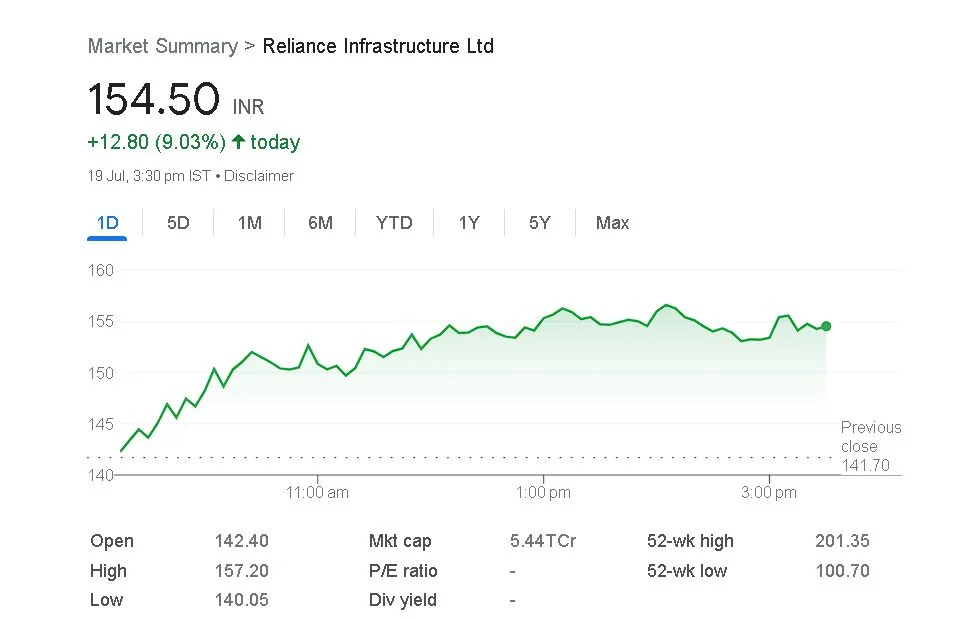
Reliance Infrastructure shares jump 11% today;

Price of Reliance Infrastructure stock: The 14-day relative strength index (RSI) for the stock was 54.20. Oversold is defined as a value below 30, and overbought as a value beyond 70. In comparison to a price-to-book (P/B) ratio of 0.50, the company’s stock has a negative price-to-equity (P/E) ratio of 1.56.

Shares of Reliance Infrastructure Ltd rose sharply in Wednesday's trade amid heavy volumes. The stock jumped 10.75 per cent to hit a day high of Rs 157.15 over its previous close of Rs 141.90.
Price of Reliance Infrastructure stock: Based on the technical setting, the counter might find support at Rs. 147, then at Rs. 143.

In Wednesday’s trading, Reliance Infrastructure Ltd. shares increased significantly amid high volume. The stock increased 10.75% from its previous closing of Rs 141.90 to a day high of Rs 157.15.

  • Approximately 34.20 lakh shares were traded on the BSE today, a significant increase from the 2.94 lakh share average for the prior two weeks.
  • The counter’s turnover was Rs 49.72 crore, and it had a Rs 5,398.22 crore market capitalization (m-cap).

The stock was down 21.95% from its 52-week high of Rs 201.35, reached on September 2, 2022, at the day’s high price of Rs 157.15. Despite this, it has increased in value by 55.98% since reaching a low of Rs. 100.75 on July 19 of last year.

  • “The stock has witnessed a decent spurt in the last two sessions from Rs 134 levels to touch the peak zone of Rs 157,” said Vaishali Parekh, Vice President of Technical Research at Prabhudas Lilladher. It encounters resistance close to Rs 158.
  • “The risk reward ratio is looking favourable and long-term investors can hold the stock,” said Milan Sharma, founder of 35North Ventures. The companies’ assets are quite valuable, and their cash flow is solid and predictable. Over the next 12 months, investors can purchase it with a target price of Rs 220.

The 14-day relative strength index (RSI) for the counter was 54.20. Oversold is defined as a value below 30, and overbought as a value beyond 70. In comparison to a price-to-book (P/B) ratio of 0.50, the company’s stock has a negative price-to-equity (P/E) ratio of 1.56.

CONCLUSION

By providing customers with an easy and reasonable option to participate in the financial markets, discount brokers have transformed the way people invest. By offering affordable fee rates, user-friendly trading platforms, and a variety of investment choices, these brokers help people and organisations take control of their portfolios and achieve their financial goals. Before choosing the discount broker whose offers most closely fit your financial objectives, carefully examine each one’s offerings. Use cost-effective trading to your advantage and begin your investment adventure as soon as possible with a trustworthy discount broker.

FOR MORE INFO CLICK THIS SITE:https://learningsharks.in/

FOLLOW OUR PAGE:https://www.instagram.com/learningsharks/?hl=en

Options Trading: A Comprehensive Guide for Investors

Option trading is a form of investment strategy that involves the buying and selling of options contracts.
Option Trading

Introduction

Welcome to our thorough options trading guide! We want to give you in-depth knowledge and insights about this effective investment strategy as subject-matter experts in the industry. The fascinating and adaptable practice of trading options enables investors to profit from market fluctuations and potential price changes in a variety of assets, including stocks, commodities, and currencies. We will look at the basics of options trading, its approaches, and how it can help your investment portfolio in this article.

What is Options Trading?

Trading in options entails buying and selling financial instruments referred to as options. The holder of an option has the choice to buy (call option) or sell (put option) a particular asset at a predetermined price (known as the strike price) on or before a given date (known as the expiration date), but not the obligation to do so. Options trading is a strategy used by investors to make money, protect themselves from potential losses, and speculate on price movements.

Call Options

The right to buy the underlying asset at the strike price before or on the expiration date is offered by a call option to its holder. When investors anticipate a significant increase in the asset’s price, they frequently use call options. Investors can profit from the asset’s price growth without actually owning it by purchasing a call option.

Put Options

The right to sell the underlying asset at the strike price before or on the expiration date is provided by a put option, on the other hand, to the holder. Put options are used by investors when they believe the asset’s price will fall. Without actually owning the asset, investors can benefit from its decline by holding a put option.

Advantages of Options Trading

Options trading appeals to both experienced and inexperienced investors due to its many benefits.

1. Limited Risk

The ability to control risk exposure is a key benefit of options trading for investors. The maximum an investor can lose when purchasing options is the option’s premium. The potential for significant gains, however, can result in a favorable risk-to-reward ratio.

2. Versatility

Options can be used in a variety of ways, such as to hedge current positions, make money from covered calls, and speculate on market trends. Due to their flexibility, investors can modify their strategies to meet their unique investment goals.

3. Leverage

Leverage in options trading allows investors to control a larger position with less money. Leverage can increase potential profits, but it can also increase losses if the market moves against the investor’s position, so it must be managed carefully.

Popular Options Trading Strategies

1. Covered Call Strategy

Owning the underlying asset and selling call options against it comprise the covered call strategy. The premiums from selling the calls are used to generate extra income, and this strategy also offers some downside protection in the event that the asset’s price declines marginally.

2. Protective Put Strategy

The protective put strategy combines ownership of the underlying asset with the purchase of put options. Investors can reduce possible losses while still profiting from the asset’s price growth by holding puts.

Conclusion

Options trading presents an exciting opportunity for investors to diversify their portfolios, manage risk, and potentially enhance returns. As you delve into the world of options, remember to stay informed, practice prudent risk management, and align your strategies with your investment goals. By arming yourself with knowledge and understanding the intricacies of options trading, you can make informed decisions that contribute to your financial success.

FOR MORE INFO CLICK THIS SITE:https://learningsharks.in/

FOLLOW OUR PAGE:https://www.instagram.com/learningsharks/?hl=en
Understanding Capital Markets and Their Role in the Global Economy

capital market in stock market

Introduction

We will delve into the complexities of capital markets and their crucial role in the global economy in this extensive guide. The financial system’s fundamental pillar of capital markets facilitates the transfer of capital between investors and organizations looking for funding for various ventures. Our goal is to thoroughly explain to you how these markets operate, the tools they offer, and the role they play in promoting economic growth.

What are Capital Markets?

Various financial instruments, such as stocks, bonds, and derivatives, are traded on financial platforms known as capital markets by both individuals and institutions. By enabling investors to buy and sell securities, these markets make it possible for businesses and governments to raise money for growth, projects, or debt refinancing.

Key Participants in Capital Markets

  1. Investors: Investors are essential to the functioning of capital markets because they supply the money required for the system as a whole. Individuals, institutional investors, or even governments looking to invest their excess cash may be among them.
  2. Issuers: Companies, governments, and local governments that offer financial instruments for sale on the capital markets are known as issuers. To raise money for different purposes, they issue stocks or bonds.
  3. Intermediaries: Brokerages and investment banks are examples of intermediaries that serve as a bridge between investors and issuers. They support the buying, selling, and underwriting of securities processes.
  4. Regulators: To ensure fair practices and safeguard investors’ interests, regulatory organizations like the Securities and Exchange Commission (SEC) in the United States and the Financial Conduct Authority (FCA) in the United Kingdom monitor capital markets.

Types of Financial Instruments Traded in Capital Markets

  1. Stocks: Stocks, also referred to as shares or equities, signify ownership in a business. Shareholders have voting rights at shareholder meetings and are entitled to a share of the company’s profits.
  2. Bonds: Bonds are debt securities that are issued by corporations, governments, and localities to raise money. In essence, when an investor buys a bond, they are lending money to the issuer in return for a set amount of principal back at maturity as well as a set amount of interest payments.
  3. Derivatives:Financial contracts known as derivatives get their value from underlying assets or benchmarks. Futures, options, and swaps are common derivatives that give investors exposure to price movements without actual ownership.
  4. Commodities: Commodities like gold, silver, oil, and agricultural products can be traded as physical or derivative contracts on some capital markets.

The Role of Capital Markets in the Global Economy

Capital markets act as a vital conduit between savers and investors, fostering stability and economic growth. They support the world economy in the following ways:

  1. Capital Formation: Businesses and governments can raise money for investments in new projects and ventures through the capital markets. This encourages economic growth and job creation in turn.
  2. Risk Management: Capital markets give organizations the ability to manage and mitigate different financial risks, like currency fluctuations and interest rate volatility.
  3. Enhanced Liquidity: The ease with which investors can buy and sell securities on the secondary market gives investors liquidity and lowers the cost of capital for issuers.
  4. Wealth Creation: For both individuals and institutions, investing in the capital markets offers the possibility of wealth creation, supporting long-term financial objectives.

The Global Impact of Capital Market Trends

The environment of the capital markets is constantly changing due to a variety of factors, including advancing technology, geopolitical developments, and economic conditions. Investors and businesses alike must comprehend these trends.

  1. Digital Transformation: Trading has undergone a revolution as a result of technological advancements, becoming quicker, more effective, and more widely available. By enabling more people to invest, electronic trading platforms and robo-advisors have democratized the financial industry.
  2. Sustainable Investing: Trading has undergone a revolution as a result of technological advancements, becoming quicker, more effective, and more widely available. By enabling more people to invest, electronic trading platforms and robo-advisors have democratized the financial industry.
  3. Globalization and Emerging Markets: The importance of emerging markets to the global economy is constantly growing. By investigating opportunities in these areas, investors are diversifying their portfolios, which has increased the amount of cross-border investment..

Conclusion

The global economy depends on capital markets to facilitate the flow of capital and fuel economic expansion. They provide a wide variety of financial instruments for investors as well as funding options for issuers, making them a crucial part of the financial system. Investors and companies can take advantage of the potential of capital markets to achieve their financial goals and contribute to a sustainable and prosperous future by keeping up with the most recent market trends and developments.

FOR MORE INFO CLICK THIS SITE:https://learningsharks.in/

FOLLOW OUR PAGE:https://www.instagram.com/learningsharks/?hl=en
Understanding Derivatives: A Comprehensive Guide

Introduction

Derivatives are essential in the world of finance for risk management and hedging against market fluctuations. Due to the fact that investors can speculate on changes in the value of underlying assets without actually owning them, these financial contracts have become a crucial component of the global economy. We will delve into the complexities of derivatives in this extensive guide, looking at their types, applications, and effects on the financial landscape.

What Are Derivatives?

The value of derivatives derives from an underlying asset, such as stocks, bonds, commodities, currencies, or market indices. Derivatives’ defining characteristic is their dependence on the performance of the underlying asset; they do not have an independent value. Derivatives are used by investors to protect against possible losses or to profit from market opportunities without actually purchasing or selling the asset.

Derivatives come in a variety of forms, each with a specific function on the financial market. The principal categories are:

1. Futures Contracts

Futures contracts are arrangements to purchase or sell a specific asset at a predetermined price on a given future date. Producers, consumers, and investors frequently use these standardized, exchange-traded contracts to control price volatility.

2. Options Contracts

Options contracts give the holder the option to buy (call option) or sell (put option) an underlying asset at a predetermined price within a predetermined timeframe, but not the obligation to do so. Options are used by investors for speculative or hedging purposes.

3. Swaps

Swaps involve the trading of cash flows based on various financial instruments, such as interest rates or currencies, between two parties. They are frequently used to gain exposure to foreign markets or manage interest rate risks.

How Do Derivatives Work?

Let’s take a hypothetical situation involving a corn farmer, Jane, and a cereal manufacturer, John, to demonstrate how derivatives function. John is worried about an increase in cereal production costs as a result of rising corn prices, whereas Jane is worried about a potential drop in corn prices before her harvest.

Jane and John enter into a futures contract to lessen their risks. They come to an agreement on a price for a certain amount of corn that will be delivered at a later time. John benefits from the lower price that was agreed upon if corn prices increase, while Jane benefits from selling at the higher market price. In contrast, if corn prices drop, John loses money while Jane gets a good price for her produce.

The Importance of Derivatives in Risk Management

Derivatives serve as powerful tools for managing risk in various ways:

Hedging

Companies can use derivatives to reduce potential losses brought on by unfavorable market price changes. They defend themselves against unfavorable market circumstances by hedging their positions.

Price Discovery

The price discovery process is aided by derivatives markets, which reveal how the market views the potential value of an asset. Businesses and investors can make wise decisions with the help of this information.

Liquidity Provision

By enabling participants to trade assets without directly purchasing or selling the underlying instrument, derivatives increase market liquidity. The financial markets operate more smoothly as a result of this liquidity.

Risks Associated with Derivatives

Derivatives have many benefits, but there are also risks involved. The following are a few risks connected to trading in derivatives:

Market Risk

Losses on derivatives positions may result from market fluctuations, particularly if the value of the underlying asset changes negatively.

Credit Risk

Transactions involving derivatives are subject to counterparty risk, in which case one party’s failure to fulfill its obligations could result in losses for the other party.

Operational Risk

Operational risk may be presented to market participants as a result of mistakes made during the execution of derivatives transactions, technological issues, or procedural failures.

Conclusion

Derivatives are crucial tools that enable businesses and investors to control risk and make predictions about market behavior. The complexity of these financial contracts must be understood in order for market participants to make wise choices. Derivatives have inherent risks, just like any other financial tool, but these risks can be reduced through careful analysis and risk management techniques. Derivatives are a valuable addition to any well-diversified portfolio because investors can confidently navigate the financial landscape by understanding the nuances of derivatives and their applications.

FOR MORE INFO CLICK THIS SITE:https://learningsharks.in/

FOLLOW OUR PAGE:https://www.instagram.com/learningsharks/?hl=en

Understanding the Key Differences Between Investing and Trading

Introduction

Trading and investing are two well-known tactics used by both individuals and institutions in the world of finance and capital markets. Both strategies involve buying and selling financial assets, but they have very different goals, time frames, and strategies. In this thorough guide, we will examine the key distinctions between trading and investing, illuminating the traits, benefits, and drawbacks of each approach.

Investing: Building Wealth for the Long Term

A long-term strategy for accumulating wealth, investing is centered on buying assets with the hope of reaping significant returns over an extended period of time. Leveraging the power of compounding, dividends, and interest over time, investing’s main objective is to grow capital steadily. Investors frequently strive to create a diversified portfolio that can withstand market fluctuations and produce long-term growth.

Benefits of Investing

  1. Compounding Growth: Investors can take advantage of the compounding effect, in which their wealth increases exponentially over time, by reinvested gains and returns.
  2. Diversification: A well-diversified portfolio spreads risk among a variety of asset classes, which lessens the effect of volatile individual assets on overall returns.
  3. Passive Income: Some investments, like stocks that pay dividends or real estate that is rented out, can generate a consistent flow of passive income.

Risks of Investing

  1. Market Fluctuations: Investment values may change as a result of changes in the economy, the performance of particular industries, or particular companies.
  2. Long-Term Commitment: As significant returns may take years or even decades to fully materialize, investing frequently requires patience and a long-term outlook.

Trading: Seizing Short-Term Opportunities

Contrarily, trading entails more frequent purchases and sales of financial instruments with the intention of profiting from transient price changes. Many different technical and fundamental analysis tools are frequently used by traders to spot opportunities and carry out quick, well-timed trades for quick gains. Contrary to investors, traders are more focused on making quick money than accumulating wealth over the long term.

Benefits of Trading

  1. Quick Profit Potential: If traders can correctly forecast short-term price movements, they can benefit from both rising and falling markets.
  2. Flexibility: Trading allows for more agile decision-making, enabling traders to adapt to changing market conditions swiftly.
  3. Active Involvement: Traders keep a close eye on the markets, staying informed of any events or breaking news that might affect asset prices.

Risks of Trading

  1. Higher Volatility: Trading’s short-term focus exposes participants to greater market risk and volatility.
  2. Transaction Costs: Frequent trading may result in higher transaction costs, which could reduce earnings.

Key Differences Summarized

To better grasp the distinctions between investing and trading, let’s summarize their key differences:

  1. Objective: Investing aims for long-term wealth accumulation, while trading seeks short-term profits.
  2. Time Horizon: Trading concentrates on the short term, with positions held for days, hours, or even minutes, whereas investing has a longer time horizon, frequently spanning years or decades.
  3. Approach: While traders actively monitor and analyze markets in search of short-term opportunities, investors take a more passive approach, counting on the potential for assets to increase in value over time..
  4. Risk Tolerance: Trading entails higher risks because of its short-term nature and market volatility, whereas investing typically involves a lower level of risk because it focuses on the long term.
  5. Market Research: While traders place more emphasis on technical analysis and market trends, investors frequently examine a company’s fundamentals, financials, and industry performance.

Conclusion

In conclusion, trading and investing are both crucial financial strategies that cater to various goals and risk appetites. Trading focuses on taking advantage of short-term opportunities to profit from market fluctuations, whereas investing aims to build long-term wealth with a diversified portfolio. Both individuals and institutions must be aware of the subtle differences between each strategy in order to make well-informed financial decisions that support their objectives.

FOR MORE INFO CLICK THIS SITE:https://learningsharks.in/

FOLLOW OUR PAGE:https://www.instagram.com/learningsharks/?hl=en

Five Biggest Stock Market Myths?

Due to several myths and misconceptions about the stock market, investors in India have approached it with caution and fear. These fallacies frequently deter prospective investors from the market, resulting in them missing out on excellent business opportunities.

If you’re considering stock market investing but are discouraged by these fallacies, here is how they are disproved:

1. Stock Market Investing is Like Gambling

The stock market cannot be compared to gambling at all. While stock market investments are influenced by a number of factors, including market history, current economic conditions, and information about the firm you desire to invest in, gambling is based on chance. In contrast to gambling, these elements may be researched and forecasted to help investors make money.

2. The Stock Market is Exclusively for Experts

Anyone may engage in the stock market and benefit from wealth growth; stock market investing is not just for a select few. Understanding the market and choosing the right shares are prerequisites for investing in the stock market. This learning process, though, is ongoing and changes with time. Anyone with a serious interest in the market can access the stock market since it rewards preparation.

3. You Can Only Make Money By Investing A Lot of Money

This myth is based on the fallacy that one needs a lot of capital to cover losses along the road in order to be profitable, which is untrue. The stock market offers chances for traders with different money and risk appetites. After creating a trading account, you can purchase shares for between Rs. 10 and Rs. 50. The secret is to carry out study to find the right company shares and to create a plan to cut your losses as soon as possible.

4. High Risk Means High Returns in the Stock Market

In truth, certain stock market investors benefit from some high-risk trades. High-risk investments do not, however, always provide high returns. High-risk investments actually have an equal chance of success and failure. It takes prudence, perseverance, and investigation to choose a high-risk investment in which you can place your trust and money.

5. You Should Just Try My Hand at Stock Market Investment

People could feel pressured to make stock market investments based merely on a few tips and recommendations from friends and relatives. However, an investor must devote time to research, from comprehending the market and current economic trends to formulating plans, in order to actually earn from the stock market.

Conclusion

Investments in the stock market require some forethought and research. Once an investor has surmounted these challenges, they can benefit from the market’s potential for wealth development. Simply do some research, develop some straightforward methods, and open an online trading account as well as a Demat account to get started investing.

FOR MORE INFO CLICK THIS SITE:https://learningsharks.in/

FOLLOW OUR PAGE:https://www.instagram.com/learningsharks/?hl=en

Utkarsh Small Finance Bank IPO allotment out:Check latest Update ?

The allotment status for the initial public offering (IPO) of Utkarsh Small Finance Bank (SFB) has been announced.
Utkarsh Small Finance bank IPO

The Rs 500 billion Utkarsh SFB IPO had a strong reaction from investors during the bidding process, selling for between Rs 23 and Rs 25.

The allocation status for Utkarsh Small Finance Bank’s initial public offering (IPO) has been made public. Investors responded well to the Rs 500 crore initial offering during the three-day bidding period that began between July 12 and 14.

The IPO of Utkarsh SFB, which was issued for between Rs 23 and Rs 25 a share, received a total subscription of 110.77 times. While the category for non-institutional investors was subscribed 88.74 percent, the portion for qualified institutional bidders was booked 135.71 times. The retail investor quota received 78.38 times as many subscriptions as the employee quota, which brought in 18.02.

The Utkarsh Small Finance Bank’s grey market premium (GMP) has mostly stayed steady. In the grey market, Utkarsh Small Finance Bank was fetching a premium of Rs 15, which on Tuesday was almost Rs 16. The grey market signal at this time points to a listing of 60% for the investors who will receive the allotment.

Utkarsh Small Finance Bank, an Indian small finance institution founded in 2016, has the second-fastest AUM growth over the fiscal years 2018–19 and 2021–2022. Over 6,000 crores worth of assets are being managed by the private lender.

The majority of brokerage firms are bullish on the stock and advise long-term investment in it because of its competitive pricing, healthy balance sheet, and good economic fundamentals. Geographic concentration, however, has been identified by a select analyst as the main threat to the company’s operations.

The Bombay Stock Exchange (BSE) website, which is where investors who placed bids for the issue can verify the allotment status  www.bseindia.com/investors/appli_check.aspx . When choosing an issue type, one can tick the equity box and choose the firm name from a dropdown menu.

To check the status of the allotment, one only needs to enter their application number and PAN card ID.

The second option is to go to the registrar’s portal, in this case KFin Technologies Limited in the case of Cyient DLM, to check the allotment status. On the registrar’s website, investors can also check the progress of their allocation at https://kosmic.kfintech.com/ipostatus

On Thursday, July 20, refunds for bidders who failed to receive allocation in the IPO may begin. By Friday, July 21, those who would get shares may notice the credit of shares in their Demat accounts. On Monday, July 24, the IPO is most likely to list.

FOR MORE INFO CLICK THIS SITE:https://learningsharks.in/

FOLLOW OUR PAGE:https://www.instagram.com/learningsharks/?hl=en
What is Risk Management in Stock Market?

It involves implementing strategies and techniques to minimize the potential impact of adverse events on investment portfolios.
Risk Management

In the context of the stock market, risk management refers to the procedure of locating, evaluating, and minimising risks connected to investments. It entails putting plans and tactics into place to reduce the possible impact of negative occurrences on investment portfolios. Protecting capital, maintaining wealth, and maximising risk-adjusted returns are the goals of effective risk management. Diversification (spreading investments across various assets or industries), stop-loss orders (pre-set price levels at which an investment will be sold to limit losses), and using hedging strategies (such as options or futures contracts to offset potential losses) are some common risk management techniques in the stock market.

Finding a balance between risk and return is the main objective of risk management. It entails knowing one’s risk tolerance, establishing investment goals, and putting effective loss management measures into practise. Monitoring and changing tactics as market conditions and individual circumstances change are part of the continuing process of risk management. Investors can safeguard their cash and improve their chances of attaining their financial objectives by efficiently managing risk.

How Does Both Work In Stock Market?

Strategies for risk management are used to lessen the possible impact of market volatility on assets. These tactics are designed to safeguard assets, reduce losses, and maximise risk-adjusted returns. Here are a few illustrations:

  • a. Portfolio diversification can help to lessen the effects of volatility by investing in a number of assets, industries, or geographical areas. Other investments could provide as a buffer if one performs poorly.
  • b. Stop-loss orders: Using stop-loss orders, you can specify the price levels at which an investment will be automatically sold. By stopping further decreases once the price exceeds a predetermined threshold, this helps to limit losses.
  • c. Hedging: Hedging entails utilising financial instruments to cover anticipated losses, such as options or futures contracts. By purchasing put options on their existing positions, for instance, an investor can use options to hedge against downside risk.
  • Asset allocation can assist manage risk by distributing investments among various asset classes (such as stocks, bonds, and cash) in accordance with investment goals and risk tolerance. Investing in d mix of higher-risk and lower-risk securities can offer stability during erratic times.
  • e. Risk assessment: It’s crucial to regularly assess the risk involved with investments and modify strategies as necessary. This involves evaluating elements including risks particular to the organisation, market trends, economic indicators, and geopolitical developments.

Advantages and Disadvantages Risk Management

Advantages of Risk Management

  • Capital Preservation: Protecting capital is one of the main benefits of risk management. Investors attempt to reduce possible losses during market downturns or unfavourable events by utilising risk management measures, thereby protecting their invested capital.
  • Enhanced Risk-Adjusted Returns: Enhanced risk-adjusted returns can result from effective risk management. Investors can optimise their investment portfolios to achieve a balance between risk and profit by carefully assessing and controlling risks. This might improve the performance of their investments as a whole.
  • Enhanced Decision-Making: Investors are urged by risk management to carefully assess and comprehend the risks connected to their investments. Better investment decisions are made as a result of this approach, which takes into account variables like market circumstances, volatility, and company-specific risks.
  • Peace of Mind: Investors experience security and peace of mind when risk management measures are implemented. During volatile market situations, knowing that potential risks are detected and minimised to the greatest extent feasible can lessen anxiety and emotional decision-making.

DisAdvantages of Risk Management

  • Opportunity Cost: Risk management techniques like hedging and diversification may have additional costs. Reduced potential earnings or higher expenditures incurred as a result of using risk management strategies are two examples of these costs. The upside potential of an investment may occasionally be restricted by risk management strategies.
  • Effective risk management methods can be difficult to develop and time-consuming to put into practise. It necessitates a thorough understanding of risk management strategies, market dynamics, and investment principles. Investors may need to spend a lot of time and money putting their risk management plans into action and keeping an eye on them.
  • False Security: Although risk management attempts to reduce possible dangers, it is unable to completely eradicate them. Unexpected occurrences or market variables are always a possibility and might lead to losses. A false sense of security can be produced by relying entirely on risk management strategies without taking other aspects into account.
  • Overemphasis on Risk Mitigation: Overly cautious risk management techniques might make it more difficult for investors to profit from possible advantages. Taking on too little risk can lead to lost opportunities and lower total investment returns, particularly during times when the market is favourable.

Conclusion

Capital preservation, better risk-adjusted returns, improved decision-making, and peace of mind are just a few benefits of risk management. However, it includes drawbacks like lost opportunities, complexity and time investment, illusory security, and the ability for upside potential to be limited.

Risk management is a crucial factor for investors. Market volatility can present possibilities for rewards, but it also carries hazards that must be appropriately managed. Putting risk management ideas into practise aids in capital protection, returns optimisation, and security. However, overly cautious methods to risk management may stifle chances and profits.

FOR MORE INFO CLICK THIS SITE: https://learningsharks.in/

FOLLOW OUR PAGE: https://www.instagram.com/learningsharks/?hl=en