
Learning sharks-Share Market Institute


Rajouri Garden  8595071711 7982037049  Noida 8920210950 , and  Paschim Vihar  7827445731  

Fee revision notice effective 1st Jan 2026; No change for students enrolled before 15th Jan 2026

Download “Key features of Budget 2024-2025here

Stock Market WhatApp Group Links of June 2023

WhatsApp group links for Stock Market for 2023
WhatsApp Group Links for Stock Market

What is WhatApp?

With just a Wi-Fi connection, WhatsApp is a free, cross-platform messaging programme that enables you to make video and voice conversations, send text messages, and more.

WhatsApp, which has over 2 billion active users, is particularly well-liked among friends and family who wish to stay in touch but live in different countries.

WhatsApp’s widespread acceptance is largely a result of its usability across platforms, accessibility, and clear, uncomplicated features.

Although WhatsApp may not be widely used in the US, it is a vital component of daily life in many other countries. Undoubtedly one of the most used messaging platforms worldwide is the Facebook-owned app.

Knowing that WhatsApp was one of the first mobile apps to provide free, internet-based chatting can help you understand why it is so popular. WhatsApp generally uses a Wi-Fi connection to send and receive messages and calls for free, as opposed to sending texts via cellular data networks, where costs may be involved.

Now, fast forward: Over 2 billion users use WhatsApp because it makes communicating easy regardless of device or location.

WhatsApp is not only easy to use, but it also provides significantly more capabilities and customizations than standard SMS messaging – all for free. If you’re already familiar with the app, our favourite WhatsApp tips and tricks might be of interest to you.

How does WhatsApp work?

WhatsApp’s key selling point is its ability to be used essentially for free for international calling and for sending and receiving calls and messages utilising only an internet connection. There are no sign-up costs, and there are no data plan limits to be concerned about.

Even while WhatsApp is similar to other messaging apps like iMessage and Messages by Google, it nevertheless has several distinct advantages, the most important of which is cross-platform compatibility (for example, between Android and iOS).

  • Phone and video calls: In addition to phone conversations, WhatsApp also provides video calls, which include a group feature that supports up to eight callers at once.
  • You can record audio messages and transmit them to individual or group chats.
  • WhatsApp uses end-to-end encryption, a secure communication protocol, so that only the parties involved in a message can see it.
  • Sharing photographs and videos: You can share films, photos, and GIFs without being concerned that they will be pixelated or not downloadable, as can occasionally happen when SMS messages are sent across various mobile platforms and cellular carriers.
  • Sharing materials: Without the burden of email or additional document-sharing apps, WhatsApp enables you to transfer various types of documents, including PDFs, spreadsheets, and slideshows.
  • Desktop accessibility: Both a Mac and a PC desktop version of WhatsApp are available.
  • WhatsApp Business: WhatsApp’s dedicated business account was created to allow business owners to communicate with their clients and exhibit their products on a user-friendly and simple platform.

Key differences between WhatsApp group and WhatsApp business 

Like any other WhatsApp group, the WhatsApp Business Group allows several members to be added and chat together. This feature functions like a chat room where all of the group’s members can share files and converse. Every member of the group can see every chat that takes place.

Private communications can be delivered to numerous recipients simultaneously using the WhatsApp Business Broadcast feature. You must set up a Broadcast group, which is akin to a WhatsApp group, where numerous persons can be added (without anybody knowing who else is in the group), and communications submitted to group members are received as private messages.

To have a better understanding of these two groups’ fundamental differences, let’s greater understanding.

1. Features

WhatsApp Group: interacting and conversing with many people at once. The group’s entire membership is able to converse and discuss with one another.

WhatsApp Business:sending a private message with a similar message to several persons at once. The subscribers to the broadcast list are unaware of the other subscribers.

2. People Limitation

WhatsApp Group: A WhatsApp group can only have a maximum of 256 members added. You will need to form another group if there are more participants.

WhatsApp Business: The number of individuals who can be added to a WhatsApp business broadcast is unrestricted.

3. Message Sender

WhatsApp Group: Any group member in a WhatsApp group can send a message to the group, and all other group members can see such messages.

Although there is a setting that only allows the administrator to send messages

WhatsApp Business: Messages can only be sent by the person who created the broadcast list. These messages are transmitted as one-to-one chats, and if a response is sent, it will show up in that person’s chat window.

4. Message receiver

WhatsApp Group: The messages sent to a WhatsApp group will be seen by everyone who has been joined to it. Whether or not a member is saved to your address book, they can still view everything in the group.

WhatsApp Business: These messages can only be read by the contacts listed in your address book; anyone else won’t see them. WhatsApp won’t let you know whether a receiver has added or removed you from their address book. However, you can verify your delivery list to make sure some persons are not receiving your messages.

5. Chat History

WhatsApp Group: The messages in a WhatsApp group are not automatically preserved, but you can star any message that you want to keep.

WhatsApp Business: The WhatsApp list’s broadcast group messages are automatically saved as one-to-one conversation history.

6. Feature Using Occasion

WhatsApp Group: A WhatsApp group is the finest choice when a group conversation is required. Multiple users can interact, discuss, and exchange experiences with other members using this function. All of the members of a WhatsApp group have access to all messages and media files shared in the group.

WhatsApp Business: The greatest time to use a WhatsApp business broadcast list is when you need to distribute files, notices, and essential information to a large group of people. Since there is a great likelihood that crucial information would get lost among several group communications, a broadcast list is the most effective. Furthermore, broadcast message WhstaApp works best when you don’t want the group’s members to know who the other group members are.

7. Participants Reply

WhatsApp Group: Any member of a WhatsApp group can reply, and it is accessible to and received by all group members. These notifications show up directly in the group window.

WhatsApp Business: Private chat is how the messages from a broadcast list are delivered. All list members receive all messages in their individual chat windows, and any replies also show up there.

Advantages of WhatsApp Group and WhatsApp Business

WhatsApp Group: Using a WhatsApp group, you can have a discussion involving the ideas, thoughts, and viewpoints of many different people. It is possible to send information to numerous recipients at once.

WhatsApp Business: There is a good probability that among hundreds of communications, some persons will miss or lose critical information. As messages are delivered directly to the recipient conversation in this case, broadcast list proves to be the ideal choice. Additionally, the broadcast list is the ideal tool when you don’t want to show who is in a group. Creating a personal connection with the recipient, improved one-on-one communication, serving as a fantastic marketing tool, and more are just a few additional advantages of employing the function.

Stock Market WhatsApp Group Links for June, 2023

Bull TraderClick to Join Group
NSE & MCX APR-18Click to Join Group
StockClick to Join Group
EQUITY AND MCX INTRADAYClick to Join Group
Zerodha new a/c openingClick to Join Group
Earn money groupClick to Join Group
Stock Cra ker 2Click to Join Group
200% తెలుగుgenuine stocksClick to Join Group
SHARE MARKET EARNINGSClick to Join Group
MCX & EQUITYClick to Join Group
UAE Buy and SellClick to Join Group
An intraday Trading ideaClick to Join Group
Blockchain Community IndiaClick to Join Group
MONEYClick to Join Group
STOCK ROLLERS -783Click to Join Group
Best BuyClick to Join Group
Stock MarketClick to Join Group
Trading PassionClick to Join Group
SharmaStocksClick to Join Group
MCX ExpertClick to Join Group
Investment GuruClick to Join Group
CRUDE ExpertClick to Join Group
Free Forex SignalsClick to Join Group
Group11 Stock MarketClick to Join Group
BrainStorm CommunityClick to Join Group
Daily StonksClick to Join Group
PFTSharing GroupClick to Join Group
EQUITY & FUTURES EXPERTClick to Join Group
Zerodha AccountsClick to Join Group
Nifty OptionsClick to Join Group
RAJ FINANCIALSClick to Join Group
DEMO BANK NIFTY 3DAYSClick to Join Group
ALPHA FOREXClick to Join Group
Forex mentorshipClick to Join Group
TRADER’S SPOTClick to Join Group
BrainStorm CommunityClick to Join Group
Group11 Stock MarketClick to Join Group
Sensex_BankniftyClick to Join Group
Loss recoverClick to Join Group
Option trading nightClick to Join Group
AdsexchangClick to Join Group
Stock Future Positional CallClick to Join Group
GromoClick to Join Group
Stock Market SchoolClick to Join Group
Learn Financial MarketClick to Join Group
The index pointsClick to Join Group
Stock Market TipsClick to Join Group
My StocksClick to Join Group
Stock Market earnClick to Join Group
AdsexchangClick to Join Group
Bank nifty and niftyClick to Join Group
The Stock Bull 2Click to Join Group

FOLLOW OUR WEBSITE FOR MORE INFORMATION: https://learningsharks.in/

FOLLOW OUR PAGE : https://www.instagram.com/learningsharks/
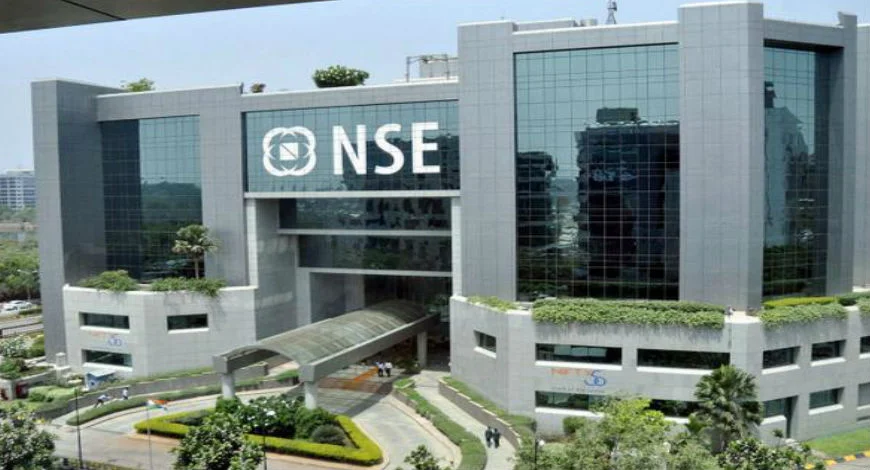
What is National Stock Exchange (NSE)?

 National Stock Exchange of India Limited is largest financial market in India and the fourth-largest market in terms of trading
National Stock Exchange of India Limited (NSE)

The largest financial market in India is the National Stock Exchange of India Limited (NSE). The NSE, which was founded in 1992 and is now a sophisticated electronic market that ranks fourth globally in terms of equity trading volume, has grown since its incorporation. The wholesale debt market was introduced in 1994, and shortly after that, a cash market segment.

Additionally, it was the first stock exchange in the nation to introduce electronic trading capabilities, which made it easier to unite investors from all over the nation under one roof.

On the list of the largest stock exchanges in the world as of April 11, 2023, the NSE’s total market capitalization was approximately USD 3.26 trillion, placing it in ninth place.

However in India, this sector only accounts for 12–14% of the country’s overall GDP, in contrast to the USA, where trading from the corporate sector accounts for about 70% of the country’s GDP. 4000 of the approximately 7800 listed companies in this entire corporate sector trade on Indian stock exchanges. Thus, only 4% of the nation’s GDP is attributable to stock market trading.

KEY TAKEAWAYS

  • The largest financial market in India and the fourth-largest market in terms of trading volume is the National Stock Exchange of India Limited (NSE).
  • The first exchange in India to offer contemporary, fully automated electronic trading was the National Stock Exchange of India Limited.
  • In India, the NSE is the biggest private wide-area network.
  • The NSE was the first electronic limit order book to trade derivatives and ETFs, making it a pioneer in the Indian financial markets.

Functions of NSE

The NSE was created with the express purpose of carrying out the following duties:

  • Establishing a national trading platform for debt, hybrid, and equity instruments.
  • Granting fair access to investors nationwide via a strong communication network.
  • Investors have access to a fair, effective, and transparent securities market when using electronic trading systems.
  • Enabling book entry settlement systems, quicker settlement cycles, and compliance with current global securities market standards.

How Does NSE Stock Exchange Work?

An electronic limit order book is used for trading on this Indian stock exchange, and a trading computer executes order matching. Orders are the only thing driving this entire process; neither experts nor market makers are involved.

A limit order is automatically matched with a market order when investors place one. As a result, both buyers and sellers in this market can remain anonymous.

A market that is driven by orders also gives investors greater transparency because all buy and sell orders are displayed in the trading system. These orders are placed on the NSE through stockbrokers, who frequently offer their clients an online trading platform.

Few institutional investors can place their orders directly into the trading system using this “direct market access” facility.

The equities segment of the NSE market is open for trading every day of the week, barring Saturdays, Sundays, and other holidays declared by the stock exchange. Following is the timing:

Pre opening Session:-

  1. Order entry opens at 9.00 hours
  2. Order entry closes at 9.08 hours

Regular Session:-

  1. The market opens at 9.15 hours
  2. The market closes at 15.30 hours

The Nifty50, which represents about 63% of the total market capitalization listed under it, is the NSE’s flagship index. This index includes 50 variable stocks and roughly 12 economic sectors.

Currently, Vikram Limaye serves as the CEO and Managing Director of the stock exchange, and Ashok Chawla serves as the Chairman of the Board of Directors.

Benefits of the NSE

The National Stock Exchange is a top venue for businesses getting ready to list on a significant exchange. Greater transparency in trade matching and the settlement process is encouraged by the sheer volume of trading activity and the use of automated systems.

This alone may increase market visibility and bolster investor confidence. Utilizing cutting-edge technology also makes it possible for orders to be filled more quickly, increasing liquidity and ensuring accurate pricing.


FOR MORE INFO CLICK THIS SITE:https://learningsharks.in/

FOLLOW OUR PAGE:https://www.instagram.com/learningsharks/?hl=en

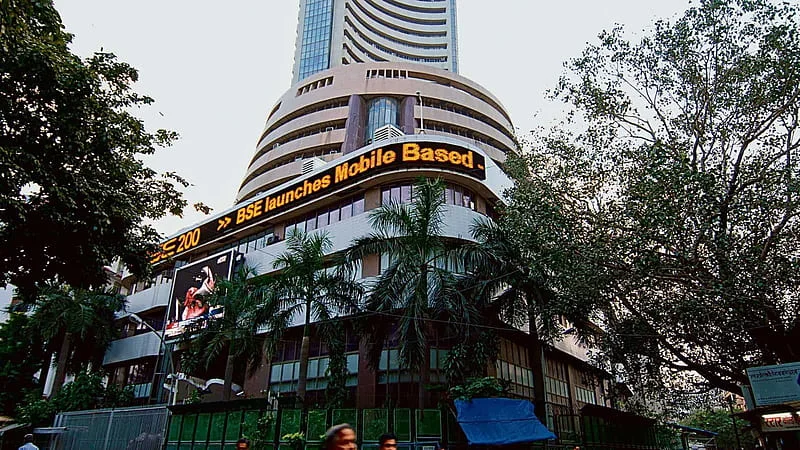
What is Bombay Stock Exchange (BSE)?

Bombay Stock Exchange is the oldest stock exchange in India as well as Asia.
Bombay stock market (BSE)

The first and biggest stock market in India, the Bombay Stock Exchange (BSE), was founded in 1875 as the Native Share and Stock Brokers’ Association. Along with the New York Stock Exchange (NYSE), Nasdaq, London Stock Exchange Group, Japan Exchange Group, and Shanghai Stock Exchange, the BSE, which is based in Mumbai, India, is one of the largest exchanges in the world and lists nearly 6,000 companies.

The BSE has contributed to the growth of the Indian corporate sector and to the development of India’s capital markets, including the retail debt market. The BSE, the first stock exchange in Asia, offers a platform for small-and-medium-sized businesses (SME) to trade stocks. BSE has expanded its offerings to include clearing, settlement, and risk management services for the capital markets.

KEY TAKEAWAYS

  • The Bombay Stock Exchange (BSE), the first exchange in Asia and the biggest stock market in India, was founded in 1875 as the Native Share and Stock Brokers’ Association.
  • By offering an effective platform for the Indian corporate sector to raise investment capital, the BSE has contributed significantly to the growth of India’s capital markets
  • The BSE is renowned for its quick and effective trade execution provided by its electronic trading system.
  • Investors can trade in equities, foreign exchange, debt instruments, derivatives, and mutual funds on the BSE.
  • Other significant capital market trading services are also offered by the BSE, including risk management, clearing, settlement, and investor education.

How the Bombay Stock Exchange (BSE) Works?

The BSE transitioned from an open-floor trading system to an electronic trading system in 1995. The New York Stock Exchange (NYSE) and Nasdaq are the two most well-known of the more than a dozen electronic exchanges that exist in the United States alone.

Because they provide fewer errors, quicker execution, and greater efficiency than conventional open-outcry trading systems, electronic trading systems currently dominate the financial industry as a whole. Stocks, stock futures, stock options, index futures, index options, and weekly options are among the securities that the BSE lists.

The Sensex, a benchmark index of 30 of the BSE’s largest and most actively traded stocks covering 12 sectors, serves as a gauge for the BSE’s overall performance. The Sensex is India’s oldest stock index, having debuted in 1986. The index, which is also known as “BSE 30,” broadly depicts the make-up of the entire Indian market.

What Are The Various Investment Methods?

Depending on the volume of transactions made, trading in the securities of a company listed on the Bombay Stock Exchange can be done directly or indirectly. Only institutional investors and registered brokerage firms are permitted to conduct primary trading on the BSE.

Retail customers, on the other hand, are not permitted to use direct investment plans and must instead conduct their transactions through a licensed stockbroker or stock trading website. A secondary trading mechanism, governed by the Financial Industry Regulatory Authority (FINRA), is what this is known as. An individual must have a Demat account, through which financial transactions are made, in order to engage in secondary trading. Through the account itself, one can effectively become the owner of every stock.

What is Bombay Stock Exchange’s Role?

The Bombay Stock Exchange (BSE) is a significant tenet of the Indian stock market and a significant player in the economy. It provides a platform for businesses to raise money by selling shares to the public and enables investors to buy and sell those shares. This makes it easier to mobilize capital and directs it toward profitable projects that might encourage economic growth. The BSE’s Sensex, widely regarded as the barometer of the Indian stock market, is comprised of the 30 largest and most popular companies listed on the exchange. The SENSEX is closely watched by economists, investors, and decision-makers as a gauge of the health of the Indian economy as a whole.

In order to reflect market capitalization and sector performance, the BSE also provides a number of indexes, including the BSE 100, BSE 200, BSE 500, BSE Small-cap, and BSE Mid-cap, among others. As a result, investors can choose investments based on their level of risk tolerance. BSE also provides a number of additional services, such as trading, clearing, settlement, and depository services, for the smooth operation of the Indian stock market. BSE is a significant economic institution in India because it promotes economic growth by acting as a vital link between companies and investors.

Note:– The BSE has helped to develop India’s capital markets, particularly the retail debt market, as well as the country’s business sector. Small and medium-sized businesses (SMEs) can trade stocks on the BSE, the first stock exchange in Asia, which also offers a platform for doing so. Clearing, settlement, and risk management services for the capital markets are now part of BSE’s expanded menu of services. Tracking market fluctuations in a given economy is made simple by the performance of that economy’s benchmark index, which has a significant impact on the capital markets of nations around the world.

How does BSE function?

The Bombay Stock Exchange (BSE) serves as a regulated market for the trading and settlement of securities. The exchange serves as a middleman, providing a trading platform for both buyers and sellers of securities. The BSE operates as follows, generally speaking.

  • If a business plans to raise capital by selling shares to the public, it may submit an application to list on the BSE. Once the company is listed on the exchange, shares can be bought and sold there.
  • Buyers and sellers place orders to buy and sell shares at specific prices using the bid-ask method o
  • The BSE also creates and publishes a number of indices to reflect market capitalization and the performance of various sectors. The most well-known index is the SENSEX, which consists of the 30 largest and most active companies listed on the exchange.
  • The BSE also provides depository services, which facilitate online share trading, electronic trade settlement, and the ability for shareholders to hold their shares in electronic form (a process known as dematerialization, or Demat)

The BSE serves as a centralized market for buying and selling securities, providing investors with a variety of investment options, making it easier for businesses to raise capital, and ensuring the efficient operation of the Indian stock market.

FOR MORE INFO CLICK THIS SITE:https://learningsharks.in/

FOLLOW OUR PAGE:https://www.instagram.com/learningsharks/?hl=en

What is Investment in Stock Market?

 an asset acquired or invested in to build wealth and save money from the hard earned income or appreciation.
Investment in stock market

What Is Investment?

A solid foundation can withstand all the whims of an economic environment. This is an undeniable fact. The first chapter offers insight into the idea of investing itself. This offers everyone a foundation of fundamental knowledge. Once that is finished, we have focused more on the practical than the theoretical aspect in the following chapters. Money multiplication is a difficult task. It’s an art form. This art requires time and a lot of effort to master. We give you the necessary instructions in the most straightforward manner possible to make learning easy for you.

Make your money work for you! Best Wishes and Happy Learning!

How does one achieve their dreams? Money is the solution. The real obstacle, however, is how to generate income. Making ends meet is a concern for everyone in today’s world. There are many such uncertainties, including rising costs, shifting lifestyles, pink slips, health issues, etc. We must balance our income and expenses in order to maintain our social standing. Aside from that, the future looks bleak, so one should also make plans for rainy days. Saving alone is not a solution. Savings should be able to grow on their own through self-sustaining growth. Investment is what that is. You need to make financial plans in order to make your money work for you and then ‘relax’ the rest of your life.

There are many options open to us to invest our hard earned money. However, there is always the possibility of making a wrong choice which may lead to reduction of our investments. In today’s world, where it is easy to acquire simple and practical knowledge, there is no excuse if we do not learn about the various investment options and their ability to meet our needs. We all know that there are no guarantees in this world and there is always a factor called risk which may upset our plans. Just as sudden rain may upset our plans to go for a walk, risk can reduce the returns  we are expecting from our investment. We, therefore, need to acquire sufficient knowledge to be more informed investors. As a result, we must gain the necessary knowledge to become better investors.

Nature Of Investments

How do I invest?

The best course of action for you is to choose a strategy after getting your finances in order.

Where should I invest?

In mutual funds, stocks, bonds, and certificates of deposit (CDs). We’ll give you the lowdown on all of them while concentrating primarily on stocks.

When is the right time to invest?

There is no time like the present. Every time is equally good. But you will need to make a wise choice.

In this program, we will put an emphasis on making investments with the extra cash we have left over after taking care of our immediate needs. At this point, it is appropriate to mention a few fundamental concepts in investing, such as:-

• Time value of money (see the reference).
• Return (we shall discuss it later).
• Risk (covered separately).
• Ability to cash the investment etc.

Why Investment?

The stock market is a vital part of the Indian economy.
Investment in stock market

You Can Beat Inflation

Consider a scenario in which the interest rate on a fixed deposit is 10% and you are aware that the inflation rate has reached 12%. The rupee loses value at year’s end because the interest rate is lower than the inflation rate. Therefore, you suffer a loss.

Achieve Financial Goals

This might involve paying for a dream home, car, or level of education.

Plan your Retirement

Yes, you should start thinking about retirement also. Why not?

Numerous people receive recurring income in the form of monthly salaries or variable income in the form of fees, such as professional consulting fees for doctors. After subtracting monthly expenses, any remaining savings must be invested. The investment requirements could vary depending on the need: such as housing and education, are top priorities. long-term demands, such as retirement savings. Low priority requirements like a summer vacation or international travel.

  • Urgent needs, such as housing and education.
  • Long-term needs, such as saving for retirement.
  • Low-priority requirements like a summer vacation or a trip abroad.

A range of time frames, including the next 12 to 36 months, longer terms, or even 10 to 12 years or more, are possible.

Risk & Return

Risk & return relationship is important in Investments

Just as we learn new words when we learn a new language, we need to learn the fundamental terms used when we set out to learn about any subject. They will become a part of our daily lives once we learn and comprehend them. These words must be commonplace in your daily life for you to be familiar with them. Still, let’s begin!

The terms include:

• Principal amount or amount initially invested.
• Date of investment.
• Period of investment.
• Date of encashment of investment.
• Return of investment or interest

Let’s use Mr Swapnil as an example. He is a medical representative and makes Rs30,000 per month. He can save Rs10,000 per month and needs about Rs20,000 for his monthly expenses. He desires for his son to become a doctor. In order to have enough money to support their son’s medical studies, he asks his wife to invest the money in the appropriate strategy. Mrs Swapnil is aware that obtaining a medical degree will set her back Rs5 lakhs after five years. In order to help cover the cost of Rs5 lakhs, she decides to invest Rs5,000 each month in a five-year scheme (we will explain this later).

  • A sum of Rs5,000 is invested over 60 months (five years), or Rs3 lakhs.
  • At the end of five years, they will require R 5 lakhs or more.
  • If this occurs, their investment will have produced the desired return for them.

You can quickly determine the total amount with a 10% return using the calculator. If that doesn’t happen, she needs to choose alternative investment plans.

RISK
We take a certain amount of risk in every activity we engage in. When you toss a coin, for instance, you can’t predict with certainty whether it will land on its head or tail. There are two potential results, and the risk is 50%.

There are three possible results in a football game: victory, defeat, or a draw. The level of risk varies in business as well, in a similar manner. Although there is a significant amount of risk involved in investments, it can be reduced with the right information and analysis.

Consider, for example,

That MrsSwapnil purchased a share for Rs 200 of an oil company based on the fact that the same share was quoting only Rs150 a year back, thus giving an approx. annual return of 33 per cent (200-150/150). Her plans were based on the recommendations of Mr Moneybhai who said that the company is doing well. In case of an unexpected event such as an increase in oil prices the company’s performance will be affected and the share price may fall to Rs150, thereby resulting in a loss of 25 per cent.

Risks come in a variety of forms. Investors won’t ever be able to fully quantify them. All investments come with a risk warning because of this. Risks need not deter investors; instead, they should make them cautious and aid in their careful selection of the various investment options and planning of their strategies, as we will discover in the course’s later lessons. Each option may have low, medium, or high risk, as well as low, medium, or high expected returns. A wise investment choice will consider these risks and work to strike a balance between the investment’s risk and the anticipated returns. In essence, this is what is meant by risk management.

A course like this is designed to assist students like you in making informed decisions. This does not imply that there is no risk. It implies that the risk will be recognized and, with careful planning, it may be reduced. ‘No risk, no gain’ is the golden rule for all market investments. Without being willing to take the risk, there is nothing to be gained.

What is the difference between Investment and speculation?

The following table lists the key distinctions between investment and speculation:-

Investments Speculation
1. Its time horizon is wider.
2. Tries to balance the risk taken and the anticipated return.
3. May lead to recurring or consistent returns
4. Typically a scheduled activity
5. Is adapted to the needs of each individual
1. The time frame is limited.
2. Takes on more risk in the hopes of earning more money
3. Is anticipated to produce prompt returns
4. Usually impulsive and unplanned
5. No basis

Some uneducated individuals equate stock market investments with gambling. It’s completely untrue. Gambling or betting primarily involves making an educated guess about the likelihood of an event. You might want to wager on the outcome of a cricket match, for instance. The odds are 50/50 if there are only two teams. Since a coin only has two sides, the odds of either side being the head or the tail are 50/50. Therefore, there is a 50% chance that it will be either head or tail. This implies that if the coin is tossed a very large number of times—let’s say 10, then 5 times it will land on its head and an equal number of times it will land on its tail. However, it is impossible to predict the result of an eight-time coin toss if someone makes a guess as to whether the outcome will be heads or tails. Gambling will have played a part in this situation’s outcome, especially if there is a potential payout.

Investments
Gambling
1. Constructed with a longer time horizon
2. Tries to balance the risk taken and the anticipated return.
3. Can lead to constant or consistent returns
4. Typically a scheduled activity
1. Instantaneously created
2. Is risky, and balancing risk and return is impossible.
3. Unexpected or impulsive behavior
4. Is adapted to the needs of each individual

Methods Of Investing

Direct and Indirect investing

As was briefly mentioned at the beginning of this chapter, an individual has a variety of options or avenues for investing. The decision should be based on information, professional counsel, the opportunity to invest, and a number of other factors. This course’s goal is to aid participants in reaching well-informed decisions.

We can distinguish between two categories of investments on a broad scale: direct investment and indirect investment.

A direct investment is one in which the investor directly decides to make the investment and fully bears the risk of the investment’s outcome, which could be profitable or result in a loss.

In the case of indirect investment, the investor seeks the assistance of a bank advisor or utilizes tools like a mutual fund to benefit from the financial institution’s or bank’s investment expertise and make a smart investment. The investor is the one who benefits from the gains or losses in this scenario as well. Investment advisory providers accept their respective professional fees in exchange for their services and disclaim any liability for any gains or losses resulting from the investments.

Investment Alternatives

What are the Investment Alternatives available for an Investor?

There are several investment option:

Real Assets:

are assets that, due to their utility, have intrinsic value. They include things like land, gold, machinery, and patents. They stand in stark contrast to financial assets. Real assets may be material or immaterial.

Tangible Assets:

As they lead to the creation of tangible assets, investments made to acquire assets like a car, television, washing machine, or any other household items that are physical and have a long lifespan are regarded as tangible investments. Depending on the justifications for purchasing them, acquiring these assets may be seen as an expense or an investment. For instance, purchasing a car for personal use is regarded as an expense. If a car is purchased with the intention of operating a taxi service to generate income, the purchase would be regarded as an investment because it has the potential to produce periodic income.

Intangible Assets:

An investment in an intangible asset could be thought of as the acquisition of knowledge, such as the course you have paid for with the goal of becoming a wise investor. Knowledge about investments is the asset you are acquiring, and it is an intangible asset.

A person may decide to buy a piece of property with either a short- or long-term horizon in mind. This choice is made in light of the person’s current needs. Investments in tangible assets include, for instance:

Real Estate:

It might be a commercial or residential apartment. It might be the acquisition of undeveloped land for the construction of single homes, bungalows, or commercial or residential structures.

Bullion: Precious metals, such as gold, silver, and others, can be invested in.

Precious Stones:

Investments in precious stones, such as diamonds and gems, are also likely to produce profitable results.

Business:

Intangible assets like patents, royalties, etc. or fixed assets like land, buildings, machinery, etc.

Others:

include paintings, antiques, etc.

Individual investors are typically drawn to physical assets and purchase them to satisfy their financial needs, which may be long-term or short-term. Financial instrument classification examples are shown in the section that follows. A contractual right to receive or deliver money or another financial instrument, as well as cash, are all examples of financial instruments.

Financial Instruments:

Are money, proof of ownership in a company, a legal right to receive or deliver money, or another type of financial instrument.

Financial Assets Vs Real Assets

WANT TO KNOW THE DIFFRENCE BETWEEN FINANCIAL ASSETS & REAL ASSETS?

It is crucial to emphasize now that there are distinctions between financial assets and physical assets. For instance, investing in company shares (a financial asset) is different from buying a real asset like a residential apartment, which can cost several lakhs of rupees. This comparison does provide a measure of the return each asset class provides. Sometimes, to illustrate the risk-return characteristics of each class of investment, comparisons between investments in gold, shares, and mutual funds are made.

Financial AssetsReal Assets
• Available through active markets like stock exchanges• Available in traditional markets
• Offer high liquidity• Offer low to moderate liquidity
• Easy to possess• Difficult process to possess
• Does not require physical holding• Requires physical holding
• Divisible to smallest unit, as for example, one share• Unit of division is large, as for example, one flat or one bungalow

Depending on your needs, goals, time frame, and level of risk tolerance as an investor, you will decide whether to buy financial or physical assets. In some cases, acquiring a real asset may require you to pursue financial assets. For instance, if you want to buy a house in three years, you can put your money into financial assets first and then buy the real estate.

But the choice could be based on:

• Availability of funds.
• Need for liquidity (ability to sell the asset and generate cash).
• Time period of investment.
• Required rate of return
• Tax benefits

Matrix Of Investments And Their Relative Comparison

Features/InvestmentReturnRiskTDSTax BenefitMarket abilityLiquidity
Real EstateHighLowNoNoLowLow
BullionMediumLowNoNoHighHigh
AntiquesMediumLowNoNoLowLow
Bank DepositsLowLowYesNo*NoHigh
P O DepositsLowNoYesYesNoMedium**
Government Bonds***LowNoYesYesMediumMedium
Mutual funds – DebtLowLowNoNoHighHigh
Mutual funds – EquityHighHighNoYesHighHigh
Mutual funds Money MarketVery LowLowNoNoHighHigh
Equity SharesHighHighNoNo*HighHigh


FOR MORE INFO CLICK THIS SITE:https://learningsharks.in/

FOLLOW OUR PAGE:https://www.instagram.com/learningsharks/?hl=en

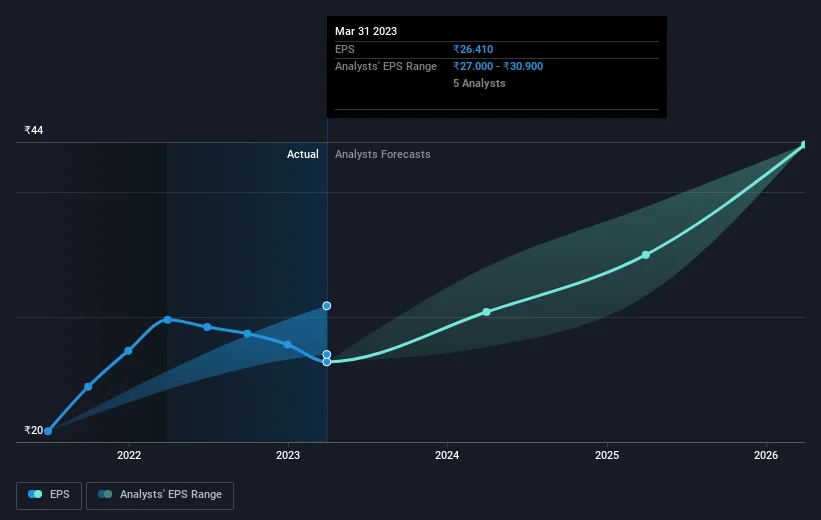
The 59% CAGR of Central Depository Services (CDSL) surpassed the company’s earnings growth.

The worst that can happen when you acquire a stock (without leverage) is if its share price falls to zero. However, if you invest in a truly exceptional firm, you can more than double your money.

For example, the share price of Central Depository Services (India) Limited (NSE:CDSL) is 293% higher than it was three years ago. What a treat for those who held the shares! Meanwhile, the share price is up 5.0% from a week earlier.

Following a strong 7-day performance, let’s examine the impact of the company’s fundamentals in creating long-term shareholder returns.

Central Depository Services (India) SWOT Analysis

Strength

  • Currently debt free.

Weakness

  • Earnings have fallen in the last year.
  • Dividend is low when compared to the top 25% of dividend payers in Capital Markets.
  • Based on the P/E ratio and projected fair value, the stock is expensive.

Opportunity

  • Annual revenue is expected to outpace the Indian market.

Threat

  • Cash flow does not cover dividends.
  • Annual earnings are expected to expand at a slower rate than the Indian market.

While some continue to teach the efficient markets concept, it has been demonstrated that markets are too reactive dynamic systems, and investors are not always rational. We may obtain a sense of how investor sentiments towards a company have changed over time by comparing earnings per share (EPS) and share price fluctuations.

Central Depository Services (India) was able to grow its EPS at 37% per year over three years, sending the share price higher. This EPS growth is lower than the 58% average annual increase in the share price. 

As a result, it’s reasonable to believe that the market now has a greater opinion of the company than it did three years ago. Given the three-year track record of earnings increase, this is not surprising.

What About Dividends?

It is critical to analyse both the overall shareholder return and the share price return for each given stock. The TSR includes the value of any spin-offs or discounted capital raisings, as well as any dividends, assuming dividends are reinvested.

We observe that the TSR for Central Depository Services (India) for the last three years was 304%, which is higher than the share price return given above. And no prizes for guessing that the dividend payments account for the majority of the difference!

A Different Perspective

While the overall market gained roughly 11% in the previous year, Central Depository Services (India) shareholders lost 12% (even after dividends). Even solid firms’ share prices fall from time to time, but before we get too excited, we want to observe improvements in a company’s basic data. Long-term investors would be less upset because they would have made 32% each year for five years.

While considering the many effects that market conditions can have on the share price is crucial, there are other aspects that are even more important. Nonetheless, Central Depository Services (India) is displaying two warning indicators in our investment research, one of which should not be overlooked…

Look at more info: https://learningsharks.in/

Follow us on insta” http://learningsharks

What is SEBI-Securities and Exchange Board of India In Stock Market?

On April 12, 1992, the SEBI Act 1992 established the Securities and Exchange Board of India (SEBI) as the controlling body for the Indian securities market.

SEBI on 12 April 1992 by the SEBI Act 1992
It was Introduced to promote transparency in the Indian Investment Market

What is SEBI?

In essence, SEBI is a statutory agency of the Indian government that was founded on April 12th, 1992. To encourage transparency in the Indian investment sector, it was introduced.

Along with its headquarters in Mumbai, the organisation has regional offices around the country in cities including New Delhi, Ahmedabad, Kolkata, and Chennai.

Who is the CEO of SEBI?

The head of India’s securities watchdog, the Securities and Exchange Board of India (SEBI), is Madhabi Puri Buch. She is not just SEBI’s first non-IAS chairperson but also its first female chairperson.

Objectives of SEBI

The task of policing the operation of the Indian capital market falls to SEBI. To protect investors’ interests, SEBI’s goals as a regulatory organisation include monitoring and controlling the Indian securities market.

By putting into place a number of rules and regulations and creating investment-related standards, it seeks to foster a safe investment environment.

Moreover, preventing fraud in the Indian stock market was one of the other primary goals.

Organizational Structure of SEBI

There is a corporate structure at SEBI India. Senior management, department heads, a board of directors, and numerous important departments are all present.

More specifically, the SEBI organisational structure consists of over 20 departments, each of which is managed by a department head who in turn is managed by a general hierarchy.

The nine specified officers who make up the hierarchical structure are as follows:

  • The Indian Union Government nominated the chairman.
  • Two representatives of the Indian Union Finance Ministry.
  • One RBI member, or Reserve Bank of India, member.
  • The Indian Union Government nominated the other five members.

Some of SEBI’s most important divisions are highlighted in the list below:

  • The department of information technology.
  • The Custodians and Foreign Portfolio Investors.
  • International Affairs Office.
  • A national securities market institute.
  • Department of Investment Management.
  • Department of Commodity and Derivative Market Regulation.
  • Human Resources Division

In addition to these, additional significant departments handle matters connected to law, finance, and enforcement.

Functions and Powers of SEBI

Being a regulatory organisation, SEBI has the authority to carry out essential duties. Such authority granted to the regulatory body is listed in the SEBI Act of 1992. As a result of its duties, SEBI acts as a financial intermediary, a defender of traders and investors, and an issuer of securities.

The suggestions below provide a quick overview of the subject.

Functions of SEBI

  • To safeguard Indian investors’ interests in the securities industry.
  • To encourage the growth and smooth operation of the securities market.
  • To control the securities market’s commercial activities.
  • Providing a platform for various professionals, such as portfolio managers, bankers, stockbrokers, investment advisers, merchant bankers, registrars, and share transfer agents.
  • To oversee the duties assigned to participants, including foreign portfolio investors, credit rating companies, custodians of assets, and depositors.
  • To inform investors about securities markets and the middlemen that operate inside them.
  • To outlaw unethical and dishonest business practises in the securities market and related areas.
  • To keep track of stock purchases and corporate takeovers.
  • To maintain the effectiveness and modernity of the securities market through appropriate research and development strategies.

Powers of SEBI

1. Quasi-Judicial Powers

SEBI India can make decisions in matters of fraud and unethical behaviour in the securities market.

The aforementioned SEBI authority supports the securities market’s transparency, accountability, and fairness.

2.Quasi-Executive Powers

The Book of Accounts and other important papers can be examined by SEBI to spot infractions or gather proof of them. The regulatory body has the authority to enforce rules, render verdicts, and pursue legal action against violators if it discovers someone breaking the rules.

3.Quasi-Legislative Powers

The authoritative body has been given the authority to create relevant rules and regulations in order to safeguard investors’ interests. These regulations frequently include listing requirements, insider trading restrictions, and crucial disclosure standards.

To stop fraud in the securities market, the body creates rules and regulations.

When it comes to the authority and duties of SEBI, the Supreme Court of India and the Securities Appellate Tribunal are in charge. The two supreme entities must do all necessary tasks and make all necessary judgements.

Advantages of SEBI

1. Short-term likelihood of increased returns

Investing in the stock market has the potential to generate larger inflation-beating returns in a shorter amount of time than other investment options like PPF and fixed deposits. People can considerably boost their chances of obtaining superior returns by adhering to the fundamentals of the stock market, such as preparing the trade and performing due diligence.

2. Purchased stock in the listed company and became a shareholder

No matter how few shares you purchase, the moment you do so, you gain proportionate control over the company’s shares.

3. Unparalleled liquidity

Comparing stock investing to other investment strategies, it provides a level of liquidity that is essentially unmatched. Investors can naturally decide fast whether to buy or sell a security. If someone needs access to money right away, they can always sell their shares and do so.

4. A regulatory agency that protects the interests of the public

The Securities and Exchange Board of India regulates and keeps an eye on the stock market. SEBI is charged with monitoring all developments and defending the interests of all parties. Once more, this goes a long way towards safeguarding their interests from any fraudulent action or business.

Disadvantages of SEBI

1. Volatility risks are rising

Due to how volatile and dynamic markets are, investing in shares has some risks. Share prices routinely go through peaks and valleys in a single day. Despite the low likelihood of a big failure, it might take years for the market to recover from a crisis’ worst consequences. These fluctuations are frequently unpredictable, which puts assets at risk.

2. The profit margins can be eroded by the brokerage

An investor must pay the broker a set percentage of the purchase price or sale price of each share they choose to buy or sell. Profitability could thus be put in danger.

FOLLOW OUR WEBSITE: https://learningsharks.in/

FOLLOW OUR PAGE: https://www.instagram.com/learningsharks/
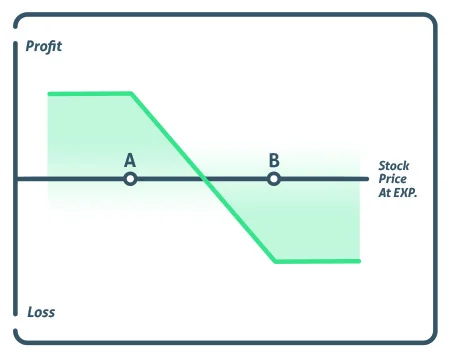
Bear Put Spread Option Strategy

A bear put spread is a vertical spread in which you are long the higher strike price put and short the lower strike price put, both of which expire in the same month.

The strike price of the short strike, represented by point A, is lower than the strike price of the long put, represented by point B, implying that the investor will always have to pay for the deal. The fundamental goal of the short put is to help pay for the upfront cost of the long put.

Profit/Loss

A bear put spread’s maximum profit is derived by subtracting the difference between the two strike prices from the premium paid. At expiration, the strike price falls below the lower strike price.

The maximum loss is the trade’s cost. At expiration, the stock must trade over the upper strike price.

Breakeven

The breakeven point for a bear put spread is the higher strike price minus the trade cost.

Breakeven = long put strike – debit paid

Example

A Rs.2.50 bear put spread would consist of buying a 50-strike price put and selling a 40-strike price put, with a Rs.10 wide strike width (50-40), which is the maximum profit the investor could make on the trade, minus the premium paid to enter the trade, in our example Rs.2.50, leaving the investor with a maximum profit of Rs.7.50.

If this put spread is out of the money, time decay works against the investor because they need more time for this transaction to become lucrative. If the vertical has both strikes in the money, time would be on the investor’s side since they would want this transaction to end as soon as possible so that there is no more time for it to go against them.

Conclusion

This is not a method that should be used frequently until there is indication of an expected downward swing.

Without that, it’s a lower-probability strategy that relies on the stock falling in price before the expiration date. It needs less capital to engage than merely acquiring shares, implying lower risk, but it is still seen as a trade with a lower possibility of success.

FOLLOW OUR WEBSITE FOR CHART PATTERNS: https://learningsharks.in/chart-patterns/
Follow us on insta” http://learningsharks

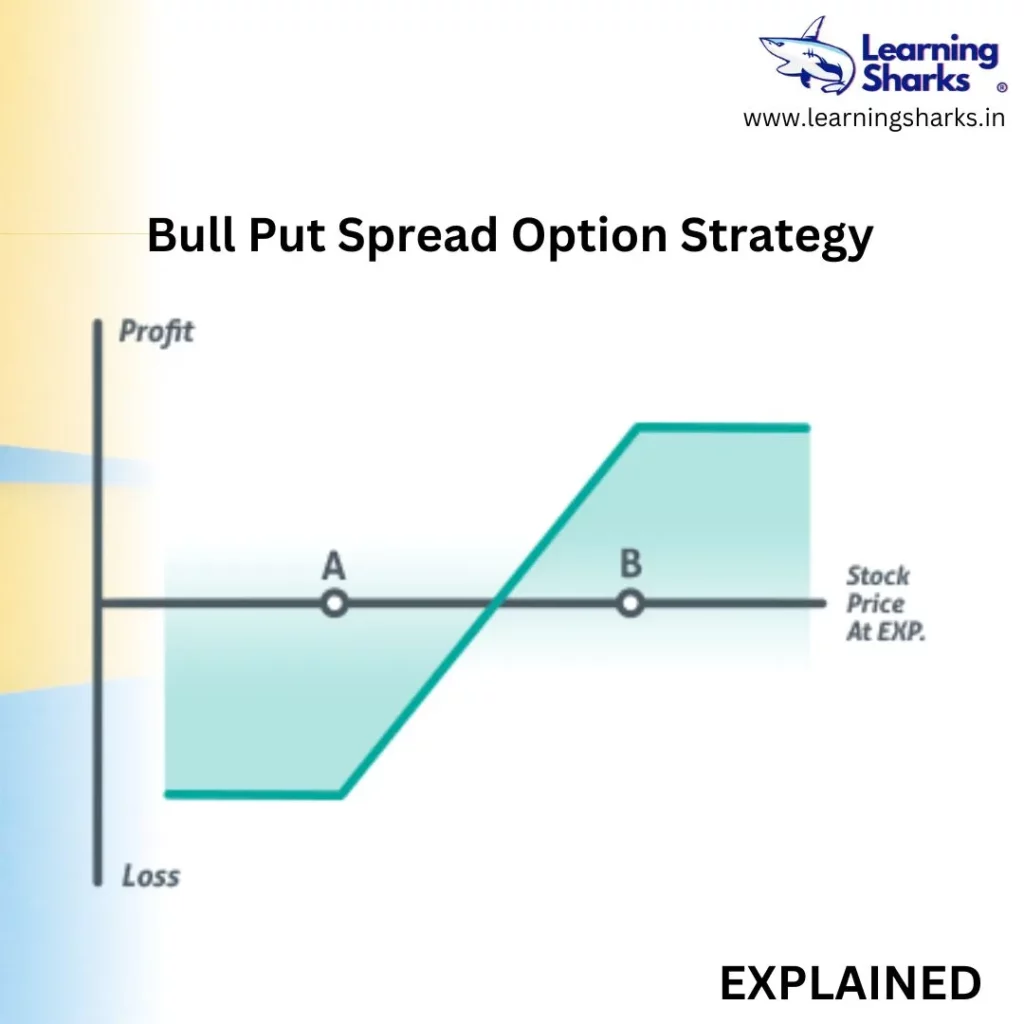
Bull Put Spread Option Strategy

The Bull Put Spread is a vertical spread strategy in which the investor sells a higher strike price put option, represented by point B, and buys a lower strike price put option, represented by point A, both inside the same expiration month.

The investor will receive a premium or credit, as the higher strike price put will have more value than the lower strike price put.

If the investor believes the market will remain flat or rise, they will employ this method. The lower put option is used as a hedge in case the market trades lower, allowing the investor to limit their maximum loss.

Profit/Loss

  • The maximum profit an investor can expect from this trade is the credit they received. The investor will profit the most if the stock closes above the higher strike price at expiration.
  • The maximum loss can be computed by subtracting the strike prices from the premium received. This is achieved when the strike price at expiration exceeds the aforementioned strike price.

Breakeven

A bull put spread’s breakeven point is the higher strike price minus the premium received.

Breakeven = short put strike – premium received

Example

A 70-75 bull put spread worth Rs.2 would involve selling a 75-strike price put and purchasing a 70-strike price put. If the stock remained above the 75-strike price, the maximum win would be Rs.2.

Having a Rs.5 strike width (70-75), reflecting the maximum loss if the deal ends below both strike prices, less the premium earned to enter the trade, in our example Rs.2, leaving the investor with a maximum loss of Rs.3.

If the put spread is out of the money, time decay works in the investor’s favour since they want the deal to expire so they may keep the full premium received. If the vertical has both strikes in the money, time will work against the investor since they will want this trade to continue, providing them more time for the stock to grow in price.

Conclusion

This is a wonderful strategy to adopt if an investor believes a stock is going up but is unsure of the timing or wants to provide himself a buffer in case the market trades sideways or slightly lower.

FOLLOW OUR WEBSITE FOR CHART PATTERNS: https://learningsharks.in/chart-patterns/

Follow us on insta” http://learningsharks

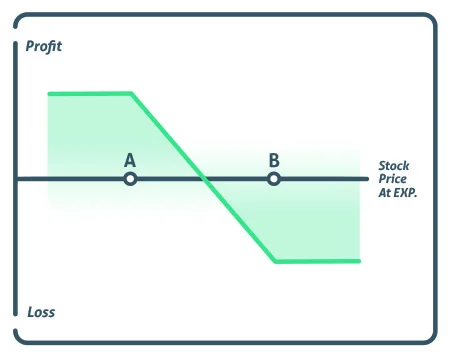
Bear Call Spread Option Strategy

Within the same expiration month, the bear call spread is a vertical spread options strategy in which the investor sells a lower strike price call option, represented by point A, and buys a higher strike price call option, represented by point B. The investor will earn a premium or credit since the lower strike price call is more valuable than the higher strike price call.

An investor entering this trade has a potential profit that is limited to the premium they received when they executed the trade and a potential loss once the stock raises above their short strike price in an amount larger than the premium they received.

If the investor believes the market will remain flat or fall, they will employ this method. The higher call is used as a hedge in case the market trades higher, allowing the investor to limit their maximum loss.

The Bear Call Spread Strategy

The bear call spread is an options strategy that works by allowing the options to decay gradually day by day until the expiration date, resulting in both options expiring worthless and the investor keeping the entire premium.

  • It is better to use the approach when it is anticipated that a stock will trade sideways or fall in price.
  • This method is popular among many traders and is appropriate for all investors since it allows them to implement a high probability trade with minimum risk.

When implied volatility is high, the vertical call spread is most effective because option pricing rises, allowing the trader to earn a bigger premium on the deal.

Profit/Loss

The maximum profit an investor can expect from this trade is the credit or premium obtained. If the stock closes below the lower strike price at expiration, the investor will earn the most.

  • The maximum loss can be estimated by subtracting the premium received from the difference between the two strike prices. On the expiration date, the stock price must end above the higher strike price.
  • In general, if short calls expire in the money, the trader will be assigned the stock position upon expiry. When calls go deep into the money, though, there is always the possibility of early assignment.

Breakeven

The breakeven point for a bear call spread is the lower strike price plus the trade cost.

Breakeven = short call strike + premium received

Example

A Rs.2 55-60 call spread consists of selling a 55-strike price call and purchasing a 60-strike price call. If the stock stays below the strike price of 55, the Rs.2 premium represents the maximum win.

With a Rs.5 wide strike width (60 -55), the maximum loss is Rs.3, less the premium earned to enter the transaction, in our example Rs.2, leaving the investor with a maximum loss of Rs.3.

If the vertical has both strikes in the money, time will work against the investor since they will want this trade to continue, giving them more time for the stock to plummet in price.

Conclusion

This is a wonderful strategy to adopt if an investor believes a stock is trading sideways or lower but is unsure of the timing or wants to provide themselves a buffer in case the market goes sideways or slightly up.

Many traders flocked to the bear call spread because of its high potential of success and little risk, but if the stock moves against them, they might lose significantly more than their initial investment. Those interested in executing a spread with a lesser probability of success but a far lower potential loss might consider the bear put spread or the bull call spread.

FOLLOW OUR WEBSITE FOR CHART PATTERNS: https://learningsharks.in/chart-patterns/
Follow us on insta” http://learningsharks

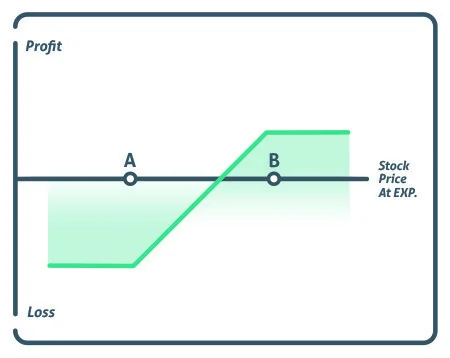
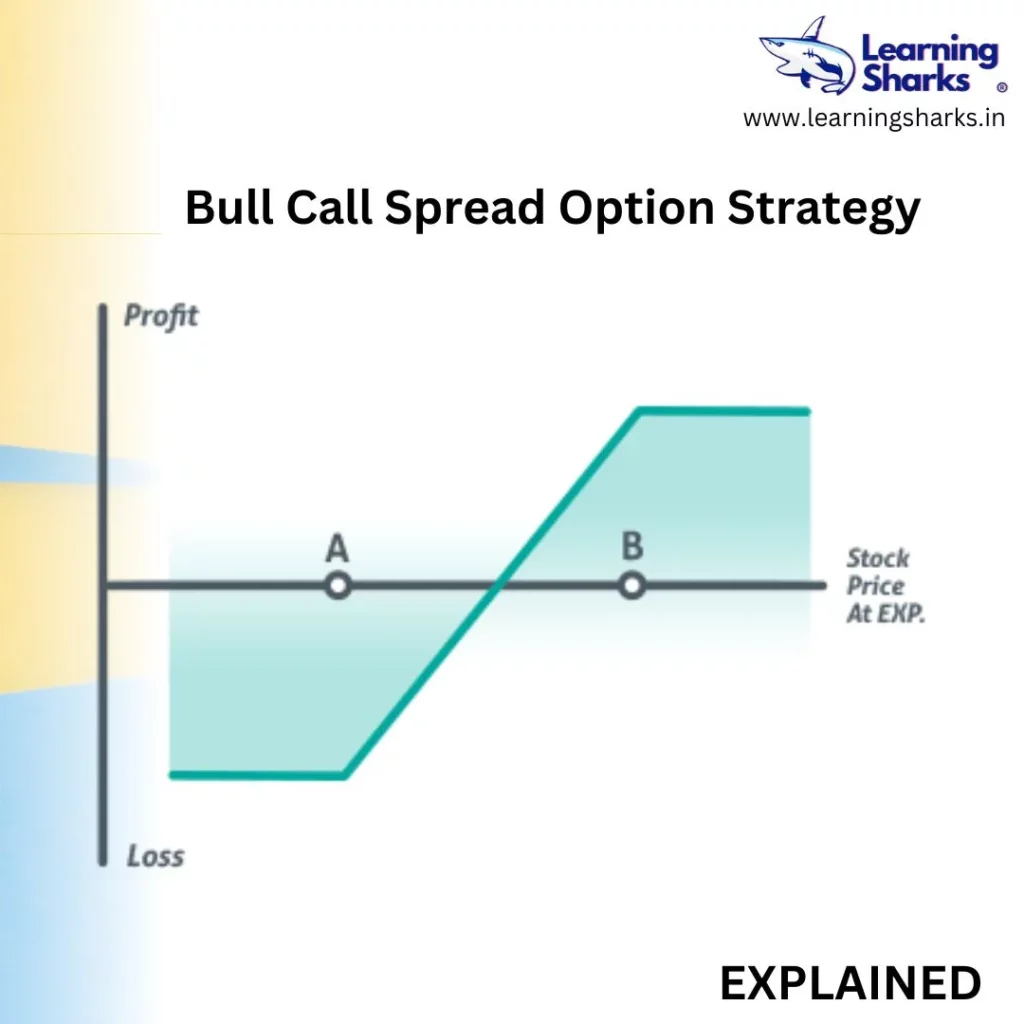
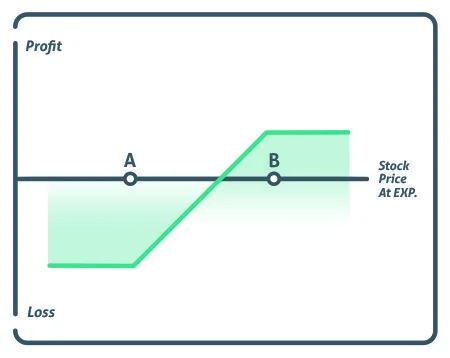
Bull Call Spread Option Strategy

The strike price of the short call, represented by point B, is higher than the strike price of the long call, represented by point A, implying that the investor will always have to pay for the trade. The primary goal of the short call is to help pay for the initial cost of the lengthy conversation.

Profit/Loss

  • A bull call spread’s maximum profit is computed by subtracting the difference between the two strike prices from the premium paid. This is achieved when the strike price at expiration exceeds the aforementioned strike price
  • The maximum loss is the trade’s cost. At expiration, the stock must trade below the lower strike price.

Breakeven

A bull call spread’s breakeven point is the lower strike price plus the cost of the trade.

Breakeven = long call strike + net debit paid

Example

A Rs.2.50 call spread would consist of buying a 55-strike price call and selling a 65-strike price call, with a Rs.10 wide strike width (65 -55), which is the maximum profit the investor could make on the trade, minus the premium paid to enter the trade, in our example Rs.2.50, leaving the investor with a maximum profit of Rs.7.50.

If the vertical has both strikes in the money, time would be on the investor’s side since they would want this transaction to end as soon as possible so that there is no more time for it to go against them.

Conclusion

The recommendation, this is not a strategy that should be executed very often unless there is evidence of an expected upward movement. Without that it’s a lower probability of success trade that relies on a stock to trade higher.

It needs less capital to engage than merely acquiring shares, implying lower risk, but it is still seen as a trade with a lower possibility of success.

FOLLOW OUR WEBSITE FOR CHART PATTERNS: https://learningsharks.in/chart-patterns/
Follow us on insta” http://learningsharks