Learning sharks-Share Market Institute


Rajouri Garden  8595071711 7982037049  Noida 8920210950 , and  Paschim Vihar  7827445731  

Fee revision notice effective 1st Jan 2026; No change for students enrolled before 15th Jan 2026

Download “Key features of Budget 2024-2025here

Understanding Environmental, Social, and Governance (ESG)

Environmental, Social, and Governance (ESG) considerations have become crucial in today’s investing environment for making wise selections. As ethical investors, we understand that making money and engaging in sustainable practices that benefit people and the environment go hand in hand. This thorough book digs into the fundamental ideas of ESG criteria, illuminating their importance and bearing on investment strategies.

Introduction to ESG Criteria

The cornerstone of ethical and sustainable investing is the Environmental, Social, and Governance (ESG) framework. These standards assess a company’s performance based on its commitment to social responsibility, environmental preservation, and effective corporate governance in addition to its financial performance. By incorporating ESG considerations, investors can match their portfolios with businesses that uphold principles like ecological sustainability, ethical hiring procedures, and open management.

The Environmental Dimension

2.1 Environmental Sustainability

Businesses that adhere to ESG principles recognize the value of reducing their carbon footprint and protecting natural resources. These organizations pursue sustainable practices include lowering emissions, maximizing energy use, and putting waste management plans in place. By doing this, companies help the environment and set themselves up for long-term growth in a market that is becoming more environmentally sensitive.

2.2 Renewable Energy Initiatives

Investors are becoming more attracted to businesses that emphasize green energy solutions. These projects demonstrate a forward-thinking strategy that is expected to be well received by stakeholders while also aiding in the mitigation of climate change. Examples include the incorporation of solar and wind energy as well as cutting-edge technologies that support the production of clean energy.

3. The Social Dimension

3.1 Diversity and Inclusion

Companies that adhere to ESG standards understand the importance of diversity and inclusion in the workplace. Accepting people from different backgrounds encourages innovation, improves decision-making, and helps create a society that is more egalitarian. Investors look for companies that value gender and racial diversity because these traits reveal an innovative company culture.

3.2 Community Engagement

Socially conscious businesses actively interact with their neighborhood communities to address societal issues. They start charitable activities, back programs for healthcare and education, and work to improve the lives of others who are less fortunate. Such involvement improves society as a whole and enhances the company’s reputation, luring investors who value morality.

4. The Governance Dimension

4.1 Transparent Leadership

Transparency, accountability, and moral decision-making are ensured by effective corporate governance. Investors who are ESG conscious place a high value on governance systems that avoid conflicts of interest and encourage ethical behavior. In addition to protecting shareholder interests, transparent leadership reduces the chance of reputational harm brought on by unethical activity.

4.2 Executive Compensation

The congruence between executive pay and company success was clarified by ESG standards. Investors carefully examine pay packages to see if they are fair and accurately reflect the company’s long-term viability and financial stability. Compensation plans that are fairly distributed exhibit responsible governance and a dedication to shareholder value.

5. The ESG Investment Landscape

ESG parameters have been increasingly included into investment strategies in recent years. As a result, ESG-focused investment products like mutual funds and exchange-traded funds (ETFs) have been created. These products give investors the option to allocate money particularly to businesses that adhere to stringent ESG requirements, creating a path for both financial gains and beneficial social effect.

6. Conclusion

In conclusion, ESG criteria have transformed the investment landscape by introducing a holistic approach that considers environmental, social, and governance factors. Ethical investors recognize the potential for financial growth while contributing positively to the world around them. As we navigate the dynamic market, embracing ESG principles empowers us to make choices that align with our values and create a more sustainable future for all.

FOR MORE INFO CLICK THIS SITE:https://learningsharks.in/

FOLLOW OUR PAGE:https://www.instagram.com/learningsharks/?hl=en

Understanding Market Risk: A Comprehensive Guide

Introduction

In a financial environment that is always shifting, investors face a wide range of worries. To succeed as an investor and make informed decisions, one must comprehend market risk. In this comprehensive book, we will go extensively into the concept of market risk, its types, and how it affects investing. In order for you to successfully and confidently navigate the financial markets, we want to provide you with the knowledge you need.

What is Market Risk?

The potential for losses as a result of negative developments in the market is known as market risk, also known as systematic risk or non-diversifiable risk. It affects every investment as well as the state of the financial market as a whole. Contrary to unsystematic risk, market risk cannot be eliminated through diversification because it is an inherent component of investment.

Understanding the Types of Market Risk

1. Equity Risk

The most frequent kind of market risk, equity risk is brought on by changes in stock prices. It is influenced by a number of variables, including investor attitude, economic conditions, firm performance, and geopolitical events. Stock investors need to be mindful of this risk because market fluctuations can cause major changes in portfolio value.

2. Interest Rate Risk

Interest rate risk is all about the potential impact of interest rate changes on fixed-income assets like bonds. The value of existing bonds decreases as interest rates rise, potentially causing losses for investors who sell their bonds before they mature. On the other side, a decline in interest rates might lead to a rise in bond prices, which would be profitable for investors.

3. Currency Risk

Currency risk, often known as exchange rate risk, affects investors who have exposure to foreign assets or engage in international trade. The value of assets purchased overseas may be impacted by changes in exchange rates, and the conversion of such investments back into their home currencies may result in gains or losses.

4. Commodity Risk

Commodity risk is connected to investments in commodities like gold, oil, or agricultural products. The price volatility in these markets may cause substantial changes in investment values.

5. Systemic Risk

Since they have an effect on the entire financial system, risks like economic downturns, financial crises, or regulatory changes are referred to as systemic risks. It is challenging to predict and might have broad effects on many different asset classes.

Managing Market Risk

For an investor to be successful in the long run, they must understand and manage market risk. Listed below are some strategies for lowering market risk:

1. Diversification

A key risk management tactic is to spread assets among several asset classes, industries, and geographical regions. Investors can take this action to protect their portfolios against significant losses and reduce their exposure to specific market movements.

2. Hedging

Investors can protect their current positions against potential losses by using financial products like options or futures. Its use can assist investors in maintaining their investment positions and offer sufficient protection against unfavorable market movements.

3. Dollar-Cost Averaging

Investors that employ the dollar-cost averaging strategy consistently invest a particular amount in the market at regular periods, regardless of the market’s current price levels. This strategy lowers the impact of market volatility on overall assets and aids in the development of a disciplined investing style.

4. Risk Tolerance Assessment

Knowing one’s risk tolerance is essential for choosing the optimal investing strategy. Investors must determine whether they have the ability and desire to withstand unfavorable market volatility, and they must then change their portfolio as appropriate.

Conclusion

Understanding the complexity of market risk, an inherent aspect of investment, is necessary to achieving financial stability. By diversifying their investments, utilizing hedging strategies, and evaluating their risk tolerance, investors can successfully manage the challenges posed by market risk. A logical and informed approach to investing is the key to success in the fast-paced world of finance, keep that in mind.


FOR MORE INFO CLICK THIS SITE:
https://learningsharks.in/

FOLLOW OUR PAGE:https://www.instagram.com/learningsharks/?hl=en

How to Pick a Stock?

Basic Best Practices for New Investors:

So you’ve made the decision to start investing. You already know that a company with a lot of cash on hand is better than one with debt, that a low P/E ratio typically performs better than a high one, and that you should never take an analyst suggestion at face value. You’re also familiar with the smart investor’s “golden rule,” which suggests that a portfolio should be diversified among several industries.

Whether or not you comprehend the more complex ideas of technical analysis, that very much covers the essentials. You are prepared to choose a stock.

KEY LESSONS

  • Set goals for your portfolio and stick to them.
  • Choose a field that interests you, then familiarise yourself with the latest events and news that have an impact on it.
  • Pay attention to the statistics and the company or companies leading the market.
  • You should be aware that picking equities often outperforms passive indexing, particularly over longer time horizons.

How to pick the best stocks to invest in?

  • Understand the market and be informed about it. This involves evaluating a stock’s fair value using fundamental and technical research, as well as looking into a company’s potential futures to make sure they align with your strategy and objectives.
  • Utilise both quantitative and qualitative stock analysis to create your portfolio. By doing this, you may create a plan that works for you.
  • Don’t let emotions influence the investments you make. Avoid buying stocks just because they are popular, and consider all of your options before deciding whether to buy or sell.
  • Be careful to diversify your investments to reduce risk.

Because they can reinvest dividends to grow a holding, many investors prefer companies that pay dividends. As a result, in addition to capital growth linked to the initial amount invested, the return on investment is dependent on any dividends that are accumulated over the course of the position. Others are less concerned with dividends and prefer to invest in firms with solid fundamentals using Warren Buffett’s value investing strategy.

How to use fundamental analysis to choose stocks?

If you intend to choose stocks using fundamental research, there are a few steps to do. First, remember that the main goal of fundamental analysis is to ascertain a stock’s intrinsic worth. This implies that you should investigate the qualitative and quantitative aspects of the economy, as well as the various economic sectors and the distinctive businesses that comprise each sector.

Quality elements

Among the qualities to take into account are:

  • corporation personnel changes news
  • fiscal occurrences

1.Company News

Stock prices may rise or fall as a result of news about the firm you want to invest in. The reason behind this is that people typically buy stocks in response to positive news while selling them in response to negative news. Changes in supply and demand have an effect on the share price.

2.Personnel Changes

For stock investors, personnel changes, particularly management restructurings, are important because they have an impact on how the market perceives them. The reputation of the company could be impacted by any staff changes, and stock values are directly impacted by reputation.

3.Financial Events

When choosing stocks, financial events should be considered because they may increase market volatility and unpredictability. Interest rate decisions, impending management changes, and significant occurrences like Brexit are examples of economic events.

FOR MORE INFO CLICK THIS SITE:https://learningsharks.in/

FOLLOW OUR PAGE:https://www.instagram.com/learningsharks/?hl=en

Stock Market WhatsApp Group Links – August, 2023 [Updated]

WhatsApp group links for Stock Market for 2023
WhatsApp Group Links for Stock Market

If you’re looking for WhatsApp group links, you’ve come to the correct place! August 2023 has been added to our list. We offer 100,000+ WhatsApp Group Links at WappGroups for your convenience, covering virtually any type of person.

We’ll talk about a handful of the many various sorts of WhatsApp Groups that are accessible.

You can join the WhatsApp Group to interact with others in your area of expertise who share your interests or to get updates on a certain subject.

We’ll give you a list of the top WhatsApp group links for the stock market, so you don’t need to worry about it.

You can join the WhatsApp Group to interact with others in your area of expertise who share your interests or to get updates on a certain subject.

Stock Market WhatsApp Group Links

Best BuyClick to Join Group
Stock MarketClick to Join Group
Trading PassionClick to Join Group
Brain Storm CommunityClick to Join Group
Daily StonksClick to Join Group
PFT Sharing GroupClick to Join Group
Sharma StocksClick to Join Group
MCX ExpertClick to Join Group
Investment GuruClick to Join Group
CRUDE ExpertClick to Join Group
Free Forex SignalsClick to Join Group
Group11 Stock MarketClick to Join Group
Trading Guru batch 16Click to Join Group
FREE SHARE MARKET TIPSClick to Join Group
BankniftyClick to Join Group
NIFTY updatesClick to Join Group
Tips On MobileClick to Join Group
Traders clubClick to Join Group
StockClick to Join Group
INTRA_DAY TRADINGClick to Join Group
PROFESSIONAL TRADERSClick to Join Group
Best buysClick to Join Group
Stock marketClick to Join Group
Trading passionClick to Join Group
Daily Shit StinkyClick to Join Group
STOCK ROLLERSClick to Join Group
Sharma Stocks™Click to Join Group
MCX EXPERTClick to Join Group
Investing GuruClick to Join Group
Free forex signalsClick to Join Group
Open Free Demat AccClick to Join Group
STOCK MARKET groupClick to Join Group
Free Share Market DiscussClick to Join Group
NSE whatsapp groupClick to Join Group
BSE Whatsapp groupClick to Join Group
Mutual funds groupClick to Join Group
learn investment newbiesClick to Join Group
Nifty & Market AnalysisClick to Join Group
Striker stock tipsClick to Join Group
200% Telugu genuine stocksClick to Join Group
Bull TraderClick to Join Group
INTRADAY TRADINGClick to Join Group
INTRA_DAY TRADINGClick to Join Group
Gurgao batchClick to Join Group
trial option2daysClick to Join Group
MarketClick to Join Group
sureshoot callsClick to Join Group
F AND O PROFIT CALLClick to Join Group
Expert Market ViewClick to Join Group
Stock vichaar” square of 9″Click to Join Group
INTRADAY TRADINGClick to Join Group
LIVE COMENTARYClick to Join Group
Options TradingClick to Join Group
capital acquire groupClick to Join Group
Advanced Stocks BusinessClick to Join Group
BEGINERSClick to Join Group
Stock Market (ABPL)Click to Join Group
Market UpdatesClick to Join Group
TIPS BENEFIT GROUPClick to Join Group
Gurgao batchClick to Join Group
Learn Market BasicsClick to Join Group
DAILY GOOD PROFITClick to Join Group
1 Month Free Trial- MCXClick to Join Group
EQUITY TRIAL MAY 2021Click to Join Group
SG/MY Stock Trading GroupClick to Join Group
BANK LOANSClick to Join Group
HWMG (TEAM YUSUFF)Click to Join Group
Sharma StocksClick to Join Group
P4profit NSE Fut 100%FreeClick to Join Group
Sure Profit Call..Click to Join Group
Learn Market BasicsClick to Join Group
FREE TIPS ACCOUNT OPENINGClick to Join Group
Trial2days pftsharing fnoClick to Join Group
EQUITY INTRADAY CALLSClick to Join Group
Winning stocksClick to Join Group
TIPSClick to Join Group
EWL Sponsor ID- DF75BAClick to Join Group
Brain Storm CommodityClick to Join Group
Just Stock IndiaClick to Join Group
CMRNSETIPSClick to Join Group
Self millionaireClick to Join Group
morning news paperClick to Join Group
Stock Market(IPO)Click to Join Group
ROYAL RESEARCH HOUSEClick to Join Group
INTra CALL SramClick to Join Group
Simple treding technicLClick to Join Group
TIPSINFOClick to Join Group
NSE & MCX MAR-18Click to Join Group
Simple treding technicClick to Join Group
Stock Cracker 2Click to Join Group
MarketClick to Join Group
Stock Vichaar Su VichaarClick to Join Group
TRADERS GROUPClick to Join Group
ONLY TRADE TIPSClick to Join Group
Trade zoneClick to Join Group
Intraday & positional tipClick to Join Group
2.Stock Daily Tips 20%Click to Join Group
EQUITY AND MCX INTRADAYClick to Join Group
Zero brokreg- free tipsClick to Join Group
ZERODHA Dmat A/c onlyClick to Join Group
Stock vichaar square of 9″Click to Join Group
Bank nifty option groupClick to Join Group
Traders TerminalClick to Join Group
Traders Terminal 2Click to Join Group
Traders Terminal 3Click to Join Group
BANKNIFTY SHARE MARKETClick to Join Group
UpstockClick to Join Group
Share Market TrainingClick to Join Group
STOCK WAYClick to Join Group
BANKNIFTYClick to Join Group
BANKNIFTY 02Click to Join Group
DEMO TRADERSClick to Join Group
BANK NIFTY &NIFTY OPTIONClick to Join Group
Option trending nifty 50Click to Join Group
Bank nifty and niftyClick to Join Group
DEMO BNK NFTY 3DAYSClick to Join Group
Bank Nifty Masters OriginalClick to Join Group
Nifty and Banknifty F&OClick to Join Group
Share marketClick to Join Group
FOREX_TRADERSClick to Join Group
Frustum Fashion ApparelsClick to Join Group
NIFTY ST₹EET bets ₹Click to Join Group
StockPro2Click to Join Group
Banknifty nifty tipsClick to Join Group
Share Market HubClick to Join Group
Share Market 2021Click to Join Group
Traders VenueClick to Join Group
Share Market HubClick to Join Group
Stock market tipsClick to Join Group
DEMO BANK NIFTY 3DAYSClick to Join Group
Share market HubClick to Join Group
Happy World TradeClick to Join Group
Zerodha AccountsClick to Join Group
Stonks DailyClick to Join Group
Stock TradingClick to Join Group

FOR MORE INFO CLICK THIS SITE:https://learningsharks.in/

FOLLOW OUR PAGE:https://www.instagram.com/learningsharks/?hl=en

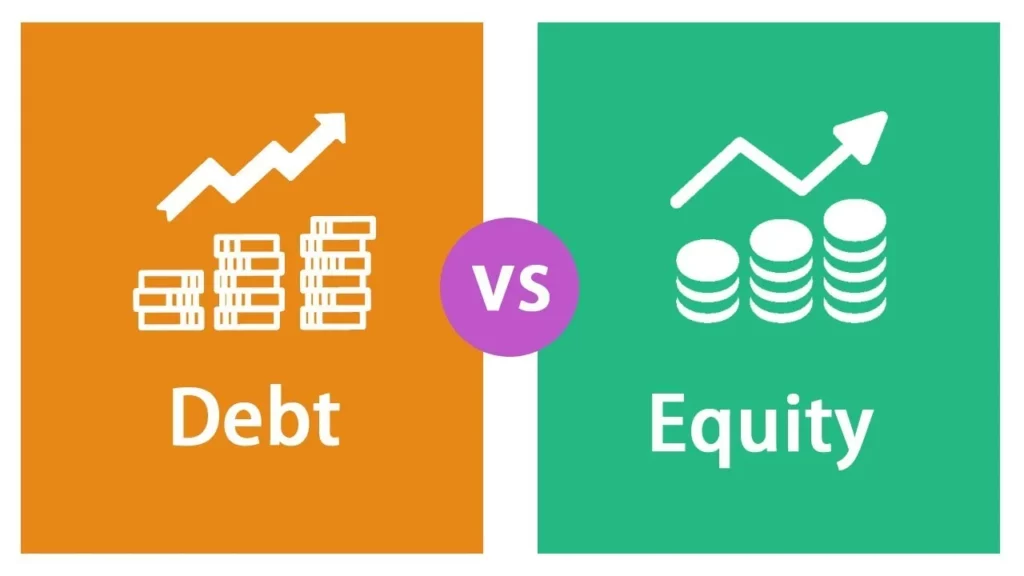
Difference between Debt and Equity Market?

The debt market and the stock market are the two main categories of investments in the overall investment environment. At the very endpoints of a very long curve, they are situated. Debts are the capital that a corporation has borrowed, whereas equity markets are made up of the capital that a firm has on hand. There are differences between the two in every aspect, including risk, rewards, fundamental structure, and motivation. No single investment product is suitable for everyone. Let’s look more closely at each idea to understand why, despite their clear distinctions, they can occasionally be related and have equal weight.

How do Equity Markets Work?

Equity markets are where shares or stocks of firms that are traded on stock exchanges are traded. Stock is a symbol for a company’s ownership stake. As a shareholder, you have a portion of the business. The shareholder who owns 50% or more of the voting stock owns the company.


Debt markets are less riskier than equity markets in terms of return. Listed shares can be purchased and sold every day during market hours. Their financial success is uncertain. Dividend payments and market resale of your investment at a greater markup are two ways to record earnings.

They are quite irregular, and the figures depend on a variety of factors, including supply and demand, a company’s financial standing, sector success, quarterly results, and more.

There, returns are likewise erratic. If kept for a longer period of time, stocks can produce returns of more than 10–12% over a period of 7–10 years.

The quantity of research required differs slightly between the debt and stock markets. A stock market investment requires a great deal of reading and study on the part of the investor. The financial accounts, balance sheets, management, and general financial status of the organisation must all be carefully examined.

Who can invest in equity markets? 

Here are a few brief suggestions to assist you in understanding the characteristics needed to engage in stock markets:

  • increased risk profile
  • More money is needed to counteract volatility.
  • perseverance to stay invested and to tolerate market turbulence
  • Time to investigate and analyse the businesses
  • Be patient as returns grow and stabilise because they can go quite high but can also fluctuate.

How do debt markets work?

Definition of debt: A type of debt is a capital that is borrowed, whereas a type of equity is a capital that is owned. The federal or state governments raise money from the market by issuing bonds or other types of government securities. In reality, the government is taking out a loan from you and will pay you back over time with interest. The principal is refunded upon maturity. A firm can do something similar by providing debt market securities like corporate bonds in order to raise funds from the market. The debt market consists of government and corporate bonds.

Equity is a sort of capital that is owned, whereas debt is a type of money that is borrowed. The federal or state governments raise money from the market by issuing bonds or other types of government securities. In reality, the government is taking out a loan from you and will pay you back over time with interest. The principal is refunded upon maturity. A firm can do something similar by providing debt market securities like corporate bonds in order to raise funds from the market. The debt market consists of government and corporate bonds.

Bonds need less study than other forms of assets, on average. Less factors, especially if you don’t frequently purchase and sell bonds like you would with stocks, affect the interest rate you get for the money you lend out.

Who can invest in debt markets?

Before choosing whether or not to invest in debt markets, keep the following in mind:

  • Investors that are cautious
  • Investors seeking a return that is assured
  • If you want to park your money and leave it there without worrying about it, or if you don’t want to spend a lot of time investigating

How are the investors prioritised in the debt and equity market?

Investors from the two markets are not competing fairly when they are combined since they are given various degrees of priority. Bondholders are given priority in the case of a company’s default and forced liquidation, which is a key difference between the debt and stock markets. In all cases of default, across all industries, creditors are paid off first; in this instance, it is the bondholders. Business owners, such as stockholders, are prioritised last.

Equity markets and debt markets differ from one another

Sr. No.Equity MarketDebt Market
1)MeaningEquities are owned capital.Debt is a form of borrowed capital.
2)Who can issueCompanies registered with SebiCompanies, governments
3)RiskHigh riskLow-risk because government-backed however corporate bonds are risky
4)ReturnsVolatileModerate
5)Investor statusShareholders, part owners in the companyCreditors to the company/government
6)Nature of returnDividends or profit booking while trading in the stock marketinterest paid by the bond issuer
7)RegulatorSebiRBI and Sebi in case of corporate bonds

How might one make investments in the two markets?

When it comes to how you approach these two markets, the debt market and the stock market are very similar. Despite the fact that both of them can be approached directly or through mutual funds, there may be a few minor distinctions.

Equity markets: There are two methods for getting access to them.

  • Direct investment: You can invest directly in equities by purchasing the individual stocks listed on stock exchanges. With this strategy, you’ll need to find out more information on the particular companies you wish to invest in. Choose the top-performing companies with a bright future after determining which industry best suits your investing style.
  • Mutual funds are collective investment vehicles that combine investor capital and invest it in stocks. You can invest in mutual funds. In this instance, you won’t be directly participating in the investment process. The stock chosen for investment will be chosen by the fund manager. You will be charged a fee for the fund manager’s services in addition to any other fees that may be imposed.

Investing in debt markets can be done in two different ways.

  • Direct investment is possible with corporate bonds through a private placement with the issuing business. The RBI, which is in charge of controlling them, organises auctions for the selling of government bonds. There are two ways to participate in these auctions:
  • Competitive bidding: Due to the process’ intricacy, larger investors—such as banks, mutual fund firms, and other commercial enterprises—participate through this method.
  • Non-competitive bidding: This is a simplified approach for private investors including high net worth individuals (HNI), retail investors, and the like. This can be done through online platforms. The National Stock Exchange (NSE) enables smaller investors to invest directly in government securities through the NSE goBid app.
  • Mutual funds: This is a dishonest strategy. The mutual fund industry functions the same whether equities or debt funds are utilised. The right government securities for investment will be chosen by a fund manager. Using debt or hybrid mutual funds is a covert strategy to keep a stake in the debt markets.

FOR MORE INFO CLICK THIS SITE:https://learningsharks.in/

FOLLOW OUR PAGE:https://www.instagram.com/learningsharks/?hl=en
How to Invest in Share Market?

Investing in the stock market can be difficult, especially for beginners. Because customers can choose to invest in shares through a variety of digital channels, investing is now hassle-free.

If you are unfamiliar with the process, you may find detailed instructions on how to invest in the stock market online here.

We can assist if you’re unsure about how to invest online in the Indian stock market.

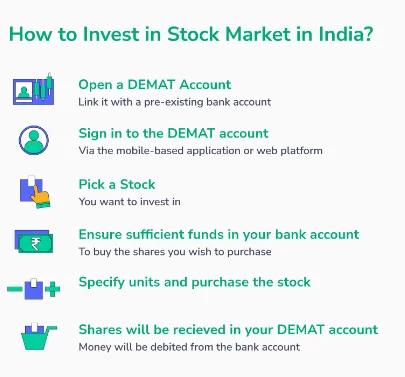
The following steps must be taken in order to effortlessly buy stocks from the comfort of your home:

Step 1: Create a DEMAT account and link it to an active bank account to enable easy transactions.
Step 2: Log into your DEMAT account via the web platform or the mobile application.
Step 3: Pick a stock you want to invest in.
Step 4: Verify that you have sufficient funds in your bank account to purchase the shares you choose.
Step 5: Decide how many units you wish to purchase and buy the stock at the specified price.
Step 6: After a seller accepts your purchase order, it will be executed. After the transaction is finished, the required amount will be deducted from your bank account. The shares will appear in your DEMAT account simultaneously.

Factors To Consider Before Making Stock Market Investment

Investment Purpose

If you’re wondering How to Start Investing in the Stock Market in India or any other investing option, you must first identify what your financial goals are. The goal of investing fluctuates and is dependent on the investor.

You must therefore choose stocks after taking your financial goals into account. Decide on your investment horizon before you invest.

Risk-Taking Skills

When investing in shares, it’s important to take your risk tolerance into mind. Defensive shares, which provide constant returns and are less impacted by market volatility, may be an option for low-risk investors to consider.

Diversification

By building a diversified portfolio, you can lower your risks. In other words, the more equitably your investment is spread throughout several industries, the lesser the financial risk will be.

When investing in stocks, you might consider one of two markets.

Conclusion

By registering a DEMAT account with the broker of your choice and following the steps indicated above, you can now invest in the Indian stock market online. For better outcomes, keep in mind the several important factors while choosing the companies to include in your portfolio.

FOR MORE INFO CLICK THIS SITE:https://learningsharks.in/

FOLLOW OUR PAGE:https://www.instagram.com/learningsharks/?hl=en
The Benefits of Investing in the Stock Market

People are turning away from more traditional investment choices like fixed deposits, regular deposits, etc. in favor of the stock market since investing in stocks can be a good strategy to beat inflation. A few benefits of stock market investing include increased returns on your investment, wealth accumulation over time, accomplishing long-term goals, portfolio diversification, and reduced risk. In this post, we will learn about the advantages of the stock market, things to think about while buying shares, and motivations to buy stock.

This article covers: 

  • Why invest in stock market?
  • Benefits of investing in stock market
  • Things to keep in mind while investing in the stock market

Why invest in stock market?

The stock market is a crucial part of the Indian economy. It gives investors the chance to profit from changes in stock prices. It’s a great opportunity to explore different businesses while staying safe. You can make money by selling your shares for more than you bought for them.

There are numerous justifications for stock market investment. Some people believe that the stock market will always rise, therefore they wish to put some of their money there. Some people only enjoy the idea of making money through investing without having to worry about equities.

Whatever your reason, investing in the stock market is a great opportunity to put your money to work and make some additional cash. You can start with mutual funds like debt funds, multi-cap funds, and index funds if you are just beginning to invest in equities and have a basic understanding of the stock market. But if you’ve been investing in stocks for a while, you may create your own portfolio by doing careful study.

Key takeaways: 

  • Owning stock in a business entails making an investment in its future by devoting resources with the expectation of a return.
  • When you own shares in a firm, you hold a percentage of its ownership.
  • Investing in the stock market might result in very large returns over the long run.

Benefits of investing in stock market

There are many reasons why you invest in stock market: 

1. Earning Returns On Your Investment

One of the key benefits of investing in the stock market is the ability to earn returns on your investment. This indicates that you will make money as time goes on and the value of the stocks or investments you own increases. You can raise your income by buying stocks that offer dividends. By investing in dividend equities, you can gain from both capital appreciation and dividend income.

In addition, stock investments have the potential to provide substantially larger returns than other investment choices like bonds or savings accounts. This is because having shares gives you an interest in a company’s future success.

2. Building Wealth Over Time

Another benefit of investing in the stock market is that your wealth might grow gradually. This indicates that buying stocks or other securities will increase the value of your holdings. Over time, this can lead to large financial savings and enhanced financial security. As a result, it helps you reach your goals, including retirement, children’s education, home construction, etc.

3. Diversifying Your Portfolio

One of the key benefits of stock market investment is the possibility of diversifying your portfolio. Consequently, a variety of securities, including stocks, bonds, gold, real estate, and many others, are likely to make up your portfolio. Even if some of them might be more volatile than others, each of these will offer a unique potential payoff.

By diversifying your assets, you can reduce the risk associated with individual investments in your portfolio and increase the possibility that your entire investment will make a profit.

4. Liquidity

Because it makes buying and selling stocks relatively simple, liquidity is essential. When a stock’s market is liquid, which means there are numerous buyers and sellers, it is easy to find a willing buyer or seller when you wish to purchase or sell that stock. Real estate, on the other hand, may take longer to sell because there aren’t as many buyers and sellers interested in it.

However, it’s important to remember that market conditions might affect liquidity. During times of market or economic volatility, the liquidity of the stock market may decline, making it more difficult to acquire or sell equities.

5. Flexibility

One of the benefits of stock market investing is the chance to begin with small deposits and progressively build up your portfolio over time. Because they usually have more opportunity for expansion and the possibility for higher returns, small-cap or mid-cap companies may be a suitable location to start investing.

You also have the choice to invest directly in equities rather than through a mutual fund or another investment vehicle, which have minimal investment requirements. This enables you to make smaller, more frequent investments if you don’t have a large sum of money to put at once or wish to invest in a method that is more flexible and adjustable.

Things to keep in mind while investing in the stock market

Even though investing in the stock market can be unpredictable and risky, there are a few things to bear in mind to make sure your money is secure:

  1. Do your research

Make sure you have done your homework and comprehend the business model and prospects of the company before investing in any stock. You should also review the financial statements, financial ratios, cash flow, management, etc. of the company. The company’s annual report contains all of this information.

  1. Don’t time the market

It’s important to avoid becoming overly invested emotionally in the stock market because it can be challenging to predict how prices will evolve over time. Therefore, it is advised to implement the proper risk management plan to reduce losses.

  1. Diversify your portfolio

It’s crucial to spread your risk among various investment categories. You can diversify your portfolio, for instance, by purchasing various sector stocks with large, mid, and small-cap market caps. This way, even if the value of one kind of stock declines, your portfolio’s other stocks and assets will still have some value.

  1. Have a plan

It’s crucial to have a budget in place before investing in the stock market. By doing this, you can prevent yourself from making hasty decisions that might result in investment losses.

Conclusion

It is possible to increase your wealth over time by investing in stocks, but it’s also critical to understand that there is some risk involved and that the stock market can be volatile. As a result, when investing in stocks, it’s critical to do your research and come to a wise decision. A financial advisor should always be consulted before making any significant investment decisions, as well.

FOR MORE INFO CLICK THIS SITE:https://learningsharks.in/

FOLLOW OUR PAGE:https://www.instagram.com/learningsharks/?hl=en


What is Swing Trading in Stock Market?

Swing trading's potential for capturing intermediate-term price movements can lead to substantial profits, and the reduced stress compared to day trading is appealing to many.
Swing Trading

Swing trading is a type of trading method used on financial markets with the goal of capturing short- to medium-term price changes within a given trend. Swing trading entails maintaining holdings for a few days to a few weeks as opposed to day trading, which involves fast trades inside a single trading day. The objective is to profit from price swings that take place as an asset moves together with its general trend.

This is how swing trading functions:

  • Identification of Trends: Swing traders begin by spotting trends in the price changes of a specific item, like a stock, currency pair, or commodity. They search for assets that are trending either positively (bullish) or negatively (bearish) inside a larger market trend.
  • Entry Points: Swing traders search for advantageous entry points after identifying a trend. They frequently identify probable entry points by using technical analysis, which involves examining charts, indications, and patterns. Swing traders seek to place trades when they anticipate that the price of the asset will either reverse or maintain its current trend.
  • Holding Period: Unlike day traders, who sell off their positions at the end of each trading day, swing traders keep their positions for a few days to a few weeks.
  • Risk Control: In swing trading, effective risk control is essential. Stop-loss orders are used by traders to prevent losses and protect their capital. Swing traders are more vulnerable to overnight price fluctuations and news events than day traders since they maintain positions for a longer period of time.
  • Profit Targets: Based on their analysis and the anticipated price movement within the recognised trend, swing traders set profit targets. They close the deal to lock in profits once the asset’s price hits their target or starts to decline.
  • Analysis and Monitoring: During the duration of their holding period, swing traders continue to keep an eye on both their positions and the general market trends. This enables them to decide intelligently whether to modify their holdings or quit transactions early in the event that the trend shifts.

Both short-term and long-term trading are included in swing trading. It provides greater temporal flexibility while also having the ability to capture larger price changes than day trading. It still necessitates a thorough knowledge of technical analysis, market movements, and risk management.

Swing trading is a risky form of trading, and not every deal will turn a profit. Swing traders should thoroughly research the strategy, practise on practise accounts, and create a trading strategy that includes entry and exit rules, risk management guidelines, and profit targets.

How They Work in Stock Market?

Swing trading includes profiting from short- to medium-term changes in stock prices on the stock market. Here is how swing trading functions in the stock market:

  • Trend Recognition: Swing traders start by recognising trends in the price development of the asset. They search for stocks that are experiencing an uptrend (bullish) or a downtrend (bearish). Various technical indicators, chart patterns, and trendlines may be used in this research to comprehend the stock’s trajectory.
  • Swing traders look for advantageous entry points once a trend has been detected. These are times when the stock’s price is most likely to briefly retreat or reverse course within the larger trend. Technical tools that traders may employ include moving averages, support and resistance levels, and candlestick patterns.
  • Position Holding: Swing traders hold their holdings for a few days to many weeks, as opposed to day traders, who close their positions by the end of the trading day. By doing so, they can profit from price changes that last longer than a day.
  • Risk management: To safeguard their capital, swing traders employ risk management techniques. In order to limit potential losses, they establish stop-loss orders, which are specified price levels at which they will abandon the trade. These orders are intended to shield traders against substantial losses in the event that the stock price fluctuates contrary to their predictions.
  • Profit Targets: Based on their estimate of the anticipated price movement of the company, swing traders also create profit targets. When the stock reaches a predefined level that is consistent with their desired level of profit, they want to close the trade.
  • Swing traders keep an eye on the price development of the stock and the state of the market as a whole throughout the holding time. In the event that the trend changes, they can use this information to decide whether to modify their holdings, alter their stop-loss orders, or close the trade out early.
  • Swing traders are subject to overnight risk because they maintain holdings for several days. When the market is closed, the stock price may be affected by news that could move the market, earnings reports, or other events. This could result in price gaps when the market reopens.
  • Swing trading demands less time and continual monitoring during trading hours than day trading does. This makes it appropriate for those who are unable to commit to a full day of trading.
  • Diversification: Swing traders frequently hold many positions open at once, enabling them to spread their portfolio among various companies and sectors.
  • Flexibility: Swing trading allows traders to earn from both rising and falling stock prices by being adaptable to various market conditions.

In conclusion, stock market swing trading entails spotting trends, picking entry and exit opportunities, and holding positions for a few days to a few weeks. A thorough understanding of technical analysis, risk management, and market dynamics is necessary for this strategy. Swing trading has dangers, just like any other trading strategy, therefore investors should carefully examine their risk tolerance and financial objectives before using this strategy.

Advantages and Disadvantages of Swing Trading

Advantages:

  1. Potential for Gains: Compared to day trading, swing trading tries to catch intermediate-term market fluctuations, which may provide traders with the opportunity to profit from more significant price swings.
  2. Reduced Stress: Because traders don’t have to keep an eye on the markets constantly during the trading day, swing trading is less stressful than day trading.
  3. Flexibility: Swing traders are able to adapt their trading strategies to various market conditions and profit from both price increases and decreases.
  4. Less Time Consumption: Swing trading takes less time commitment than day trading, making it appropriate for people with other obligations.
  5. Opportunities that come from after-hours news or events are presented to swing traders who hold positions overnight, potentially resulting in profitable price gaps.
  6. Diversification: To spread their risk and diversify their portfolio, swing traders can have many positions in various companies, sectors, or industries.

Disadvantages:

  1. Swing traders are exposed to overnight risk when they hold positions overnight since market-moving news can result in large price gaps when the market reopens.
  2. Less Direct Feedback: Because swing traders hold positions for lengthier periods of time, they don’t get direct feedback on their transactions. This may make it more difficult for them to swiftly adjust their strategy.
  3. Transaction costs, like as commissions and spreads, might still result from frequent trading and have an impact on overall profitability.
  4. Swing trading still involves emotional control to handle market volatility and hold positions in accordance with the trading plan, although being less demanding than day trading.
  5. Uncertain Trends: It can be difficult to precisely identify trends, and market instability can result in false breakouts or reversals, costing investors money.
  6. Swing traders may overlook intraday opportunities for rapid gains that day traders are positioned to take advantage of.
  7. Limited to Trends: Trending markets are best for swing trading. Finding trustworthy trends can be more challenging in markets that are turbulent or sideways.
  8. While there are overnight chances, negative news stories can also cause unforeseen losses or gaps that have an influence on swing traders’ positions.
  9. Knowledge and Analysis: To identify entry and exit positions correctly, swing traders need a solid grasp of technical analysis, chart patterns, and indicators.
  10. Psychological difficulties: Managing positions for numerous days to weeks can be difficult for traders’ patience and self-control, particularly when trends develop slowly or abruptly change.

Conclusion

Swing trading is a balanced strategy in the world of trading methods, to sum up. It provides a compromise between long-term investing’s more patient approach and day trading’s quick pace. Before starting a swing trading adventure, traders should take into account the approach’s specific benefits and drawbacks.

Swing trading appeals to many since it has less stress than day trading and the ability to benefit significantly from intermediate-term price swings. A realistic alternative for traders to participate in the market without constant monitoring is provided by the flexibility to respond to different market situations and a more reasonable time commitment.

Swing trading does provide some difficulties, though. Because of the possible consequences of unexpected news or occurrences, overnight risk is a serious worry. Making informed selections requires accurate trend detection and solid technical analysis skills. Swing trading success also depends on controlling one’s emotions, following one’s trading strategy, and dealing with the psychological effects of holding positions for days or weeks.

Swing trading’s suitability as a method ultimately depends on a person’s risk tolerance, time constraints, skill level, and financial objectives. It needs commitment to learning, practise, and the creation of a well-structured trading plan that includes risk management and reasonable profit expectations, just like any other trading strategy.

CHECK OUT OUT LATEST STOCK MARKET COURSES: https://learningsharks.in/share-stock-trading-courses-online/

FOLLOW OUR PAGE: https://www.instagram.com/learningsharks/

What is Rollover in Stock Market?

Regulatory Oversight: Central banks usually have regulatory authority or collaborate closely with regulatory organizations to ensure the proper operation and integrity of financial markets. They create and uphold rules and laws to promote transparency, stop market manipulation, and protect investor interests.

The stock market has many different and significant roles for central banks. Central banks have an effect on the stock market through their monetary policy decisions, which include setting interest rates. Changes in interest rates may have an effect on how much it costs for individuals and businesses to borrow money, which may have an impact on investment decisions and stock market activity.

Traders may choose to engage in rollover activity if they think that carrying their positions forward to the next series of a contract and another expiration date will increase their profits. When traders have knowledge of the industry they deal in, they may choose for rollovers.

A rollover means carrying forward your future positions from closing your positions near the expiry date to opening the same new position in a further-out month contract.
Rollover in Stock Market

The Rollover in the Stock Market – How it Works

How does the stock market’s rollover mechanism work? A better question would be, “How and when do rollovers occur?” Now that you understand what a rollover is, you should be able to answer all of these questions clearly.

In India’s stock markets, equity derivatives have an expiry date that corresponds to the last Thursday of each month. As a result, a rollover can occur until the end of a trading session on that particular day. The majority of rollovers occur at least a week before the expiry date of a futures contract and continue until the last moment of the expiry date. These contracts are then “rolled over” to the following month.

How Does a Rollover Work in India?

In India, contract settlement takes place on the last Thursday of every month. In the event that Wednesday is a holiday, contract settlement occurs on Thursday. A portion of the rollover starts one week before the expiry, and it is finished up until the conclusion of trading on the expiry day. Through a spread window on the trading terminal, the rollover process is executed.

Anyone owning a one-month futures contract has the option of extending their position to the next month. In order to accomplish this, the investor must input the spread at which he or she wants to roll over the investment for the following month.

How are Contracts Rolled Over and Work in India?

The final Thursday of the month—or the day before, on Wednesday, if Thursday falls on a holiday—is when stock derivatives contracts in India are decided and settled. Rollovers start a week before the expiry date and continue until the close of business that day.

Positions, on the other hand, are rolled over to the next month on the trading terminal via a spread window. For example, if a trader owns one Nifty futures contract that is about to expire in May, he would enter to carry forward this position to May by entering the spread at which he wants to roll over the positions to June. Previously, it was a two-step process, but this spread window has made it easier for all Indian traders to rollover.

How to Interpret in Rollovers?

Typically, rollover is expressed as a percentage of total positions. There are no specific rollover benchmarks.
They are, however, compared using historical data, primarily the trailing three-month average.


Rollover, in general, is an indicator of traders’ willingness to carry forward their bets on the market. However, the figures will not reveal which way traders are betting.
On several occasions, lower-than-average rollovers indicate uncertainty, whereas higher rollovers indicate intense market sentiment.


If the rollover in future Nifty starts from May series to June is 70% and the three-month average is 65%, it means that all traders are willing to build more positions and are confident in their market views.

Rollover trends, though, can occasionally go in the wrong direction.
For instance, a rollover of 70% might have happened at a lower open interest, or the total number of open positions.
While with a greater open interest base, rolls would have happened on average at 65%.

How to Access Rollover data?

Several exchange websites do not properly reflect rollovers, in contrast to trading data. Instead, many analysts simply calculate and aggregate vast volumes of trading data to represent rollovers.

Are Rollover possible in option?

Only the future offers rollovers; options do not. This is because, unlike options, which may or may not be executed, futures must be settled at the expiration date.
This does not, however, eliminate the possibility of other choices. Some traders use multiple variations in the implied volatility (IV) of options with comparable expirations to support their rollover theory.
Strong bullish rollovers and elevated implied volatility point to a fervently optimistic mood.

FOR MORE INFO CLICK THIS SITE:https://learningsharks.in/

FOLLOW OUR PAGE:https://www.instagram.com/learningsharks/?hl=en

What is Day Trading in Stock Market?

Day traders often make multiple trades throughout the day, capitalizing on small price fluctuations.
Day Trading

Buying and selling securities, such as stocks, currencies, or commodities, during the same trading day is known as day trading in the financial markets. In day trading, investors seek to profit from these instruments’ transient price changes. This indicates that they don’t keep any positions overnight, but rather open and close them throughout a single trading day.

Day traders frequently place many transactions throughout the day to profit from slight price changes. To find probable entry and exit points for their trades, they rely on technical analysis, charts, and patterns. Understanding market trends, price patterns, and market indicators is essential for day trading.

It’s crucial to remember that day trading can be extremely dangerous and difficult. This strategy’s rapid pace can result in big gains, but it also puts traders at risk of sizeable losses. Day traders must act quickly, closely monitor their holdings, and efficiently manage risk because of the short time period at play.

Each nation and financial market may have its own rules and criteria for day trading. Some markets might have requirements for minimum account balances, trade frequency, and other things that traders must follow. Before engaging in this sort of trading, it is advised that those who are interested in day trading thoroughly educate themselves, practise with virtual accounts before spending real money, and take into account the potential hazards.

How they Work in Stock Market?

Day traders in the stock market concentrate on purchasing and selling equities during the same trading day in order to profit from swift price changes. Here is how they usually operate:

  • Day traders start their days by doing research on and analysing equities. To find probable entry and exit points for their trades, they may employ technical analysis, which involves examining price charts, patterns, and indicators. They may also consider the results of fundamental analysis, which evaluates a company’s financial standing and current affairs.
  • Setting Up Trading Plans: Day traders frequently lay out their trading strategies for the day before the market begins. They select the stocks to trade, as well as their entry and exit locations, profit targets, and stop-loss prices (the price at which they will sell to limit losses).
  • Execution: Day traders keep a careful eye on the stocks on their watchlist as soon as the market opens. They keep an eye out for possibilities that meet their pre-set criteria, such as particular price patterns or signs that concur with their analysis. They carry out their trades when the necessary conditions are met.
  • Quick Trades: Day traders often only maintain positions for a few minutes or hours. They seek to profit from daily price fluctuations, which can be impacted by news, market mood, and other variables. They leave the position as soon as they make the anticipated profit or as the trade turns against them.
  • Risk management: For day traders, effective risk management is essential. To prevent any losses on a trade, they place stop-loss orders. A single bad trade doesn’t have a substantial influence on their whole portfolio because they make several trades each day.
  • Due to their frequent trades and the necessity to meet brokerage houses’ margin requirements, day traders frequently need a sizeable amount of capital. In order to trade larger positions, traders can borrow money using margin. Losses are also more likely as a result, though.
  • Technology and Tools: Trading platforms, software, and tools that offer real-time data, charts, and market insights are heavily used by day traders. For swift transaction execution, fast and dependable internet connections are also necessary.
  • Day traders keep a close eye on both their positions and the market as a whole during the trading day. They keep up with news and happenings that can affect their trading.
  • Emotional Control: Day trading requires a high level of emotional control. The market’s rapid pace might cause hasty decisions that are motivated by greed or fear. Successful day traders follow their trading strategy and refrain from acting on impulse.
  • Position closure: At the conclusion of the trading day, day traders terminate all open positions, minimising the risks involved in keeping holdings overnight. This reduces exposure to overnight news events and after-hours market swings.

Advantages and Disadvantages of Day Trading

Advantages:

  1. High Profit Potential: Day traders look to profit from quick changes in price, which might lead to them making big gains in a single trading day.
  2. Rapid Results: Day trading gives traders rapid feedback on their trades, enabling them to view the outcomes of their choices the same day.
  3. No Overnight Risk: Day traders settle their positions by the close of business, minimising the chance that bad news or other events will have an impact on their positions while the market is closed.
  4. Greater Control: Day traders have complete control over their deals and are able to act quickly to take advantage of intraday chances.
  5. Utilisation of Leverage: Some day traders boost their trading positions by using leverage (loan money), which could increase their profits. But the risk is also raised by this.
  6. Variety of Markets: Day traders can diversify their trading by trading a range of financial products, such as stocks, FX, commodities, and cryptocurrencies.

Disadvantages:

  1. High danger: Day traders face a lot of danger because of how quickly the market moves. Rapid price changes can produce large losses in a short period of time.
  2. Decision-making can be impacted by emotional stress, which is brought on by the strain of making quick judgements and managing positions throughout the day.
  3. High Costs: Frequent trading can lead to significant spreads, commission fees, and other transaction costs, which can eat away at earnings.
  4. Time-consuming: Continuous market monitoring is necessary for successful day trading, which may be tough and time-consuming.
  5. Lack of Long-Term Perspective: Day traders may overlook longer-term investing opportunities because they only pay attention to short-term price changes.
  6. Lack of Consistency: It might be difficult to make consistent gains in day trading. Many traders go through times of volatility or loss, which can reduce gains.
  7. Regulatory Restrictions: Day traders may be subject to regulatory limitations or minimum capital requirements for day trading, depending on the country.
  8. Competition: Day traders go off against experts, algorithms, and other seasoned market participants in this extremely competitive sector.
  9. There may not be enough time for in-depth research and learning due to the fast-paced nature of day trading, which might affect decision-making.
  10. Potential for Burnout: Day traders may eventually become exhausted due to the rigorous nature of the job, particularly if they don’t take breaks or deal with stress well.

Overall, day trading entails considerable risks and difficulties but has the potential to be financially rewarding for dedicated and talented traders. A thorough understanding of the markets, technical analysis, risk management, and emotional restraint are necessary for day trading success. Before committing to this trading strategy, ambitious day traders must fully educate themselves, practise on practise accounts, and take their risk tolerance into account.

Conclusion

In conclusion, day trading is a dynamic and quick-paced method of trading that entails purchasing and disposing of financial assets during the same trading day in order to profit from swift price changes. It has certain benefits, such as the opportunity for quick gains, immediate outcomes, and the avoidance of overnight hazards, but it also has some significant drawbacks.

It is impossible to overstate the tremendous level of risk involved with day trading. Rapid price changes can result in significant losses, and the mental strain of having to make split-second choices and manage holdings can be debilitating. Overall profitability may also be affected by the expenses associated with frequent trading and the time-consuming nature of market monitoring.

A thorough understanding of technical analysis, market patterns, and risk management techniques is necessary for day trading. Traders need to have emotional restraint and the flexibility to change their trading strategies when the market conditions do. Its intricacy is further increased by regulatory restrictions as well as the competitive nature of day trading.

Future day traders should approach this type of trading cautiously and with careful planning. The creation of a clear trading plan, practise, and education are essential. While some people may be successful at day trading, it’s crucial to balance the rewards against the considerable risks. Making wise selections and being aware of the difficulties will ultimately be crucial to successfully navigating the world of day trading.

CHECK OUT OUT LATEST STOCK MARKET COURSES: https://learningsharks.in/share-stock-trading-courses-online/

FOLLOW OUR PAGE: https://www.instagram.com/learningsharks/