Learning sharks-Share Market Institute


Rajouri Garden  8595071711 7982037049  Noida 8920210950 , and  Paschim Vihar  7827445731  

Fee revision notice effective 1st Jan 2026; No change for students enrolled before 15th Jan 2026

Download “Key features of Budget 2024-2025here

The two primary, unlawful arguments that finfluencers have against becoming SEBI-registered RAs, according to MC

If these organizations don’t register themselves, there are thousands of dollars to be made off of retail investors.

Using illiquid stock options with big lot sizes is the secret to success.

The Securities and Exchange Board of India (SEBI), the market regulator, has received many justifications for why finfluencers, or financial influencers, do not want to be registered as research analysts (RAs). Among these justifications are the limitations on trading stocks they have recommended and, consequently, live trading.

The market regulator may at any moment request information about a registered RA’s trades. This is done to make sure the analyst isn’t engaging in any trading that is against the law (such purchasing a security before 30 days and after five days after their recommendation, for example), according to a RA filed with SEBI.

What then are these instruments?

Both front-running and a pump-and-dump plan include the use of illiquid or just moderately liquid stock options.Because profits are only realized when the price of the security may be moved, even by a few rupees, they use illiquid options. It is challenging to adjust the price if they are very liquid.

Telegram or any other social media platform is used in the pump-and-dump strategy. A Telegram channel may have up to 10,000+ subscribers with ease. Let’s say an option trades for about Rs 20. The finfluencer or his/her partner may purchase a number of them before placing a call on the channel to purchase them for Rs 21. The finfluencer will then earn Rs 10,000 (10×1,1000xRe 1) from just one subscriber if they sell 10 lots of 1,000 shares each. A day’s profit of Rs 1 lakh can easily be made if 10 of the 10,000 subscribers choose to heed the finfluencer’s recommendations. That is from just one Telegram channel; there are typically at least two or three active ones.

Selling spoiled fruit

The second racket involves handling money. On their social media platforms, many finfluencers promote their rags-to-riches tale in an effort to attract followers for their illicit money-management business.

They use the client’s trading account information to execute trades on the client’s behalf when managing the client’s money.

They purchase an illiquid stock option from the customer’s account and sell it for a price over the market price in order to profit from the client. The client’s account is where the loss was incurred.

The customer is left holding the illiquid option while the influencer claims it was an honest error, and they square off their position by purchasing the option at the reduced market value.

Similar to a pump-and-dump scheme, if a client is sold merely 10 lots with 2,000 lot sizes at a profit of Re 1, the client may not feel the pinch of Rs 20,000 very much. However, the finfluencer can earn Rs 1 lakh per day if they achieve so with just five clients, according to an insider.

Using huge lot sizes of illiquid stock options is the key to the success of both strategies.

Littler fraud

There is also, albeit to a lesser level, a tax evasion scheme. This is only a small portion of the business since it requires a lot of talent, a larger network, and the willingness to accept the greater risks associated with tax fraud against the government. The current tax scam operates as follows.

Consider a scenario in which you earned Rs 50 lakh through trading while finfluencer A lost Rs 50 lakh. Through a loss-making transaction, you can ‘transfer’ your profit to the influencer and evade taxes. As a result, both you and the influencer are in net loss (because the influencer’s initial Rs. 50 lakh loss cancels out the profit you transferred and you have no taxes to pay).

How do I transmit this?

You ask the influencer to sell an option that is very far out of the money at a price that is far more than its market price. You might urge the influencer to sell the option for Rs 25 if it is already selling at Rs 5, for instance. There won’t be any other buyer because it is so much higher than the market price. After purchasing this option, you quickly sell it back to the influencer for, say, Rs 5 less. Overall, the influencer has earned Rs 20 and you have lost the same amount.

250 contracts, each with a 1,000-lot size, would require a transfer of Rs. 50 lakh (250 x 1,000 x Rs. 20).

The influencer then transfers the money back to you via a hawala transaction or a company established up in a tax haven like Dubai. Since there are no restrictions on transferring money between different offices of the same business, the influencer will establish an office in the other country and send money there.

FOR MORE INFO CLICK THIS SITE:https://learningsharks.in/

FOLLOW OUR PAGE:https://www.instagram.com/learningsharks/?hl=en

FacebookTwitterEmailWhatsAppTelegramShare

Best Indian Stock Market Instagram Accounts You Should Follow

We have put together a list of the top 10 Indian stock market Instagram accounts for you to follow in order to receive daily information on the market because Instagram has grown to be one of the greatest social engagement channels for you. These accounts not only give you information on the news and what’s happening in the stock market, but they also give you some of the trading tactics they employ. Some of these accounts also teach you the vocabulary and techniques for trading on the Indian Stock Market. You can obtain a wealth of information from these accounts with the latest introduction of Muhurat Trading.

List of 10 Best Indian Stock Market Instagram Accounts

  • Above.Stocks
  • Stockmarket_Times
  • StockMarketBulls_
  • Investywise
  • InvestMentorStocks
  • __Moneyway__
  • Finventure.in
  • Index.daily
  • TraderDost
  • TheStockMarketLive

Above.Stocks

One of the newest Indian stock market Instagram accounts is Above Stocks, which you should follow if you want to learn everything there is to know about the Indian stock market. It has a team set up specifically for research that offers helpful advice. Additionally, Above Stocks has an application where you can access daily tips, stock market news, IPO updates, and much more. Daily analysis of the Nifty and the Indian Stock Market is also provided. Additionally, they provide recommendations in their Telegram channel, which you may join to get cost-free access to premium updates. Above Stocks is committed to consistently giving its audience the greatest information it can get in every way.

Stockmarket_Times

One of the top Indian stock market Instagram accounts is Stock Market Times, which offers stock market news, statistics, quotations from role models, obviously memes, and much more. It is safe to say that a person will like and understand the information much easier than from any other source if it is presented in a graphical fashion and has humor.

Additionally, they offer advice on a variety of stock market and news-related topics. If you’re interested in learning about the ups and downs of the Indian stock market, you should follow this page.

StockMarketBulls_

StockMarketBulls_ is an Instagram account you should follow for financial advise, as the name suggests. It gives you information about important companies that you should keep an eye on and keeps you informed about market updates. Additionally, they provide information on which parent firm owns which specific companies. These are some of the facts you should be aware of while considering to trade stocks.

Investywise

It’s nice that Investywise gives you the data in the form of a meme. They share the holdings of major investors, which may aid you in expanding your holdings and keeping abreast of market conditions. Additionally, they publish a number of quotes from influential investors in the sector, which encourages you to become involved and take a chance in the stock market. They categorize and distribute the best-performing stocks.

InvestMentorStocks

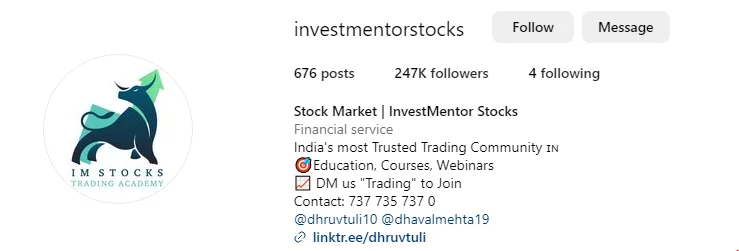
A popular Instagram account that teaches you how to trade on the stock market in India is InvestMentorStocks. On their website, you may purchase a variety of courses that might be quite beneficial. They offer signals, swing trading, and intraday trading. The business is also NSE-registered to offer stock market education.

__Moneyway__

One of the top Instagram accounts for the Indian stock market is Moneyway, which we recommend you follow. The Instagram page is very active and offers fascinating information about the businesses. Additionally, the account offers insightful information on impending IPOs, which you can use to decide whether to invest your hard-earned money in the company.

Finventure.in

Finventure.in is a website where you may get free stock market education. It gives you a piece of in-depth stats information and occasionally delivers astounding facts. It also performs stock analyses and distributes information on Instagram, making it one of the accounts to follow for the Indian stock market.

Index.daily

Index.daily is a developing Instagram account run by stock market influencers whose primary interests include investing and money. It continues to offer frequent updates on the infographics for each market sector, which may be quite useful for you to determine which stocks could be profitable. They possess a variety of statistical information, which is quite beneficial.

TraderDost

One of the top trading Instagram accounts where you can understand the fundamentals and latest developments of the stock market is TraderDost. Additionally, it demonstrates how to interpret a candlestick chart and do analysis using it. You will have an advantage over other traders if you have this knowledge and receive daily updates.

TheStockMarketLive

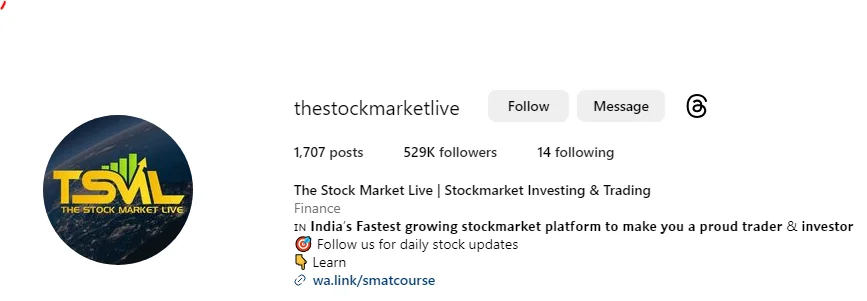
You must follow The Stock Market Live’s Instagram account. It offers fantastic insight with the benefit of learning as you go. This website explains all the technical terms in layman’s terms. Additionally, they give you information about the company’s background and its profile along with a thorough statistical report.

FOR MORE INFO CLICK THIS SITE:https://learningsharks.in/

FOLLOW OUR PAGE:https://www.instagram.com/learningsharks/?hl=en

What’s Open and What’s Closed at the G20 Summit in Delhi, September 8–10?

G20 Summit Delhi: If you are travelling to or from Delhi between September 8-10, here is everything you need to know on the restrictions and traffic

Unquestionably, the Group of 20 or G20 Leaders’ Summit, which will take place in New Delhi on September 9 and 10, is the most important international event that India has ever hosted. The Delhi government has announced a public holiday from September 8 to 10 in anticipation of the summit, which will be attended by luminaries including US President Joe Biden, British Prime Minister Rishi Sunak, and China’s Xi Jinping.

The G20 Summit will be place at the “Bharat Mandapam” in central Delhi’s Pragati Maidan. The Delhi Police has also prepared a full advise on traffic limitations and offered alternate routes for vehicular movement during the summit.

G20 Summit: What Will Be Closed In Delhi

  • Each and every public and private office
  • Institutions of higher learning, such as schools and colleges
  • Commercial banks and financial institutions: Supreme Court
  • Stores and businesses within the jurisdiction of the New Delhi Police District
  • Connaught Place, Khan Market, Malcha Marg, Shankar Market, Janpath, Mohan Singh Place, and Palika Bazaar
  • Licensed booze retailers inside the New Delhi Police District

G20 Summit: What Will Be Open In Delhi

  • NDMC-exclusive markets and malls
  • essential amenities like milk stands and pharmacies

G20 Summit: Will Delhi Metro Be Operational?

  • All metro lines and stations will run as usual. However, from 5 a.m. on September 9 to 11 p.m. on September 10, no boarding or deboarding will be allowed at the Supreme Court Metro Station.


G20 Summit: Will Buses, Autos, Taxis Be Available?

Buses

There won’t be any bus services available in the NDMC region or Lutyens’ Delhi, which will be under control. Buses will be permitted to run on the Ring Road and all other roads.

Buses from other states will be allowed to enter Delhi, but they must end their trips on the Ring Road. They won’t be able to make a stop at an interstate bus terminal.

Autos and Taxis

From 5 am on September 9 to 11.59 pm on September 10, three-seater vehicles, including taxis, will not be permitted to enter or operate in the New Delhi district. The use of taxis on the roads outside the New Delhi district would be permitted.

Taxis carrying genuine locals and visitors with hotel reservations in the New Delhi district area will be permitted, nonetheless. Visitors will need to present valid hotel reservations, and locals will need to present identification documents.

G20 Summit: What About Flights And Those Headed To Delhi Airport

According to Delhi Airport, 160 domestic flights were canceled in the capital city between September 8 and 10, according to ANI.

It has been suggested that travelers with flights on the aforementioned dates arrive at the airport early and take the Delhi Metro Airport Express Line for a smooth journey.

Delhi Police has suggested the following routes for people driving to the airport:

Rao Gajraj Singh Marg, Old Delhi Gurugram Road, UER II, Service Road, NH-48, and T3 Terminal Road are the routes from Gurugram to Terminal 3.

Rao Gajraj Singh Marg, Old Delhi Gurugram Road, UER II, Service Road NH-48, T3 Terminal Road, Service Road, NH-48, Sanjay T-Point, Ullan Batar Marg, Terminal are the routes from Gurugram to T1.

AIIMS Chowk, Ring Road, Moti Bagh Chowk, RTR Marg, Sanjay T-Point, Service Road NH-48, and T3 Terminal Road connect New Delhi and South Delhi to T3.

AIIMS Chowk, Ring Road, Moti Bagh Chowk, RTR Marg, Sanjay T-Point, Ullan Batar Marg, Terminal T1 are the routes from New Delhi and South Delhi.

The Delhi Traffic Police website now includes a comprehensive advise for drivers.

G20 Summit: Advisory For Railway Passengers

  • On September 10 between 5 am and 1 pm, there will be delays in the Ajmeri Gate side road traffic to the New Delhi Railway Station.
  • On September 10 from 5 am to 1 pm, trips to Old Delhi Railway Station from the Shyama Prasad Mukherjee (SPM) road side will be impacted.

G20 Summit: Other Key Things To Remember

  • Call 6828400604 for ambulance aid service.
  • To assist delegates and other visitors, a virtual support desk has been established.
  • Drones, hot air balloons, and paragliding are not permitted to fly in Delhi until September 12.
  • No goods vehicles would be permitted to enter Delhi, with the exception of those transporting vital commodities with authorisation.

FOR MORE INFO CLICK THIS SITE:https://learningsharks.in/

FOLLOW OUR PAGE:https://www.instagram.com/learningsharks/?hl=en

FacebookTwitterEmailWhatsAppTelegramShare

Finfluencers and brokerages are perplexed by the Sebi suggestion; experts respond to six queries

Many problems have been raised by the plan to limit the affiliation of regulated organizations with unregistered finfluencers. A person cannot be nominated as an authorized person by more than one brokerage, according to the present regulations.

Every time a registered influencer shares a referral link, the exchange will need to approve it, according to a compliance expert.

There is a lot of ambiguity surrounding the Securities and Exchange Board of India’s (Sebi) guidelines that limit registered intermediaries’ relationships with unregistered influencers.

A consultation paper that attempts to limit the affiliation of Sebi-registered intermediaries with unregistered firms, such as finfluencers, was released by Sebi on August 5.

While recommendations to empower investors have been made, the paper has generated a lot of issues among unregistered finfluencers and brokerages, particularly those regarding the type of registration necessary to maintain their affiliation.

With assistance from brokerage executives and compliance specialists, we have made an effort to address a few of them.

No, a finfluencer is not required to be registered as an investment advisor (IA) or research analyst (RA). Even as an authorized person (AP), he or she may be registered.

“Unregistered entities (including finfluencers) who wish to associate with broking firms should obtain prior approval from Sebi and register themselves as authorised persons,” said Tejas Khoday, co-founder and CEO of FYERS and member of the governing body of the Bombay Stock Exchange Brokers’ Forum (BBF). Additionally, they must adhere to all applicable provisions of the SEBI Act of 1992 and its implementing rules.

A Certificate of Registration from an exchange is required for all APs.

Can an influencer collaborate with multiple brokerages as an AP?

According to a compliance expert who wished to remain anonymous, even the existing regulations state that a person cannot be hired as an AP by more than one brokerage. The person cannot charge clients for anything; only this brokerage may pay the fee or commission. The AP enters into a contract with a stock brokerage that includes the scope of activity, commission-sharing, and termination clause, all in the manner required by the exchange. The activities of the AP will be held accountable to the stockbroker.

Are RAs and IAs permitted to advertise a service or product?

In certain circumstances, yes. Khoday of FYERS stated that “Registered advisers or analysts are allowed to promote any product or service that is related to their area of expertise and competence, subject to certain conditions and restrictions.”

“According to the Sebi consultation paper, they should avoid any conflicts of interest or bias and disclose their affiliations with the registered/regulated firms whose goods or services they are marketing. Additionally, they should abide by the relevant code of conduct and make sure that any promotion or commercial they run is truthful, accurate, and not deceptive.

What guidelines should APs’ promotional content follow?

According to Pravin Jadhav, founder of brokerage Dhan, an AP must follow by the advertising rule issued by the exchanges.

This comes from a discussion he started on Twitter to explain some of the changes.

The exchanges had published a revised advertising code for stock brokerages on February 2, 2023, which among other things clarified what would and would not be considered advertising, provided general rules to be followed with advertising, and detailed what commercials should and should not contain.

According to the compliance specialist who was originally quoted, even if the content supporting the referral link does not discuss the stock market, every instance of a registered influencer sharing a referral link will need to be approved by the exchange. To obtain permission, brokers must provide stock exchanges with information about the influencer and all of his or her social media accounts.

Will it mean the account-opening incentive program, which pays unregistered finfluencers for each new account, is coming to an end?

It won’t completely stop, but it will be significantly reduced. The proposed rules, in Khoday’s opinion, might not kill the program, but they might restrict the amount of money that can be made through it.

The consultation paper suggests that any collaboration between Sebi-registered intermediaries and regulated firms and unregistered parties (including finfluencers) for the purpose of promoting or advertising their goods or services must first receive prior Sebi clearance. Additionally, it suggests that Sebi set a limit on the amount of benefits or payments that unregistered businesses may obtain or pay for such a relationship.

What impact will it have on referral fees?

There are some contrasting views in play here. While some think it has been made clear that everyone will receive the same percentage of the brokerage fee as compensation, others think it has not.

In his Twitter thread, Dhan’s Jadhav stated that many finfluencers make thousands or even millions of dollars each month through affiliate and referral incomes.

Although brokers typically reward those who refer new clients 10% of the brokerage fee, they may give influencers a significantly higher amount. Jadhav claims that it is customary for finfluencers to receive more than 50% of the brokerage charge, and that the amount may even reach 70%.

This will end with the proposed regulations. There will be “no differential sharing via referral,” he added.

In other words, a person who brings in one client will receive the same proportion as a person who brings in ten.

Khoday claimed that the consultation paper was vague about whether or not the brokerage may be shared with unregistered organizations. “However, Sebi has suggested limited referrals from retail clients and payment of fees for such limited referrals,” he added.

FOR MORE INFO CLICK THIS SITE:https://learningsharks.in/

FOLLOW OUR PAGE:https://www.instagram.com/learningsharks/?hl=en

FacebookTwitterEmailWhatsAppTelegramShare

Vijay Kedia emphasizes the need for increased regulation and instruction in F&O trading for novice investors.

According to Vijay Kedia, the F&O sector needs some amount of regulation and education due to the increasing number of investors, or else it runs the risk of turning into a gambling den for individuals seeking quick money.

While the NSE, BSE, and SEBI are doing their part to educate investors, in Kedia’s opinion, much more can be done.

A certain amount of education and regulation are required due to the expanding number of investors in the F&O area or else it runs the risk of turning into a gambling den for people trying to make quick money, according to Kedia.

“Ninety percent of those involved believe they are playing an online game. Vijay Kedia even called for a ban on futures and options trading for new investors, claiming that no one has the intelligence, understanding, or resources to play the future option.

The market veteran compared it to a casino or playing poker on a mobile device and added, “This should be taken into consideration, this is high time, and it should be banned, otherwise the end result is bad.”

The market watchdog SEBI requested earlier this month that broking platforms notify users that over 90% of traders in the futures and options segment lose money. After COVID, India saw an increase in the number of retail investors, not just in SIPs but also in direct stocks and the Futures and Options (F&O) market. From 40.9 million in March 2020 to 123.5 million in July 2023, the total number of Demat accounts on the NSE has increased as of May 2023. The number of F&O contracts has also increased, from around 3 million in January 2020 to almost 8 billion in August 2023.

Kedia noted that having a technique that works in all markets is necessary since making money quickly using tactics like those that only work when the market is rising is frightening. “If something only works once, it’s a chance, not a strategy,” he declared.

In a tweet from four or five years ago, I advocated for the SEBI (Securities and Exchange Board of India) to outlaw new investors. You need a permission to drive a car, just like there is a legal drinking age, and vice versa, he claims.

Kedia acknowledged that SEBI might not be able to take harsh action. “In democracy, there is a formula that works similarly to how cigarettes and alcohol are sold but discouraged from consumption. Therefore, the only way to get ahead is to teach them the proper way to do things. For example, you must walk to the left, stop your car at the signal, and turn left if there is an ambulance so that they will let you pass. We utilize it on the market in the same way that we use it in everyday life, he continued.

While the NSE, BSE, and SEBI are doing their part to educate investors, in Kedia’s opinion, much more can be done.

FOR MORE INFO CLICK THIS SITE:https://learningsharks.in/

FOLLOW OUR PAGE:https://www.instagram.com/learningsharks/?hl=en

FacebookTwitterEmailWhatsAppTelegramShare

What Are Capital Markets ?

What Are Capital Markets?

Savings and investments are transferred between suppliers and those in need on capital markets. Suppliers, who can lend money or make investments, often comprise banks and investors. In this market, corporations, governments, and individuals are looking for capital. Primary and secondary markets make up capital markets. The stock market and the bond market are the two most popular capital markets. By connecting suppliers with people looking for money and providing a platform where they may trade securities, they aim to increase transactional efficiency.

Contrarian trading is an investment strategy employed in financial markets where traders and investors deliberately go against the prevailing market sentiment and trends.
Contrarian Trading

Understanding Capital Markets

The phrase “capital market” is a general one that refers to both physical and virtual locations where diverse entities trade various kinds of financial products. The stock market, bond market, currency and foreign exchange (forex) markets, among others, may be among these venues. Major financial cities like New York, London, Singapore, and Hong Kong are where the majority of markets are concentrated.

Suppliers and consumers of funds make up capital markets. Households, as well as organizations like pension and retirement funds, life insurance firms, charity foundations, and non-financial businesses that have surplus income, are suppliers (through the savings accounts they hold with banks).

Financial items like stocks and debt securities are generally sold on capital markets. Stocks, or “equities,” are ownership interests in a firm. Bonds and other debt securities are interest-bearing IOUs.

There are two distinct groups into which these markets fall:

Primary markets where investors can purchase fresh equity stock and bond issues


Secondary markets for existing securities trading

Primary VS Secondary Markets

Primary Market

In the primary capital market, a corporation offers new stocks or bonds for the first time to the general public, as in an initial public offering (IPO). The new issues market is another name for this marketplace. The company that provides the securities employs an underwriting firm to review it and produce a prospectus explaining the pricing and other features of the securities to be issued when investors purchase securities on the primary capital market.

On the primary market, there are strict regulations that apply to all issues. Companies are required to file reports with the Securities and Exchange Commission (SEC) and other securities organizations, and they must hold off on becoming public until their filings have been authorized.

Because the company and its investment bankers need to quickly sell all of the available securities to reach the required volume, they frequently restrict access to the primary market for small investors and instead concentrate on marketing the sale to institutional buyers who can purchase larger quantities of securities at once. Investment bankers and the company’s management may travel to meet with potential investors and persuade them of the worth of the security being issued as part of a roadshow or dog and pony show for the purpose of marketing the sale to investors.

Secondary Market

These previously issued securities are traded between investors in the secondary market, which consists of places governed by regulatory bodies like the SEC. Companies that issue securities have no involvement in the secondary market. Examples of secondary markets include Nasdaq and the New York Stock Exchange.

The auction market and the dealer market are the two distinct subcategories of the secondary market. The open outcry system, where buyers and sellers gather in one place and declare the prices at which they are willing to purchase and sell their securities, is unique to the auction market. One such instance is the NYSE. However, in dealer markets, commerce occurs across electronic networks. The majority of small investors transact on dealer markets.

Are Capital Markets the Same as Financial Markets?

Although there is frequently a considerable deal of overlap, there are some key differences between these two phrases. Financial markets, which are frequently secondary markets, include a wide range of locations where people and organizations exchange assets, securities, and contracts. On the other side, capital markets are largely used to raise funds, typically for a company, to be employed in operations or for growth.

Which Markets Do Firms Use to Raise Capital?

Companies that need to acquire equity capital can look for private placements from angel or venture capital investors, but an IPO—when shares are initially listed publicly on the stock market—allows them to raise the most money. Bank loans and bonds market-issued securities are two ways to raise debt financing.

The financial sector’s capital markets are a crucial component. They connect those who have money to give and those who need it for their own needs. This might apply to organizations that want to grow, governments that want to finance infrastructure projects, and even private citizens who want to purchase a home. They are separated into two groups: the main market, where businesses list new issues for the first time, and the secondary market, where investors can buy securities that have already been issued. The main advantage of these marketplaces is that they enable the transfer of wealth from those who possess it to others who require it for personal needs.

FOR MORE INFO CLICK THIS SITE:https://learningsharks.in/

FOLLOW OUR PAGE:https://www.instagram.com/learningsharks/?hl=en

FacebookTwitterEmailWhatsAppTelegramShare
What is Initial Public Offering (IPO) ?

What Is an Initial Public Offering (IPO)?

An initial public offering (IPO) is the procedure of releasing fresh shares of stock to the public for the first time in a private firm. A corporation can raise equity funding from the general public through an IPO.

Since there is often a share premium for present private investors, the transition from a private to a public firm can be a crucial period for private investors to completely realize rewards from their investment. Additionally, it enables public investors to take part in the sale.

How an Initial Public Offering (IPO) Works

An organization is regarded as private before an IPO. The company has expanded with a very small number of owners as a pre-IPO private company, including early investors like the founders, family, and friends as well as qualified investors like venture capitalists or angel investors.

A company taking part in an IPO is taking a big step because it opens up the possibility of significant capital raising. This increases the company’s capacity for development and growth. Additionally, the enhanced transparency and trustworthiness of the share listing may help it get better terms when looking for borrowed money.

A company will start to publicize its interest in going public when it reaches a point in its growth process where it believes it is mature enough for the demands of SEC laws as well as the advantages and obligations to public shareholders.

This stage of development often starts when a business achieves unicorn status, or a private valuation of about $1 billion.

However, depending on the market competition and their capacity to meet listing standards, private companies at varying values with sound fundamentals and demonstrated profitability potential may also be eligible for an IPO.

A company’s IPO shares are valued via underwriting due diligence. When a corporation goes public, the privately held shares are converted to publicly held shares, and the shares of the existing private shareholders are now worth the public market price. Special terms for private to public share ownership may also be included in the share underwriting.

Millions of investors have the enormous possibility to purchase firm shares and add money to the shareholders’ equity of a company through the public market. Any person or institution interested in making an investment in the company is considered a member of the public.

Overall, the components that create the firm’s new shareholders’ equity value are the number of shares the company sells and the price at which shares sell. When a company is both private and public, shareholders’ equity still refers to the shares that investors own, but when a company becomes public, the cash from the main issuance dramatically raises shareholders’ equity.

History of IPOs

Initial public offerings (IPOs) have long been a popular term on Wall Street and among investors. By selling shares of the Dutch East India Company to the general public, the Dutch are credited with launching the contemporary IPO.

Since then, firms have utilized IPOs as a means of raising funds from the general public by issuing shares of stock to the general public.

Through the years, IPOs have been recognized for uptrends and downtrends in issuance. Due to innovation and several other economic reasons, individual industries also undergo uptrends and downtrends in issuance. At the height of the dotcom boom, companies scrambled to list themselves on the stock market as technology IPOs surged.

The financial crisis of 2008 caused a year with the fewest IPOs ever. After the financial crisis of 2008, IPOs ceased, and for a few years after that, fresh listings were uncommon. A large portion of the IPO hype has recently shifted to a focus on so-called unicorns, or startup businesses with private valuations of above $1 billion. Investors and the media frequently make assumptions about these businesses’ choices to go public through an IPO or remain private.

What Is the IPO Process?

There are essentially two steps in the IPO process. The pre-marketing stage of the offering is the first, and the actual initial public offering is the second. A company that wants to go public will either request private bids from underwriters or make a public announcement to pique interest.

The corporation selects the underwriters, who oversee the IPO process. A business may select one or more underwriters to oversee certain phases of the IPO process jointly. Every step of the IPO process, including due diligence, document preparation, filing, marketing, and issuance, is handled by the underwriters.

Steps to an IPO

1.Proposals

The appropriate type of security to issue, the offering price, the number of shares, and the anticipated time frame for the market offering are all discussed in the proposals and valuations that the underwriters submit.

2.Underwriter

Through an underwriting agreement, the corporation selects its underwriters and formally accepts to underwrite terms.

3.Team

Underwriters, attorneys, certified public accountants (CPAs), and Securities and Exchange Commission (SEC) specialists constitute IPO teams.

4.Documentation

The company’s information is gathered for the necessary IPO paperwork. The main IPO filing document is the S-1 Registration Statement. The prospectus and the privately held filing information make up its two components.4-6 of “Form S-1,” U.S. Securities and Exchange Commission.

The S-1 contains preliminary details regarding the anticipated filing date.2 In the course of the pre-IPO process, it will be amended frequently. The prospectus that is presented is also updated frequently.

5.Marketing and Updates

For the pre-marketing of the new stock issuance, marketing materials are prepared. To determine a final offering price and gauge demand, management and underwriters publicize the share issuance. In the course of the marketing process, underwriters are permitted to modify their financial analysis. This may entail altering the IPO price or the issue date if necessary. Companies take the appropriate actions to satisfy particular requirements for public share offerings. Both SEC standards for public firms and exchange listing requirements must be followed by businesses.

6.Board and Processes

Create a board of directors and make sure that procedures are in place for reporting quarterly auditable financial and accounting data.

7.Shares Issued

On the IPO date, the company issues its shares. The balance sheet’s stockholders’ equity is shown on the statement of cash received from the primary issuance of capital to shareholders. The value of each share on the balance sheet is then entirely based on the shareholders’ equity per share valuation of the corporation.

8.Post IPO

There might be certain post-IPO provisions put in place. Following the day of the initial public offering (IPO), underwriters might have a set period of time in which to purchase more shares. During this time, certain investors can experience calm periods.

Advantages and Disadvantages of an IPO

Advantages

One of the main benefits is that the company can raise money by accepting investments from the entire investing public. This makes acquisition deals (share conversions) simpler to complete and improves the company’s visibility, reputation, and public image, all of which can boost sales and profitability.

A firm can typically benefit from more favourable credit borrowing conditions than a private company thanks to the increased transparency that comes with compulsory quarterly reporting.

Disadvantages

Companies may encounter a number of drawbacks to going public and may decide to adopt alternative tactics. One of the biggest drawbacks is the high cost of initial public offerings (IPOs), as well as the continuous and frequently unrelated costs of sustaining a public company.

For management, which may be payed and assessed largely on stock performance rather than actual financial results, fluctuations in a company’s share price can be a distraction. The business must additionally publish financial, accounting, tax, and other business data. It might be forced to publicly divulge trade secrets and business strategies during these disclosures, which could give rivals an advantage.


It may be more challenging to keep competent managers who are prepared to take chances if the board of directors has rigid leadership and governance.Companies may also request bids for a takeover rather than going public. In addition, businesses could look into several alternatives.

IPO Alternatives

Direct Listing

When there are no underwriters involved, the IPO is referred to as a direct listing. Direct listings omit the underwriting step, putting the issuer at greater risk if the offering fails, but they also may result in higher share prices for the issuer. A direct offering is typically only possible for a business with a strong brand and a lucrative industry.

Dutch Auction

A Dutch auction does not establish an IPO price. Shares can be bid on by interested buyers, along with their desired price. The available shares are subsequently distributed to the bidders who offered the highest price.

Investing in an IPO

Only when extensive evaluation and analysis is complete can a firm decide that raising cash through an IPO will optimize the profits for early investors and raise the most money for the business. The likelihood of future growth is therefore strong, and many public investors will be in line to purchase shares for the first time when the IPO decision is made. When an initial public offering (IPO) attracts a large number of buyers from the primary issuance, it becomes even more desirable because IPOs are sometimes discounted to ensure sales.

Initially, the underwriters typically determine the IPO’s pricing through their pre-marketing procedure. Fundamental methodologies are used to value the company as the basis for the IPO price. Discounted cash flow, which is the net present value of the company’s anticipated future cash flows, is the most widely utilized technique.

On a per-share basis, underwriters and potential investors examine its worth. In addition to these, equity value, enterprise value, comparable firm adjustments, and more may be utilized to determine the price. Demand is taken into account by the underwriters, although they also frequently lower the price to boost sales on the IPO day.

Analyzing the technicals and fundamentals of an IPO issuance can be challenging. Investors will read the headlines, but the prospectus, which is available as soon as the firm files its S-1 Registration, should be the primary source of information.3 There is a ton of helpful information in the prospectus. Investors should pay close attention to the management team’s comments, the underwriters’ qualifications, and the deal’s specifications. Big investment banks that can effectively market a new issue will often support successful IPOs.

In general, the path to an IPO is fairly drawn-out. when a result, when interest grows, public investors can keep up with breaking news and other facts to support their estimation of the ideal and prospective offering price.

Demand from major private accredited investors and institutional investors, who have a significant impact on the IPO’s trading on its first day, is often included in the pre-marketing process. Public investors don’t participate until the final offering day. All investors are eligible to participate, but only those with trading access are allowed to do so. Having an account with a brokerage platform that has received an allocation and wants to distribute it with its clients is the most typical route for an individual investor to obtain shares.

Performance of IPOs

The return from an IPO, which is frequently closely watched by investors, can be impacted by a number of factors. Investment banks may overhype some IPOs, which can result in initial losses. However, when they are made available to the public, the bulk of IPOs are renowned for increasing in short-term trading. Performance of IPOs depends on a few important factors.

Lock-Up

If you examine the charts after many IPOs, you’ll see that the stock has a sharp decline after a few months. This frequently occurs as a result of the lock-up period expiring. The underwriters need corporate insiders, including as executives and staff, to sign a lock-up agreement before a firm goes public.

Lock-up agreements are enforceable arrangements that forbid insiders of the company from selling any shares of stock for a predetermined period of time. Three to 24 months are possible as the timeframe. The minimum lock-up time stipulated by Rule 144 (SEC rule) is ninety days, although the underwriters may choose a lock-up time that is significantly longer.4 The issue is that all insiders are allowed to sell their shares once lockups expire.

Waiting Periods

In the terms of their offerings, certain investment banks contain waiting periods. This reserves a certain number of shares for purchase at a later time. If the underwriters decide not to purchase this allocation, the price could drop.

Flipping

The act of “flipping” involves reselling an IPO shares within a short period of time in order to make a quick profit. It frequently happens when a stock is discounted and then surges on its first trading day.

Tracking IPO Stocks

When an existing firm spins out a division of the business as a separate legal organization, creating tracking stocks, it is closely akin to a standard IPO. The idea behind tracking stocks and spin-offs is that occasionally, a company’s many divisions may be worth more as a separate entity than as a whole. For instance, if a segment within an otherwise slowly expanding firm has a high growth potential but big current losses, it would be profitable to carve it out, keep the parent company as a significant shareholder, and then allow it to raise extra capital through an IPO.

These IPO chances can be intriguing from the standpoint of an investor.

Investors typically learn a lot about the parent firm and its ownership share in the divesting company through a spin-off of an established business. More information is typically preferable than less when it comes to educating potential investors, therefore astute investors may find fantastic chances in this kind of scenario. Because investors are generally better knowledgeable, spin-offs typically experience less initial volatility.

What Is the Purpose of an Initial Public Offering?

Large corporations typically utilize IPOs as a means of obtaining money by selling their shares to the general public for the first time. Shares of the company are traded on a stock exchange after an IPO. One of the major reasons for doing an IPO is to raise money through the sale of shares, to give firm founders and early investors liquidity, and to benefit from a greater value.

Can Anybody Invest in an IPO?

For a new IPO, there will frequently be greater demand than there is supply. Because of this, there is no assurance that all potential investors in an IPO will be able to buy shares. While entry to an IPO may occasionally be restricted to a firm’s larger clients, those interested in taking part may be able to do so through their brokerage firm. A mutual fund or other investment vehicle that focuses on IPOs offers an additional choice for investing.

Is an IPO a Good Investment?

A lot of media attention is usually given to initial public offerings, some of which is done on purpose by the firm going public. In general, IPOs are well-liked by investors due to their propensity to induce erratic price changes on the day of the IPO and shortly thereafter. significant losses as well as significant gains might occasionally result from this. Investors should ultimately evaluate each IPO in light of their financial situation and risk tolerance, as well as the prospectus of the company that is going public.

How Is an IPO Priced?

A corporation must list an initial value for its new shares when it goes public. The underwriting banks that will market the deal are in charge of doing this. The fundamentals and growth prospects of the company play a significant role in determining the value of the company. Since IPOs could come from relatively young businesses, they might not yet have a demonstrated history of profitability. Comparables may be used in its place. However, in the days preceding the IPO, supply and demand for the IPO shares will also be important.

FOR MORE INFO CLICK THIS SITE:https://learningsharks.in/

FOLLOW OUR PAGE:https://www.instagram.com/learningsharks/?hl=en

FacebookTwitterEmailWhatsAppTelegramShare
27+ Best Whatsapp Groups For Stock Market in 2023

Everyone wants to engage in the stock market these days, but doing so without proper knowledge is quite dangerous. There are various platforms, like WhatsApp, Telegram, Instagram, Youtube, etc., to learn about the stock market.

You can get a list of the top and busiest WhatsApp groups for newbies and traders in this article.

#1 TRADE WARRIORS

Joining Link: https://chat.whatsapp.com/invite/KRSA13uZuwHAyXuI7ZL9FN

One of the top WhatsApp groups for the stock market is Trade Warriors. The traders receive information from basic to advanced from them. They also assist you in opening a trading account straight through their site. There are almost 500 people in the group. You must sign up for this group if you want daily updates and discussions.

#2 STOCK MARKET INDIA

Joining Link: https://chat.whatsapp.com/invite/5jYTYClqzr52pbiv4R2mIU

They are not SEBI Registered Research Analysts and all educational information is provided.


In this group, you also get free calls based on fundamental and technical analysis.

#3 TRADES TIME  

Joining Link: https://chat.whatsapp.com/HWOMzXQqqeWCjRKco8G4VI

“Always do smart trading and Book profit in small points,” advised the admin of TRADES TIME.

In this group, you will also receive a premium membership. The finest group for safe trading is this one.

#4 Stock Market Learnings

Joining Link: https://chat.whatsapp.com/B5TXYReUkGv4qVNfo6HB6Z

Daily trading position books are shared by the Stock Market Learnings group, and occasionally free cryptocurrency trades are also flashed. The group’s major goal is to exchange expertise and instructional materials. The group is not registered with SEBI.

#5 Stockvichaar

Joining Link: https://chat.whatsapp.com/invite/6gyb0ocix5eBOb0Xu5fytg

We offer educational guidance about nifty stocks and stock futures based on (W.D.GANN) theory and his mathematical computations.

To view live demo calls, click the aforementioned link. Positional and intraday calls will be made to you.

#6 Stock Market Tips

Joining Link: https://chat.whatsapp.com/Kjr7dmMnMUf4J0jiwKlSQe

A well-known WhatsApp group called Stock Market Tips is administered by knowledgeable consultants. They offer the most useful market trading advice. About 450 people joined the group.

#7 Stock Trading Group

Joining Link: https://chat.whatsapp.com/invite/8v4OSNPdvTZ7y7GThG5c2U

You must become a member of the Stock Trading Group if you wish to receive a guaranteed return on your investment. There are 400 happy members of the group. The group members can ask questions of the advisors as well.

#8 Stock Market Ke Nawab

Joining Link: https://chat.whatsapp.com/JHFSBI7XVbBCYwwq0NVg8V

The second-best group for stock market recommendations is Stock Market Ke Nawab. The best YouTube videos for advise can be found right here. Additionally, they offer cost-free live video calls.

#9 Trade Without Fear

Joining Link: https://chat.whatsapp.com/CJcBhaPcOVG2Gokrh7ePGx

“Learn and Earn” is the group’s motto. For traders and beginners, this club is ideal. They offer the most effective trading methods. Additionally, daily 2-3 free calls are offered.

#10 Stock Future Trade

Joining Link: https://chat.whatsapp.com/DB8dAIugIPb8AyiDfsRFAm

Join the Stock Future Trade club if you’re looking for the top nifty and banknifty options advisors. They provide both free and paid services, as well as Option Trades for Nifty, Bank Nifty, and Stocks.

One of the WhatsApp groups for options trading with the fastest growth!

#11 Capistocks Finance

Joining Link: https://chat.whatsapp.com/DxOBdDonrw33sq9vCRjnpe

The most well-liked WhatsApp stock market group. They give their participants the appropriate direction. You may get free stock market tools, stock market courses, and e-books here.

#12 STOCK MARKET SCHOOL 

Joining Link: https://chat.whatsapp.com/B4mjoqQzgQgHn103kgKN6F

They offer intraday, swing trading, short-term calls, long-term calls, Nifty, Bank Nifty, and stock options. They are not registered with SEBI. Overall, there are many resources available to you for learning about trading.

Other Best WhatsApp Groups for Stock Market:

Group NameGroup Link
Market of WorldGroup link
BANKNIFTY & NIFTY OPTIONSGroup link
Stock AddaGroup link
Investing GuruGroup link
Nifty TraderGroup link
Om Sai Share Trading AcademyGroup link
 The Index PointsGroup link
PROFIT DYNAMICGroup link
Art of TradingGroup link
TradersvenueGroup link
THE STOCKS BULLGroup link
BANKNIFTY MASTERGroup link
Secret Trading TerminalGroup link
Daily Sharemarket IndiaGroup link
STOCKEST.IVGroup link
STOCK MARKET FUND MANAGERGroup link
Trading AcademyGroup link

FOR MORE INFO CLICK THIS SITE:https://learningsharks.in/

FOLLOW OUR PAGE:https://www.instagram.com/learningsharks/?hl=en

Best Stock Market Telegram Channel Link (Aug 2023)

Best Telegram Link for Stock Market 2023: A stock market, usually referred to as the share market, is a location where capital is invested in an effort to generate large sums of money. Shares with several company names are listed on a stock exchange.

When you first begin investing in the stock market, especially if you do it without knowledge, you could find it challenging. You then run the risk of losing your money. You may invest and earn a lot of money by using the best free platform for learning about and mastering the stock market that we have developed.

We distributed the most comprehensive list of stock market Telegram channels and Group connections in 2023. Through a Telegram channel, we discovered these groups from all around the world. You can now choose your preferred stock market Telegram channel from the list below. Additionally, if you develop into the foremost authority in this area, you’ll be able to easily assess the stock market and earn a fortune.

How to Join Stock Market Telegram Channels and Groups

Joining the stock market Telegram channels and groups is easy. However, you can easily join if you adhere to the directions.

  • On your device, launch the Telegram app or website.
  • Create a Telegram account if you’ve never used it before.
  • Log into your Telegram account after that.
  • Now use the above list to choose your preferred stock market Telegram channel.
  • Next, click the Join button. To join this channel, click here.
  • Wonderful! You have joined the Telegram channel of your choice.

Stock Market Telegram Channel & Group Link 2023

Channel NameJoin Link
TRADEVIX123 (Nifty & Banknifty)Join Link
MemeCoin Whale PumpsJoin Link
Join Our Earning GroupJoin Link
Stock XpertJoin Link
Stock Pro OfficalJoin Link
Trade on DataJoin Link
Usha’s AnalysisJoin Link
Profit Daily BasisJoin Link
Tech AnalysisJoin Link
Bank Nifty SpecialsJoin Link
Stock Market NinjasJoin Link
Stock Market Ninjas ProJoin Link
Nifty F&O TradersJoin Link
Earn EverydayJoin Link
Nrj Finance OfficialsJoin Link
Stock Market Learning CourseJoin Link
Vijay Wealth ProviderStockJoin Link
Digital Marketing TelegramPost Link
Channel NameJoin Link
Indian Stock MarketingJoin Link
Vivek Stock InvestmentJoin Link
Stock market moneyJoin Link
Learngram Stock AnalystJoin Link
Indian Stock Market UpdateJoin Link
Indian Stock Market GroupJoin Link
Intraday BankNifty OptionsJoin Link
Stock Market Latest NewsJoin Link
News Telegram LinkPost Link
Channel NameJoin Link
Nifty F&O Traders OfficialJoin Link
Stock Trading & InvestingJoin Link
Investing TreeJoin Link
Safe TradersJoin Link
Intraday Cash CallsJoin Link
Banknifty MastersJoin Link
Banknifty & Nifty LearnJoin Link
Crypto CurrencyPost Link

Channel NameJoin Link
Stock Market News LiveJoin Link
Stock Result Breaking NewsJoin Link
Today Stock Market NewsJoin Link
India Market News StockJoin Link
Market News Stock BusinessJoin Link
Stock Market SignalsJoin Link
News Telegram LinkPost Link

Channel NameJoin Link
Master of BankniftyJoin Link
Trade on Data InstituteJoin Link
India Market StockJoin Link
L-Earning From Stock MarketJoin Link
Ghanshyam Tech AnalysisJoin Link
Free Intraday Options+Equity CallsJoin Link
Crypto Telegram GroupsPost Link
Channel NameJoin Link
Master of BankniftyJoin Link
Trade on Data InstituteJoin Link
India Market StockJoin Link
L-Earning From Stock MarketJoin Link
Ghanshyam Tech AnalysisJoin Link
Free Intraday Options+Equity CallsJoin Link
Crypto Telegram GroupsPost Link

Channel NameJoin Link
Stock Market IndiaJoin Link
Stock Market GroupPost Link

Channel NameJoin Link
Stock Market GroupJoin Link
Top 10 Online JobsPost Link

FOR MORE INFO CLICK THIS SITE:https://learningsharks.in/

FOLLOW OUR PAGE:https://www.instagram.com/learningsharks/?hl=en

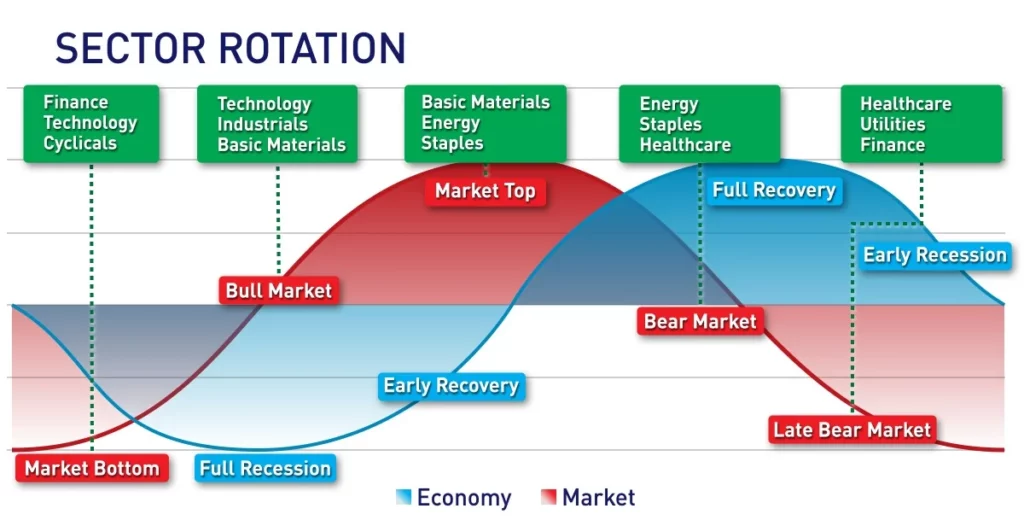
What is Sector Rotation in the Stock Market?

Sector rotation is a crucial ability for investors wanting to maximize their investment strategies over several economic cycles in the dynamic environment of the financial markets. Rotating your sector requires strategically moving your investments from one sector to another based on the current state of the economy. This sophisticated strategy enables investors to take advantage of opportunities and reduce risks, ultimately resulting in greater returns. In this thorough guide, we explore the nuances of sector rotation and offer insightful advice that can enable investors to outperform their contemporaries.

The economic cycle, from boom to crash and back again, is predictable.
Sector Rotation

Understanding Sector Rotation

Sector rotation is a systematic strategy to investing that takes use of the cyclical structure of sectors rather than just being a tactical move. It is based on the notion that diverse economic sectors behave differently at various points in the economic cycle. The four primary phases of these cycles are typically expansion, peak, contraction, and trough.

KEY TAKEAWAYS

  • The economic cycle, from boom to crash and back again, is predictable.
  • Investors in stocks try to predict the following cycle months in advance. They invest their money in the sectors that typically outperform others in the following cycle.

Navigating Economic Cycles

1. Expansion Phase

Sector rotation is a systematic strategy to investing that takes use of the cyclical structure of sectors rather than just being a tactical move. It is based on the notion that diverse economic sectors behave differently at various points in the economic cycle. The four primary phases of these cycles are typically expansion, peak, contraction, and trough.

2. Peak Phase

Inflationary pressures could develop when the economy hits its peak, forcing central banks to adopt tighter monetary policies. During this time, defensive industries like healthcare and utilities frequently do well. Strategic allocation to these sectors can help investors protect their gains and limit their losses.

3. Contraction Phase

The contraction era, often referred to as the recessionary phase, is characterized by a slowdown in the economy, an increase in unemployment, and a decline in consumer expenditure. Here, defensive sectors are still preferred, but investors should also think about allocating to generally countercyclical industries like healthcare and consumer staples. These industries are more prepared to withstand economic downturns.

4. Trough Phase

Economic indicators exhibit evidence of stabilization and recovery during the trough phase. As the economy starts to recover, cyclical industries like finance, materials, and energy are primed for potential development. Strategic positioning in these areas is an option for investors looking to profit from the early phases of the rebound.

Implementing a Winning Strategy

1. Thorough Research

The key to succeeding in sector rotation is careful study. Examine past data, economic indicators, and industry performance during different economic cyclical periods. Find trends that can help you make better investing choices and give you a competitive advantage.

2. Diversification

An essential component of sector rotation is diversifying your portfolio across industries. You lower the danger that an individual industry may be negatively impacted by economic downturns by diversifying your investments. This tactic guarantees a more comfortable ride amid market volatility.

3. Regular Monitoring

It’s important to keep up with how the economy is changing. Keep an eye on sector performance on a regular basis, and be ready to change your portfolio as necessary. To make wise judgments, consult economic studies, financial news sources, and market analysis.

Advantages of Sector Rotation:

  1. Enhanced Returns: Investors can benefit from the various ways that sectors perform over economic cycles by changing their focus. Investors may increase returns by carefully reallocating their funds to industries that are expected to grow.
  2. Diversification: By diversifying your investments, you can lessen the effect that a particular industry’s bad performance will have on your portfolio as a whole. This strategy reduces risks and offers a more evenly distributed investment exposure.
  3. Risk Management: Defensive industries can serve as a buffer against market volatility during economic downturns. Investors can allocate to various sectors thanks to sector rotation, which lowers the total risk of their investments.
  4. Adaptability: Defensive industries can serve as a buffer against market volatility during economic downturns. Investors can allocate to various sectors thanks to sector rotation, which lowers the total risk of their investments.
  5. Active Management: Rotating your sectors promotes involvement in your portfolio. A deeper awareness of the market is cultivated and can result in more educated investment decisions when economic indicators and sector performance are routinely monitored.

Disadvantages of Sector Rotation:

  1. Complexity: Sector rotation necessitates a thorough understanding of market behavior, industry trends, and economic cycles. For new investors, mastering this approach without much study and education can be difficult.
  2. Timing Risk:It might be challenging to predict sector movements with accuracy. Investors may unintentionally expose themselves to losses or lose out on potential rewards if a transaction is conducted badly.
  3. Transaction Costs: Frequent asset purchases and sales might result in greater transaction costs, which can reduce gains. Particularly for smaller portfolios, these expenses may have an impact on overall performance.
  4. Overemphasis on Short-Term Trends: Some investors may become unduly preoccupied with short-term market movements, which might cause them to make snap judgments that don’t support their long-term objectives.
  5. Inaccurate Economic Predictions: Effective sector rotation requires reliance on precise economic forecasts. An investor’s sector allocations might not provide the intended outcomes if their economic estimates are off.
  6. Behavioral Biases:Investors are susceptible to emotional biases that can interfere with the disciplined approach necessary for effective sector rotation, such as herd mentality or fear of missing out.

Conclusion

Sector rotation is a complex investment technique that calls for a blend of diligence, self-control, and flexibility. You can put yourself in a position for long-term success by matching the composition of your portfolio to the economic environment at the time and being knowledgeable about the nuances of various industries. The important thing is to stay focused on your investing goals and keep up with the always shifting financial scene, regardless of whether you opt for a tactical or strategic approach. When done correctly, sector rotation can improve your investment performance and assist you in reaching your financial goals.

FOR MORE INFO CLICK THIS SITE:https://learningsharks.in/

FOLLOW OUR PAGE:https://www.instagram.com/learningsharks/?hl=en