Learning sharks-Share Market Institute


Rajouri Garden  8595071711 7982037049  Noida 8920210950 , and  Paschim Vihar  7827445731  

Fee revision notice effective 1st Jan 2026; No change for students enrolled before 15th Jan 2026

Download “Key features of Budget 2024-2025here

Fear of a Sudden Turn of Events

Psychology and Risk Management

What to expect
Risks
• Position sizing
• illusion of control
• Accepting critisism
• Paralyzed by fear
• Loss is a feedback, not a failure
• The flexible trader
• Focusing on the positive
• Short straddle
• The dynamics of greed
• The herd mentality
• Notes

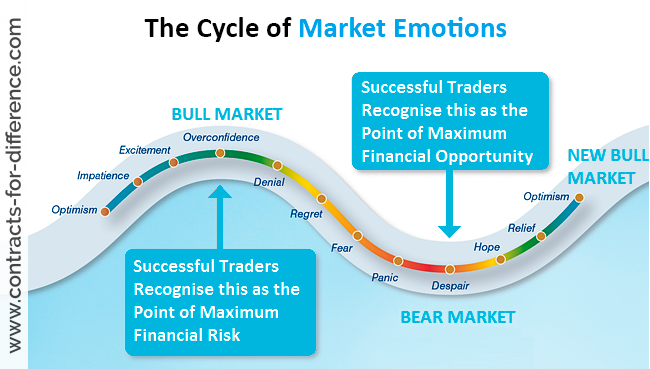
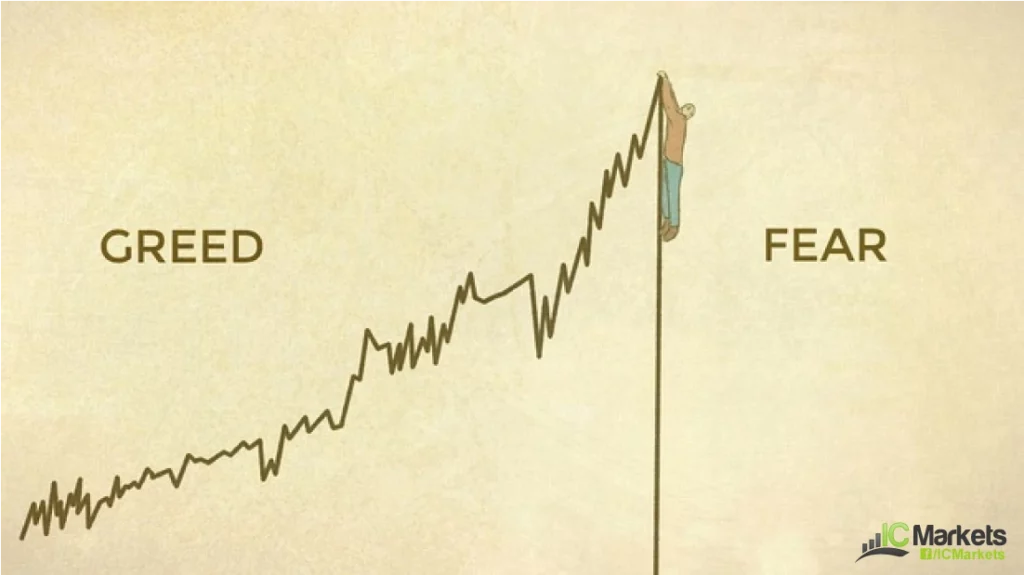
Things have been going well for the previous few months and you currently have a number of roles open. Following a Fear of a Sudden Turn of Events month of terrible weather and natural calamities, there is a sudden increase in interest rates. The markets decline as would be predicted, and many of your positions lose value. How do you behave? A seasoned trader would simply wait it out. You wait for the market to resume its previous trajectory after realising that the modest drop is just transitory. However, many traders are unsure about how to respond. They worry and begin to believe it’s the beginning of a significant bull market when they see their portfolio lose money. What is your typical response? Fear is a common factor.


But when it comes to investing, fear may be fatal.
learning sharks stock market institute

Fear of a Sudden Turn of Events propensity is biologically and genetically based. Fear and the fight-or-flight reaction are connected. Animals employ fear as a very basic survival mechanism, and it is regulated by brain regions that are really rudimentary. The instinct to either fight or retreat can be incredibly adaptive. A wild animal must gather its resources and decide quickly whether to resist the threat or run away to safety when damage is suspected. However, the fear instinct might divert you from your intended direction while trading the markets. You don’t want to lose control of your emotions and sell off your holdings hastily because you wrongly think that a brief slump heralds approaching disaster. Instead, you should calmly and logically weigh your options before making a decision.


It’s crucial to control your fear and prevent it from leading you to act inappropriately. But it’s sometimes challenging to remain rational when your money is on the line. How do you manage your fear? Ari Kiev provides a simple method for managing fear in his book “Trading to Win”: When you admit that you are terrified, the emotion will leave your body and lose all of its power. Refusing to accept your fear will only cause it to persist, however acknowledging your fear will cause it to lessen.


Simply acknowledging your fear is the first step toward overcoming it. Trading modest positions is a second strategy for controlling fear. Your risk-taking is lower and your likelihood of feeling dread is lower the less money you have on the line. 3. Control risk. You will feel more at peace and be able to handle worry more readily if you use protective stops and only risk a tiny portion of your capital on one trade. Fourthly, you can trade more circumspectly by ensuring that your trading strategy is in line with a larger trend.


Consider a day trade where your prediction is that the market will be bullish. You will be incurring less risk if the market’s longer-term trend is similarly optimistic. Even if the market goes against you during the trading day, you are aware that, in the worst event, you can wait it out and either minimise your losses or even profit. Finally, if things become too emotionally taxing, you can take a break and engage in paper trading. If you are particularly prone to fear, it is likely because you have recently executed a number of losing transactions. As a result, anxiety has become “associated” or “classically conditioned” with losing trades. You instantaneously and naturally get afraid when you start a trade.


“Systematic desensitisation” or “counter-conditioning” is a successful technique psychologists have used to overcome excessive Fear of a Sudden Turn of Events, This technique basically takes advantage of the fact that it is impossible to concurrently experience both the terror response and the relaxation response. An incident that previously caused fear will lose its power and no longer cause fear if you feel comfortable and prevent the fear response from happening. Imagine that you are placing a trade, but since no money is at danger, you won’t experience much dread. You are prepared to increase the risk once you can manage your fear while trading on paper.


Place a low-risk deal of modest size. Once more, make an effort to unwind and suppress the dread response. If you start to feel anxious, switch back to trading on paper until you can use a relaxation technique to stop the anxiety response from happening. Work your way up to placing a relatively risky trade by gradually executing trades that require more risk until you can do so without feeling nervous. Avoid letting fear get in the way of your trade at all costs. Be able to manage your fear. You can trade successfully if you can do it unrestrictedly and coolly.
 

Our location


Making Sense of it All

Psychology and Risk Management

What to expect
Risks
• Position sizing
• illusion of control
• Accepting critisism
• Paralyzed by fear
• Loss is a feedback, not a failure
• The flexible trader
• Focusing on the positive
• Short straddle
• The dynamics of greed
• The herd mentality
• Notes

People are “lay scientists,” according to social psychologists, who are Making Mistake in stock market, use this phrase frequently. Like academic scientists, they seek to comprehend their environment. They develop and test hypotheses. However, they use their daily experience to test out hypotheses they have about people rather than performing formal experiments. When we learn how to trade, we follow the same procedure. We research the markets and attempt to formulate our own unique beliefs regarding how they operate. However, since we don’t perform formal experiments, we can be susceptible to psychological biases. The false consensus effect is Making Mistake in stock market, one of these psychological biases. We have a tendency to believe that others share our beliefs and behave in the same way that we do, but this perspective is limited, and it can lead us astray.

learning sharks stock market institute

Trading in the short term frequently involves predicting what the masses will do. Will they purchase or sell? It might be challenging. Consider the previous two weeks. One may assume that the general public would flee the markets in light of the conflict, the hurricane, and the high price of oil. However, they didn’t. It proves that you can’t always predict how people would react to events happening around the world. It all comes down to having the proper perspective, which can occasionally be challenging to discover. Even though it could be difficult, we must at least attempt it.


One of the common wisdoms that might influence our actions is the false consensus effect. Social psychologists have shown that people consistently overestimate the number of those who agree with them, regardless of the decision you ask them to make, the significance of the issue, or the choice taken. It’s human nature to think that our actions are reasonable, appropriate, and similar to what our coworkers and peers would do in the same circumstances. We use our choices as a “anchor” and assess what other people might do in light of them. Being overconfident may be a result of this bias in judgement.


The process by which people choose their course of action is one theory for the false consensus effect. People attempt to put together evidence to reach a conclusion while deciding on a position. They eventually group all the evidence that favours one course of action over another, dismissing contradicting evidence. Once a decision has been taken, the supporting information is immediately “accessible” in memory and is simple to recall. People still have these numerous pieces of confirming data in mind, are able to recall them with ease, and assume that others will behave as they do based on the information they remember when asked to estimate the number of people who would reach a similar conclusion. People tend to Making Mistake in stock market, assumptions about what other people will do rather than relying on accurate facts.


In the world of trading, this prejudice frequently manifests. Trading requires ongoing foresight into how the general public will act. You consider and analyse the information in front of you, then come to a conclusion. However, your own perspective is the only one you can rely on. And that viewpoint might be incorrect.

How may the false consensus effect be countered? Learning about it is the best way to defend yourself. Keep in mind that you are acting based on incomplete knowledge. You can get around this trade reality, but you must embrace it.


Always be wary of promises. Manage your risk and be willing to admit that you might be Making Mistake in stock market, You are human, after all, and occasionally you are going to make biassed conclusions. It’s better to accept it and go on than to beat yourself up over it.


Our location

False Consensus Effects

Psychology and Risk Management

What to expect
Risks
• Position sizing
• illusion of control
• Accepting critisism
• Paralyzed by fear
• Loss is a feedback, not a failure
• The flexible trader
• Focusing on the positive
• Short straddle
• The dynamics of greed
• The herd mentality
• Notes

False Consensus Effects

Let’s say you chose to buy more bpcl shares. How many additional investors would you expect to support your choice? When faced with such a situation, people have a tendency to overestimate the number of people who will take the same course of action. The False effects in stock market “false consensus effect” is the name given to this bias in decision-making.

Social psychologists have shown that people consistently overestimate the number of people who will agree with them, regardless of the choice they are asked to make, the significance of the issue, or the importance of the issue. We all have a tendency to think that our actions are generally acceptable, typical, and consistent with what our coworkers and peers would do in a comparable circumstance.

We all have a tendency to think that our actions are generally acceptable, typical, and consistent with what our coworkers and peers would do in a comparable circumstance. We use our choices as a “anchor” and assess what other people might do in light of them. Being overconfident may be a result of this bias in judgement. Once we make a choice, we often believe that we are right and that other people would concur with us. Though they might not.

The process by which people choose their course of action is one theory for the false consensus effect. People attempt to put together evidence to reach a conclusion while deciding on a position. They eventually group all the evidence that favours one course of action over another, dismissing contradicting evidence. Once a decision has been made, the supporting information is “accessible” in memory and is simple to recall. People still have these numerous pieces of confirming data in mind, are able to recall them with ease, and assume that others will behave as they do based on the information they remember when asked to estimate the number of people who would reach a similar conclusion. People tend to make assumptions about what other people will do rather than relying on accurate facts.

learning sharks stock market institute
Image by user testing

However, there is some evidence to suggest that one’s propensity to arrive at a misleading consensus estimate relies on how confident they are in their choice. For instance, Drs. Gary Marks and Norman Miller altered the degree to which participants felt certain about a choice they had made. The estimation of the number of people who would adopt the same course of action depends on how confident one is in their choice. Therefore, the more certain we are about a choice, the more we think others will act in a similar manner. Our sense of overconfidence is further increased by these inaccurate consensus assessments.


How may the False effects in stock market, and false consensus effect be overcome? It is usually advisable to approach all of your choices with scepticism. Think about how people tend to make decisions based on information they can recall and seek for information that confirms it. It takes all of our mental effort to put information together that supports our decision together, but we must also search for information that contradicts our judgement because making a decision is so difficult. Therefore, take a step back after gathering your data and before making a decision and ask yourself, “Am I succumbing to a decision-making bias?” Was my evaluation of the facts objective or was it an effort to support an already held belief?

Always keep in mind that several typical decision-making biases, such as the false consensus False effects in stock market, can affect your perceptions.


Our location

Drive to Fail

Psychology and Risk Management

What to expect
Risks
• Position sizing
• illusion of control
• Accepting critisism
• Paralyzed by fear
• Loss is a feedback, not a failure
• The flexible trader
• Focusing on the positive
• Short straddle
• The dynamics of greed
• The herd mentality
• Notes

Drive to Fail

Most traders will respond, “I want to make enormous returns,” Drive to fail in stock market, when asked why they trade. Although the majority of traders enter the industry with the intention of earning a sizable return on their investment, the vast majority blow out their funds. Why do traders lose so much money? The most obvious explanation for many is that they just lack trading knowledge. They don’t implement suitable risk controls. They lack sufficient financial resources. They lack enough training and a reliable trading platform. They lack effective, dependable trading methods. And for many, they lack useful benchmarks and a thorough understanding of how markets operate.

For a beginner trader, any one of these factors—or all of them—could be disastrous. Other reasons for failure can be discovered without having to delve deep inside of one’s mind. Nevertheless, many aspiring traders are curious in the degree to which unconscious processes thwart their trading endeavours. There can be an unconscious reason for self-sabotage. Experienced traders are particularly curious about this subject. Many well-known, extremely successful traders ultimately lose the majority of their cash, and many never return. Some have hypothesised that the cause of such failures is a covert intention to self-sabotage. Depending on your interests and point of view, it’s worth thinking about in some detail, either for pleasure or as a serious path of investigation.

learning sharks stock market institute

In his book “Those Wrecked by Success,” Freud discussed those who Drive to fail in stock market,  after experiencing enormous success. After realising a lifetime dream, some people, according to Freud, experience shame and physical illness. They are uncomfortable with success once they have it, therefore they unconsciously adopt actions to punish themselves.

Contrarily, the majority of study psychologists today disagree that people intentionally or unintentionally seek failure. People Drive to fail in stock market  because they are unable to control challenging circumstances. In other words, traders don’t consistently lose because they have an underlying desire to undermine their efforts; rather, trading is challenging by nature. Because they lack adequate financial resources, sound trading tactics, or the right mindset, traders frequently fail.

However, according to psychoanalyst Roy Shafer, some people subconsciously perceive “success” as a form of failure and, in a perverse sense, actively shun it. For instance, in one case study, a young man avoided achievement out of fear that he would do better than his unsuccessful father. Similar observations have been reported by seasoned traders. Some new traders don’t just trade for financial gain. They have a secret goal in mind. They desire to demonstrate to their friends and family that they are capable of success.

The issue with being in this situation is that, despite one’s best efforts, a strong psychological message that one cannot succeed and is unworthy of accomplishment has been ingrained in one’s mind. Unconsciously, it’s challenging but not impossible to disprove these important partners. What people think of you, whether favourably or unfavourably, matters. Unconsciously, you might not want to want to disprove who they are since they define who you are. However, it’s essential to avoid letting such psychological difficulties affect your trade. Deal only with yourself. You should only trade if you want to, not because you’re trying to impress anyone or yourself.

But for some folks, it’s a problem. It’s a good idea to discuss some of these difficulties with a trading coach or other expert if you suspect that your motivations for trading may be driven by a desire to resolve underlying conflicts from the past. Don’t let irrational motivations rule your actions. Recognize them, navigate them, and trade profitably, easily, and without restriction.

Our location

Regrets

Psychology and Risk Management

What to expect
Risks
• Position sizing
• illusion of control
• Accepting critisism
• Paralyzed by fear
• Loss is a feedback, not a failure
• The flexible trader
• Focusing on the positive
• Short straddle
• The dynamics of greed
• The herd mentality
• Notes

A Powerful Emotion

When trading the markets, one frequently experiences actual harm: If a trade costs you a lot of money and it fails, you lose everything. Regrets in stock market, The damage is real; the financial loss is terrible. You can frequently regret making the exchange since it stings. The instinct to avoid pain at all costs is one that is very human. Both the actual financial loss and the sheer regret of making a poor trade are unpleasant. Regret may be so agonisingly painful at times that many traders will not even place a trade out of concern for having to deal with the regret of loss in the future.

learning sharks stock market institute

When we discover we’ve made the wrong choice, like placing a losing trade, we feel regret. And the hurt gets worse if we made that decision with a lot riding on it in terms of ego. We’ve risked a lot of self-identity along with our money, for instance, if we conduct an exceptionally thorough analysis and begin to believe that the analysis was so brilliant that it validates our expertise as skilled traders. Whether we realise it or not, we have a tendency to think, “I’ve worked hard on this deal, and I think I’m correct. But if I’m mistaken, it might mean that I’m not as skilled a trader as I formerly believed.

In contrast, if we made a transaction on a whim. Regrets in stock market, we might still feel sorrow over the loss, but it wouldn’t hurt as much. We can simply write off the losing trade psychologically since we didn’t put our egos on the line: “It’s not my fault that I lost money on that trade. I merely struck the deal on a whim. Since regret is difficult, some people will go to considerable lengths to avoid experiencing these unsettling feelings. On the surface, it frequently appears that simply refraining from making judgments is the simplest method to prevent regret.


You cannot make a mistake or feel regret if you don’t make a decision.

Although it would seem like a simple way to avoid regret, you might find that avoiding deals (or making impulsive, poorly thought-out trades to boost your ego) prevents you from piling up profits, which is the ultimate purpose of trading. Learning to deal with regret head-on is a more realistic answer.

There are a few easy methods for handling regret. The most crucial step in managing regret is to acknowledge that it is an emotion you will inevitably feel as a trader. You will make lost deals, and if you don’t take the necessary measures, you will later feel sorry for yourself.

learning sharks stock market institute

All people frequently have a tendency to exaggerate the negative consequences of a feared situation. We frequently believe that a bad, terrible, or disastrous exchange would occur. In actuality, if we carefully plan the trade and manage our risk, the danger will be minimal and not at all disastrous. One’s potential demise is considerably inflated in such circumstances. I’m making more of the prospective loss than it deserves; it won’t be as terrible as I’m assuming it will be, you can tell yourself as a helpful thought exercise. Attempting to make the deal impersonal is another technique to reduce, Regrets in stock market.


Consider the likelihood that this trade is only one among many others. The result of this one deal is meaningless. All that matters is the larger picture. You can lessen the possible remorse should you lose a trade by reminding yourself of its relative insignificance. Similarly, it’s crucial to keep in mind that a single losing deal (or even a few) does not necessarily indicate that you lack trading competence; it could simply be a run of bad luck. Making a trade’s result emblematic of your trading prowess serves no purpose. Most importantly, never risk your financial security by jeopardising your sense of worth. You are an expert.

Avoid letting the propensity to avoid regret affect your trading choices. Regret may be a strong feeling. Sometimes it can be so excruciatingly unpleasant that one avoids making choices, which can result in making impulsive deals to preserve one’s ego. But you don’t have to let your dread of regret guide you. Remember that even though you might experience a little regret if you make a lost deal, you can handle it. Never attempt to escape regret. Face it directly. More power and freedom will come over you.


Our location

It’s Easier to Face Fear than Avoid It

Psychology and Risk Management

What to expect
Risks
• Position sizing
• illusion of control
• Accepting critisism
• Paralyzed by fear
• Loss is a feedback, not a failure
• The flexible trader
• Focusing on the positive
• Short straddle
• The dynamics of greed
• The herd mentality
• Notes

It’s Easier to Face Fear than Avoid It


Rohan imagines himself as a successful trader. He fantasises of winning big and accumulating a tonne of money. He imagines in the back of his mind that if he were wealthy, he could live in luxury and with distinction. Sounds recognisable? Face and fear, Many beginning traders are lured to trading to realise their dreams of financial success. It is normal to want money. Humanity has spent generations chasing success and money. According to common wisdom among seasoned traders, those who are humble and only seek to enjoy trading will ultimately succeed since trading itself delivers intrinsic benefits that are satisfying in and of itself.

Nevertheless, trading can be extremely boring at times. Day after day, month after month, traders must make trade after transaction. When something needs to be done repeatedly, even the most enjoyable activities start to lose some of their charm. In addition, one has to support themselves. You won’t be able to survive if your profits are insufficient to cover your losses. The concern of blowing out or becoming burnt out is a real one that most traders have. It is extremely likely that you will lose your edge and blow out. You won’t be able to trade in the end.

learning sharks stock market institute

The notion that it is simpler to avoid facing the unpleasant than to face it head-on is a prevalent irrational one. However, we experience more anxiety and terror when we foresee an imminent catastrophe than when we courageously and resolutely face an unpleasant reality. Making plans is preferable to waiting for a tragedy to occur. And if you ignore the potential that you could easily burn out or blow out without taking preventative measures, that is exactly what you are doing. In both situations, taking a definite stance on the issue will help you save time and effort.


As a new trader, Face and fear likely that you’ll lose your entire account balance unless you establish reliable trading methods and gather enough market experience to know when they’ll work and when they won’t. Making it seem impossible will only make matters worse. It is crucial to follow these two steps: Limit your risk exposure on every one deal, and have a backup plan in place just in case you blow your account. You’ll have a better chance of surviving the learning curve if you limit your risk. A realistic recovery strategy should also be in place in case you are unable to overcome the learning curve.

The key message is that disaster prevention efforts must be proactive rather than waiting for one to happen. For instance, many traders engage in day after day of trading without receiving enough rest and relaxation. Some people think that in order to keep ahead of the competition, it is important to trade every day. The issue is that everyone has a finite amount of energy. It is essential to frequently rest, and if required, to take extended breaks. Burnout cannot be avoided by acting like you are a superhero when you are not. You must take pauses from trading, even if they span months or years, to avoid burning out.


It is human nature to want to avoid looking at prospective issues. It’s difficult and frustrating to trade. It’s highly conceivable that if you don’t take precautions, things will get worse. It is preferable to take active, deliberate action than to do nothing and avoid thinking about it. Deal with issues head-on before they overwhelm you. You’ll discover that you trade more profitably over time.

Our location

A Trading Fable

Psychology and Risk Management

What to expect
Risks
• Position sizing
• illusion of control
• Accepting critisism
• Paralyzed by fear
• Loss is a feedback, not a failure
• The flexible trader
• Focusing on the positive
• Short straddle
• The dynamics of greed
• The herd mentality
• Notes

A Trading Fable

It’s challenging to foresee every potential negative outcome. Even though we would like to, we are unable to foresee or account for every potential problem. When we look back on a deal, what may have seemed like a smart move at the time may turn out to be a mistake.Trading Fable, The prudent trader, however, does not become excessively agitated when this occurs. He or she attempts to exert as much control as possible while simultaneously accepting the things that are beyond his or her control. Second, having scepticism is helpful. Despite how uncommon they may be, you must be prepared for the worst case scenario. You cannot become unduly concerned with every potential negative event.


Big setbacks should be mentally anticipated so that you are equipped to handle them when they do.

Disasters certainly occur, but only if you choose to perceive them as such. If you enter trading with the expectation that occasionally awful things will occur, you’ll be able to recover swiftly and be prepared to seize the next market opportunity. Bert has two possibilities. He could either criticise himself for not anticipating every negative development, or he could accept the losing transaction as part of his experience and start planning how to make up the loss right now.

learning sharks stock market institute

Third, he might want to set some goals that are a little more doable. He might have been taking a little bit too much risk for a beginner trader, given the size of his account.

Trading Fable, Trading frequently involves confusion and ambiguity. No matter how much we would like to, we simply cannot take every scenario into account. Trading winners embrace the unexpected and move forward actively and enthusiastically.


Our location

A Precursor For Trading

Psychology and Risk Management

What to expect
Risks
• Position sizing
• illusion of control
• Accepting critisism
• Paralyzed by fear
• Loss is a feedback, not a failure
• The flexible trader
• Focusing on the positive
• Short straddle
• The dynamics of greed
• The herd mentality
• Notes

Detailed Action Plans


We are accustomed to acting automatically and impulsively in our daily lives. For instance, when we drive, we instinctively make turns without giving it any conscious thought. Precursor for trading, But things weren’t always like that. When we initially started learning to drive, we carefully considered each step. When participating in sports, it is also valid. At first, each action required intentional, deliberate effort. You eventually developed the skill to carry out each action without much thought as a result of practise. However, beginner traders believe they can deal on the spot despite having acquired a variety of talents over their lives.


It might be challenging to trade on the spur of the moment when you first start out in trading. There are too many things to take care of, and without a tonne of experience, mistakes are inevitable. Precursor for trading, Making a particular plan of action when trading offers obvious advantages. Scientific studies demonstrate how action plans assist people in achieving their objectives. Numerous studies by Dr. Peter Gollwitzer, a professor of psychology at New York University, show the advantages of creating detailed plans that specify when, when, and how to carry out an action.


It might be challenging to trade on the spur of the moment when you first start out in trading. There are too many things to take care of, and without a tonne of experience, mistakes are inevitable. Making a particular plan of action when trading offers obvious advantages. Scientific studies demonstrate how action plans assist people in achieving their objectives. Numerous studies by Dr. Peter Gollwitzer, a professor of psychology at New York University, show the advantages of creating detailed plans that specify when, when, and how to carry out an action.

learning sharks stock market institute

What does research on planning show? Dr. Gollwitzer makes the case that having plans makes it easier for people to recall what needs to be done explicitly in a review of pertinent studies on creating specific action plans. Instead than wasting time trying to remember what they are going to do, they just do it. They easily carry out their predetermined plans because they have already decided what to do and when. Second, studies have shown that having a strategy in place makes people more responsive.


A well-thought-out plan will enable you to react more quickly when favourable market conditions appear. Thirdly, people may more readily ignore interruptions and diversions when they have a strategy. They are better able to maintain self-control and concentrate more readily on the work at hand. Behavior plans are particularly helpful when attempting to react in high-stress circumstances, such as on days when the market action is difficult to predict. It might be stressful to trade the markets on a particularly turbulent day. Several choices must be taken immediately. However, the human mind is limited.

We are only able to focus on a certain quantity of information at once. But we can concentrate our limited psychological energy more effectively with a well-thought-out trading plan. When we have a plan, we can react quickly and with assurance. So, if you want to trade well, create a thorough trading plan and stick to it. Long term, you’ll be happy you did.


Our location

Focus on Action, Not Prize

Psychology and Risk Management

What to expect
Risks
• Position sizing
• illusion of control
• Accepting critisism
• Paralyzed by fear
• Loss is a feedback, not a failure
• The flexible trader
• Focusing on the positive
• Short straddle
• The dynamics of greed
• The herd mentality
• Notes

When trading, mistakes are simple to make. You suddenly become disoriented, anxious, and make a trading mistake. Contrarily, when trading with an ideal attitude, the successful trader is concentrates on his or her present experience, the current market activity. Focus on action not prize. Rather than the reward is the finest rule a trader can adhere to. The satisfying rewards that may be gained from trading are what draw many people to it. Profits can frequently be used to purchase items that make one feel admirable or worthy in the eyes of family and friends. Similar to the lyrics of a well-known country song, one can ask their former detractors, “How do you like me now?” after becoming successful.


Many people are drawn to trade because of not Focus on action not prize, the rewards, prestige, and status.

All of these, can serve as powerful motivators, but ironically, if you place too much emphasis on winning, you won’t be able to trade profitably or regularly. Similar to the athlete who is the favourite to win a sport, one typically falters under pressure. High expectations make it difficult to concentrate solely on the tasks at hand. When your hopes are high, you’ve already made up your mind that you deserve the reward, so the mere possibility that you might forfeit it is terrible. It is possible to stop losing.

learning sharks stock market institute

When one works under the notion that winning is the only option, one is typically easily sidetracked to the point of making a variety of blunders that result in losses rather than profits. You must develop the ability to pay complete attention to your current experience rather than the possible rewards.

Fritz Perls, a renowned psychotherapist, famously said that dread and anxiety arise when we dwell on the past and worry about what might occur in the future. We will be able to live in the now and enjoy our current experience if we can keep our attention on the here and now. We lose concentration on what we’re doing the moment we start worrying about what might happen in the future. We become disorganised, and when a deal is at stake, being disorganised can be disastrous.


Firstly, We will discuss Thinking about the large reward at the end, is the most frequent cause of concentration problems. You’ll lose focus if you start to think, “I can’t wait to make a profit and bask in the glory of success.”

You might even begin to believe that you must succeed in this trade. In the end, that kind of thinking is useless. It’s highly likely that you’ll begin to stress and make a trading mistake. Focus on action not prize, Such as, The more you can concentrate on the mental difficulty of trading as you place a transaction. The more probable it is that you will carry out your trading strategy with ease and trade regularly and profitably.

Nevertheless, it might be entertaining to occasionally consider winning the big prize, just not too frequently or during trading hours. Thinking on the possible long-term gains trading may offer, the big picture, may be stimulating during off-hours.


However, there is a distinction to be make between thinking that you “would like” to win the prize and feeling that you “must” get it. Even if the concept could come to mind when trading. It’s important not to let it consume you. It’s critical to recognise that, if prospective rewards are your major driving force, winning potential rewards may be your main driving force behind trading.

If you genuinely believe this and make an effort to suppress it, it will eventually seep through and have an impact on you—typically negatively. However, if you carefully consider this presumption and firmly persuade yourself that it isn’t a solid cause to pursue trading, you’ll neutralise the assumption.

Prize-driven traders typically don’t stay in the market for very long. The passion of the enterprise must ultimately come before trading. No matter if you win or lose, trading has its own rewards. In the end, If you can keep your attention on the actual trading process, you will feel more satisfied as a trader, trade more naturally, and trade more profitably.

Our location

The Herd Mentality

Psychology and Risk Management

What to expect
Risks
• Position sizing
• illusion of control
• Accepting critisism
• Paralyzed by fear
• Loss is a feedback, not a failure
• The flexible trader
• Focusing on the positive
• Short straddle
• The dynamics of greed
• The herd mentality
• Notes

The Herd Mentality

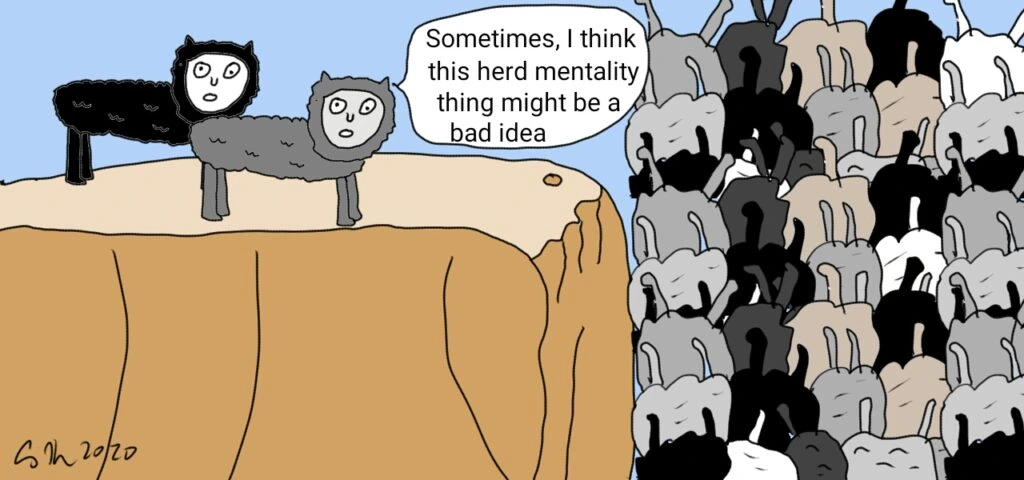
Have you ever enjoyed watching a herd of cattle graze in a wide open field? It’s very amazing. As they graze and stand in a dispersed pattern, the cows appear content. One cow suddenly decides it has had enough food and begins to move toward the barn without giving any obvious explanation. The remaining cows all appear to follow, one by one, until the entire herd is moving directly toward the barn. Where is that man going, the cows seem to be wondering. What is he aiming for? I’d like to participate in this. I’m going to go after him. Despite the fact that the leader does not appear to know what it is doing, they nevertheless follow it.


That is a stark illustration of the herd mentality, which some market experts believe to be similar to the markets. One trader begins to buy, followed by another, and so on until a number of traders are all making purchases for no apparent reason. Despite having a higher level of intelligence than cattle, people have a natural tendency to follow the herd. Everyone seems to be thinking, “These people can’t all be incorrect,”

learning sharks stock market institute

Going with the flow makes sense in some situations. In a bull market, buying and holding makes logical because rising prices are anticipated. However, if market circumstances change, you must be cautious to avoid getting crushed by the merchants at the back of the herd as you try to stop to avoid running into a brick wall. The mob is usually right up until a turning point occurs. Why? Once practically everyone has determined the market is headed in one direction, there aren’t many traders left to sustain the trend.


At that point, a countertrend starts and the market starts moving the other way. The trick is anticipating that turning point, knowing when it will happen, and creating a trading strategy to profit from it. Humphrey Neill describes how to adopt a contrary viewpoint in his book, The Art of Contrary Thinking. Having a different viewpoint from everyone else entails more than just going against the grain. A true contrarian uses creative market analysis to try to come up with a novel trading strategy. It necessitates extensive knowledge and consideration. One must develop the ability to think counterintuitively to the dominant wisdom. It resembles thinking backwards in several ways. Consider the probabilities that the audience is mistaken.


Look for indicators that could signal a change in the market’s dynamics or uncover new industries that might profit from the change.

For instance, during the Great Depression, many favoured staying in and listening to the radio to going out to watch movies or live performances. As a result, radio stations turned a profit during a difficult economic period. Such chances are discovered by a contrarian, who then seizes them.

Although taking a contrarian stance might be helpful, it can be challenging to overcome the herd instinct. People naturally have a tendency to watch what others are doing and follow suit while investing. It seems secure and cosy. However, if one is not careful, going with the flow might be disastrous. The majority may not be right. Therefore, constantly consider the alternative. Analyze the markets thoroughly. Think about the reasons the majority might be incorrect. Look for evidence to bolster the opposing argument. If you are correct, you can profit from it and achieve a significant victory.


Our location