
Introduction
The price-to-earnings (P/E) ratio is a popular financial metric that helps investors determine the worth of a company’s stock. It is a necessary tool for assessing investment opportunities and understanding market sentiment toward a specific stock. This article delves into the complexities of the P/E ratio, its significance, and how investors can use it effectively.
What is the Price-to-Earnings Ratio?
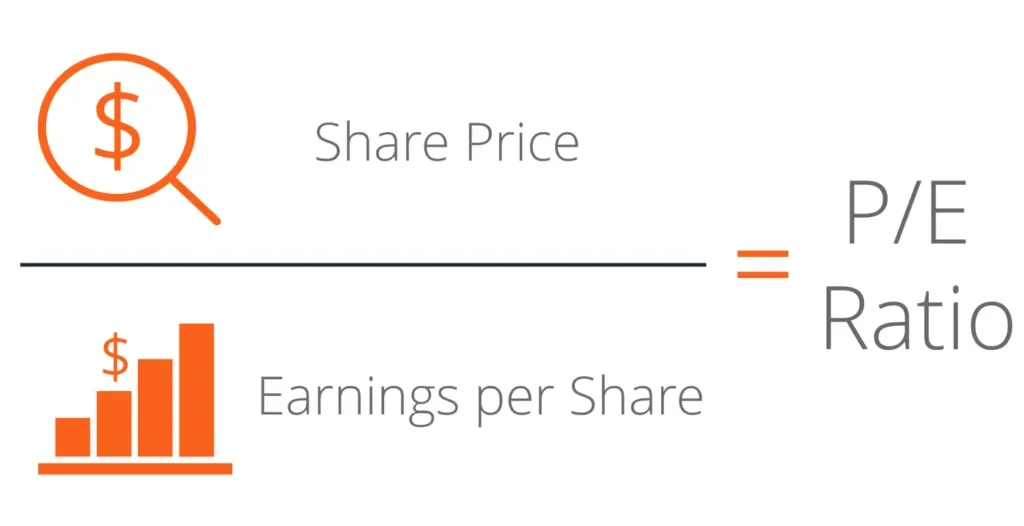
The price-to-earnings ratio, also known as the P/E ratio or simply P/E, is a valuation ratio that compares a company’s stock price to its earnings per share (EPS). It is calculated by dividing a company’s stock market price per share by its earnings per share over a specific time period.
KEY TAKEAWAYS
- The price-to-earnings (P/E) ratio compares the share price of a company to its earnings per share.
- A high P/E ratio may indicate that a company’s stock is overvalued or that investors anticipate rapid growth in the future.
- Companies that have no earnings or are losing money do not have a P/E ratio because the denominator is empty.
- In practice, two types of P/E ratios are used: forward and trailing P/E.
- A P/E ratio is most valuable to an analyst when compared to similar companies in the same industry or for a single company over time.
Why is the P/E Ratio Important?
The P/E ratio reveals important information about the market’s expectations and perception of a company’s future earnings potential. Investors can determine whether a stock is overvalued or undervalued by comparing its P/E ratio to that of its peers or the industry average. A high P/E ratio indicates that investors expect future earnings growth to be strong, whereas a low P/E ratio indicates lower growth expectations or potential undervaluation.
Interpreting the P/E Ratio
Understanding High P/E Ratios
A high P/E ratio indicates that investors are willing to pay a premium for the company’s stock because of strong growth prospects or market optimism. It could indicate a company with innovative products, a strong market position, or plans to expand into new markets. However, before making investment decisions based solely on a high P/E ratio, it is critical to consider other factors such as the company’s financial health, competitive landscape, and industry trends.
Analyzing Low P/E Ratios
A low P/E ratio, on the other hand, may indicate that the market is pessimistic about the company’s future prospects. It could be an indication of potential undervaluation, creating an opportunity for value investors. A low P/E ratio, on the other hand, should prompt further investigation into the underlying reasons, such as declining earnings, poor management, or adverse market conditions, to determine whether the stock is a value trap or a genuine investment opportunity.
Different Types of P/E Ratios
Trailing P/E Ratio
The trailing P/E ratio, also known as the historical P/E ratio, is calculated using past earnings data for a company. It gives a snapshot of how the market perceives the company’s past performance. The trailing P/E ratio is commonly used to compare a company’s valuation to its historical trends or the valuation of its competitors.
Forward P/E Ratio
The forward P/E ratio considers a company’s projected earnings for future periods. It takes into account analyst forecasts and market expectations for future growth prospects. Investors frequently use the forward P/E ratio to assess a company’s earnings growth potential and make informed investment decisions.
Limitations of the P/E Ratio
While the P/E ratio is a valuable tool, it does have certain limitations that investors should be aware of:
- Earnings Manipulation: Companies can artificially inflate or deflate the P/E ratio by manipulating earnings figures. As a result, it is critical to thoroughly examine a company’s financial statements and assess the quality and sustainability of its earnings.
- Variations by Industry: Because of differences in growth rates, risk profiles, and business models, average P/E ratios vary by industry. Comparing the P/E ratios of companies in different industries may not yield accurate results.
- Cyclical Nature: The P/E ratio can fluctuate significantly depending on the economic cycle and market conditions. P/E ratios tend to contract during economic downturns or periods of uncertainty, while they expand during bullish market phases.
Advantage of P/E Ratios
- Relative Valuation: The P/E ratio allows investors to compare a company’s stock valuation to that of its peers or the industry average. This comparative analysis aids in the identification of undervalued or overvalued stocks within a specific sector. Investors can make more informed investment decisions by examining the P/E ratios of similar companies.
- Future Earnings Growth Expectations: The P/E ratio reveals the market’s expectations for a company’s future earnings growth. A high P/E ratio indicates that investors expect strong earnings growth, which can be advantageous for investors looking for high-growth opportunities. A low P/E ratio, on the other hand, may indicate lower growth expectations, potentially attracting value investors looking for undervalued stocks.
- Quick Investor Sentiment Analysis: The P/E ratio provides a snapshot of market sentiment toward a company’s stock. A high P/E ratio indicates that investors are optimistic about the company’s growth prospects. A low P/E ratio, on the other hand, may indicate skepticism or concerns about the company’s performance. Understanding investor sentiment can assist investors in determining market expectations and sentiment toward specific stocks.
- Benchmarking Tool: The P/E ratio enables investors to compare the valuation of a company to its historical performance or competitors in the same industry. Investors can determine whether a company’s current valuation is above or below historical averages by examining the trend of its P/E ratio over time. Furthermore, comparing a company’s P/E ratio to that of its industry peers aids in identifying outliers and providing a broader perspective on relative valuations.
- Market Timing: The P/E ratio can be useful in market timing strategies. During periods of high P/E ratios, investors should be cautious because stocks may be overvalued. When P/E ratios are low, it may indicate a potential buying opportunity because stocks may be undervalued. Market timing strategies, on the other hand, should be approached with caution and supported by thorough analysis of other indicators.
- Financial Analysis Simplified: The P/E ratio simplifies the assessment of a company’s financial health and valuation. It simplifies complex financial data into a single metric that is understandable to both novice and experienced investors. This ease of use enables quick company comparisons and aids in the initial screening process when researching potential investment opportunities.
Conclusion
The price-to-earnings ratio is a basic tool that helps investors determine the relative value of a company’s stock. Investors can make informed decisions, identify potential investment opportunities, and manage their portfolios more effectively if they understand the P/E ratio and its implications. However, in order to gain a comprehensive understanding of a company’s financial health and market outlook, it is critical to consider the P/E ratio in conjunction with other financial metrics and conduct extensive research.
FOR MORE INFO CLICK THIS SITE:https://learningsharks.in/
FOLLOW OUR PAGE:https://www.instagram.com/learningsharks/?hl=en