
Learning sharks-Share Market Institute


Rajouri Garden  8595071711 7982037049  Noida 8920210950 , and  Paschim Vihar  7827445731  

Fee revision notice effective 1st Jan 2026; No change for students enrolled before 15th Jan 2026

Download “Key features of Budget 2024-2025here

The Advantages of Being a Large Trader in the Financial Market

Introduction

Being a large trader as a prominent player in the financial market provides numerous benefits and opportunities. In this article, we will look at the advantages of being a large trader, such as increased market influence, access to exclusive opportunities, and increased profitability. We’ll look at the strategies and practices that can help you become a successful large trader and outperform your competitors in the financial industry.

Enhanced Market Influence

The ability to wield significant influence in the financial market is one of the primary benefits of being a large trader. Large traders have significant capital and trade volumes, allowing them to make significant transactions that can move markets. Other market participants closely monitor their actions, and their positions can have a significant impact on prices, trends, and overall market sentiment.

Large traders can influence investor sentiment, shape market trends, and even drive the direction of specific assets or sectors by actively participating in the market. Because large traders can attract liquidity, enjoy better execution prices, and benefit from increased market transparency, this influence can result in favorable trading conditions.

Access to Exclusive Opportunities

Large traders frequently have access to exclusive opportunities that smaller market participants do not have. Investment banks, hedge funds, and institutional investors frequently offer one-of-a-kind investment options designed specifically for large traders. Participation in private placements, exclusive investment vehicles, and privileged access to pre-IPO shares are examples of these opportunities.

Large traders also frequently have access to cutting-edge trading technologies, cutting-edge research, and specialized market insights. These resources give them a competitive advantage in the financial market, allowing them to identify profitable trading opportunities before others do.

Improved Profitability

Because of economies of scale, the financial market rewards large traders with increased profitability. With higher trading volumes, they can negotiate lower transaction costs, such as lower commissions and spreads. Furthermore, large traders can take advantage of bulk trading discounts provided by brokers, resulting in significant savings in transaction costs.

Furthermore, being a large trader improves one’s ability to diversify investment portfolios across different asset classes and geographies. This diversification reduces risk and increases the possibility of generating consistent profits over time. Large traders can maximize risk-adjusted returns and achieve better overall portfolio performance by diversifying their investments across markets and sectors.

Strategies for Becoming a Successful Large Trader

Being a successful large trader necessitates a strategic approach as well as a thorough understanding of the financial market. Consider the following key strategies:

  1. Build a Strong Capital Base
    To become a large trader, you must first amass a substantial capital base. This provides the financial resources required to execute large trades and weather potential market fluctuations. Saving and reinvesting profits on a regular basis can help your capital grow over time, allowing you to expand your trading activities.
  2. Develop a Robust Risk Management Plan
    To protect their capital and investments, large traders must have a well-defined risk management plan in place. This plan should include risk tolerance guidelines, position sizing guidelines, and strategies for dealing with potential losses. Large traders can protect their capital and run a profitable trading business by effectively managing risk.
  3. Make use of technology and data analytics
    Large traders must leverage technology and data analytics in today’s digital age. Advanced trading platforms, algorithmic trading systems, and real-time market data can provide useful insights and aid in the identification of profitable trading opportunities. Using these tools can help you make better decisions and improve your trading performance.
  4. Develop Strong Relationships
    Large traders must cultivate strong relationships within the financial industry. Developing relationships with brokers, institutional investors, and industry professionals can lead to exclusive opportunities, market intelligence, and potential collaborations. Networking and attending industry conferences and events can help you develop these important relationships.

Conclusion

Being a large trader in the financial market provides numerous benefits, including increased market influence, access to exclusive opportunities, and increased profitability. Aspiring large traders can position themselves for success by capitalizing on these advantages and implementing effective strategies. Remember to establish a solid capital base, create a solid risk management strategy, embrace technology, and cultivate strong industry relationships. This allows you to confidently navigate the financial market, outrank competitors, and achieve long-term profitability.

FOR MORE INFO CLICK THIS SITE:https://learningsharks.in/

FOLLOW OUR PAGE:https://www.instagram.com/learningsharks/?hl=en

Understanding Volatility in Financial Markets

What is Volatility?

Volatility is a statistical measure of the spread of returns for a specific financial instrument or market index. It denotes the degree of uncertainty and risk associated with a particular investment. Volatility is a measure of how much an asset’s price fluctuates over a given time period.

Importance of Volatility

Volatility is crucial in investment strategies and risk management. It provides useful insights into market behavior and assists investors in determining potential gains or losses. Understanding volatility allows investors to make more informed decisions about portfolio allocation, risk tolerance, and trade timing.

Types of Volatility

1. Historical Volatility

Historical volatility is a measure of an asset’s past price movements over a specific time period. It is calculated by looking at historical data and calculating the standard deviation of returns. The use of historical volatility to forecast future price movements and assess potential risks is common.

2. Implied Volatility

In contrast, implied volatility is derived from option prices. It reflects the market’s expectations for future price changes. Implied volatility is an important component in option pricing models because it can provide insight into market sentiment and expectations.

Factors Influencing Volatility

Several factors contribute to financial market volatility. While predicting volatility with absolute certainty is impossible, understanding these factors can help investors make more informed decisions. Some of the key factors influencing volatility are as follows:

  1. Economic Indicators
    GDP growth, inflation rates, and employment data can all have a significant impact on market volatility. Positive economic news tends to reduce volatility, whereas negative or uncertain economic conditions tend to increase volatility.
  2. Market Sentiment
    Volatility is also influenced by investor sentiment and market psychology. Fear, greed, and uncertainty can all cause price fluctuations in the market. News events, geopolitical tensions, and unexpected developments can quickly change market sentiment and increase volatility.
  3. Liquidity
    Volatility can be affected by the level of liquidity in financial markets. Low volatility is often associated with high liquidity because it indicates a smoother flow of buying and selling. Low liquidity, on the other hand, can magnify price movements and increase volatility.

Managing Volatility

While volatility may appear intimidating, it can be effectively managed using a variety of strategies. Consider the following approaches:

  1. Diversification
    Diversification entails spreading investments across various asset classes, industries, or geographical regions. You can reduce the impact of volatility on individual holdings and potentially improve overall returns by diversifying your portfolio.
  2. Risk Management Techniques
    Using risk management techniques such as stop-loss orders and trailing stops can help mitigate potential losses during periods of high volatility. These strategies enable investors to set predetermined exit points and limit downside risks.
  3. Stay Informed and Seek Professional Advice
    Keeping up with market trends and seeking financial advice can provide valuable insights and guidance. Professionals can assist you in analyzing market conditions, assessing risks, and identifying suitable investment opportunities while keeping volatility in mind.

The Advantage of Volatility in the Financial Markets

Volatility in financial markets is frequently regarded as a risk or source of uncertainty. However, it is critical to recognize that volatility has some advantages that can benefit investors and market participants. In this article, we will look at the benefits of volatility and how to use it to your advantage.

  1. Increased Profitability
    One of the significant benefits of volatility is the possibility of increased profits. When the market is volatile, it provides opportunities for traders and investors to profit from price movements. Volatile markets frequently have larger price swings, allowing savvy investors to enter and exit positions at more advantageous prices. Individuals can profit from price fluctuations and generate higher returns by carefully analyzing market trends and making well-timed trades.
  2. Enhanced Trading Opportunities
    Volatility creates a plethora of trading opportunities. Active traders thrive in volatile markets because they can employ a variety of trading strategies to capitalize on price movements. Day traders, for example, can profit from short-term price fluctuations by using scalping or momentum trading techniques. Volatility creates an ideal environment for traders to put their strategies into action and potentially achieve superior trading results.
  3. Greater Market Efficiency
    Volatility, contrary to popular belief, can contribute to market efficiency. When markets are volatile, prices respond quickly to new information, ensuring that assets are priced near their intrinsic value. Volatility forces participants to reconsider their positions and revise their expectations accordingly. As a result, mispriced assets are more likely to be corrected, resulting in more efficient capital allocation. Volatility increases market participants’ vigilance and activity, fostering a healthier and more accurate pricing mechanism.
  4. Improved Risk Management
    Volatility serves as a risk indicator in the financial markets. It provides a measure of the potential ups and downs of an investment. Investors can gain a better understanding of the risk environment and make more informed decisions by monitoring and analyzing volatility. To mitigate potential losses, volatility allows for the implementation of risk management strategies such as adjusting position sizes, utilizing hedging techniques, or diversifying portfolios. Investors can protect their capital and achieve more stable long-term returns by embracing volatility and effectively managing risks.
  5. Enhanced Market Liquidity
    Volatility frequently coincides with increased market liquidity because it attracts more trading activity. More buyers and sellers participate in volatile markets, resulting in tighter bid-ask spreads and better trade execution. Increased liquidity allows investors to enter and exit positions more efficiently, lowering transaction costs and increasing market efficiency overall. During volatile periods, the presence of liquidity ensures that market participants can easily buy or sell assets at fair prices, enhancing the overall functionality of the financial markets.

Conclusion

Volatility is an inherent feature of financial markets and can have a significant impact on investment outcomes. Investors can make more informed decisions and adjust their strategies by understanding volatility, its types, and the factors that influence it. Diversification, risk management techniques, and seeking professional advice can all help you navigate the ever-changing financial landscape. Stay informed, vigilant, and take advantage of volatility.

FOR MORE INFO CLICK THIS SITE:https://learningsharks.in/

FOLLOW OUR PAGE:https://www.instagram.com/learningsharks/?hl=en

Understanding Insider Trading: A Comprehensive Guide

Insider trading is buying or selling a publicly traded company's stock by someone with non-public, material information about that company.
Insider Trading

Introduction

Welcome to our in-depth guide to insider trading. We aim to provide you with in-depth knowledge and insights into this complex financial practice as a leading authority in the field. In this article, we will look at what insider trading is, what it means legally and ethically, and how it affects financial markets. Let’s get started.

Table of Contents

  1. What is Insider Trading?
  2. Legal and Regulatory Framework
  3. Types of Insider Trading
    • a. Legal Insider Trading
    • b. Illegal Insider Trading
  4. Impact on Financial Markets
    • a. Market Efficiency
    • b. Investor Confidence
  5. Famous Insider Trading Cases
    • a. Martha Stewart
    • b. Raj Rajaratnam
  6. Preventing Insider Trading
    • a. Compliance Programs
    • b. Reporting and Surveillance
  7. Conclusion

1. What is Insider Trading?

Insider trading is defined as trading in the stock or other securities of a public company by someone who has non-public, material information about the company. Insider transactions are legal if the insider makes a trade and reports it to the Securities and Exchange Commission; however, insider trading is illegal if the material information is still not publicly available.

Insider traders face severe penalties, so it’s critical to understand what it is and how to avoid it if you own company stock and have information that could affect other investors.

2. Legal and Regulatory Framework

Governments around the world have established regulations and laws to govern insider trading in order to ensure fair and transparent financial markets. The Securities and Exchange Commission (SEC) enforces these regulations in the United States under the Securities Exchange Act of 1934. Insider trading is illegal unless certain conditions are met, such as public disclosure of material information or obtaining legitimate exemptions.

3. Types of Insider Trading

  • Legal Insider Trading:- Insider trading is not always illegal. Corporate insiders engage in legal insider trading when they buy or sell securities of their own company while adhering to all applicable laws and regulations. These transactions are typically made public through regulatory filings and are carried out in an open and transparent manner.
  • Illegal Insider Trading:- Illegal insider trading is defined as trading on material, non-public information that provides the trader with an unfair advantage. This type of trading undermines market integrity and can have serious ramifications for those involved. Insider trading is illegal when a trader violates their fiduciary duty, misappropriates confidential information, or trades based on insider information.

4. Impact on Financial Markets

Insider trading has serious consequences for financial markets, affecting both market efficiency and investor confidence.

  • Market Efficiency:- When insider trading occurs, it distorts the financial markets’ level playing field. Other investors who do not have access to the confidential information are at a disadvantage because they base their investment decisions on incomplete information. This can lead to market inefficiencies and stock price distortions.
  • Investor Confidence:- Insider trading undermines investor confidence in the fairness and integrity of financial markets. Investors may be less willing to participate in the market if they believe insiders have an unfair advantage, resulting in decreased liquidity and potential market downturns.

5. Famous Insider Trading Cases

Several high-profile insider trading cases have made headlines throughout history. Here are two noteworthy examples:

  • Martha Stewart:- Martha Stewart, a well-known businesswoman and television personality, was convicted of insider trading in 2004. She sold shares in a biopharmaceutical company just before bad news broke, saving her a lot of money. Stewart was found guilty of obstruction of justice and lying to federal investigators.
  • Raj Rajaratnam:- Raj Rajaratnam, a hedge fund manager and Galleon Group co-founder, was convicted of insider trading in 2011. He received insider information from corporate insiders and traded on it, resulting in significant profits for his fund. Rajaratnam’s case exemplified the vast network of insiders involved in illegal trading.

6. Preventing Insider Trading

Companies and regulatory bodies have implemented various measures to detect and prevent insider trading in order to combat it.

  • Compliance Programs:- To educate employees about insider trading laws and regulations, companies implement comprehensive compliance programs. Training sessions, written policies, and strict guidelines are typically included in these programs to ensure employees understand their obligations and responsibilities.
  • Reporting and Surveillance:- Regulatory bodies, such as the SEC, use sophisticated surveillance techniques to monitor trading activity and identify potential cases of insider trading. To maintain market integrity, they analyze market data, track trading patterns, and investigate suspicious transactions.

7. Conclusion

Insider trading is a complex issue that can have far-reaching consequences for the financial markets. By understanding its definition, legal framework, and impact, investors and market participants can make informed decisions while maintaining market integrity. It is crucial for companies, regulators, and individuals to remain vigilant in preventing illegal insider trading and upholding the fairness and transparency of the financial system.

FOR MORE INFO CLICK THIS SITE:https://learningsharks.in/

FOLLOW OUR PAGE:https://www.instagram.com/learningsharks/?hl=en

The Power of Volume Analysis in Financial Trading

Introduction

Knowledge and understanding of market trends and patterns are critical in the world of financial trading. Traders and investors are constantly looking for tools and techniques to help them understand the behavior of financial instruments. Volume analysis is one such powerful tool that allows traders to gain a deep understanding of market dynamics by analyzing the volume of trades executed over a given period. This article will delve into the concept of volume analysis and emphasize its importance in making informed trading decisions.

KEY TAKEAWAYS

  • Volume analysis is the process of examining relative or absolute changes in an asset’s trading volume in order to predict future price movements.
  • Volume can be used to gauge market strength, as rising markets with increasing volume are typically regarded as strong and healthy. When prices fall on increasing volume, the downward trend is gaining strength.
  • Volume is used in technical analysis by a variety of tools, including the positive volume index (PVI).

Understanding Volume Analysis

The study of trading activity, specifically the number of shares or contracts traded in a specific security or market, is referred to as volume analysis. It examines the volume of transactions rather than just price movements. Traders can gauge the strength and conviction behind market movements by examining trade volume, which can help them identify potential buying or selling opportunities.

The Role of Volume in Market Interpretation

1. Confirming Trends

Volume analysis can be used to confirm existing market trends. When a security’s price is rising or falling, it is critical to determine whether the trend is being supported by high or low trading volume. A significant increase in volume during an upward trend validates the trend’s strength, indicating a higher likelihood of continued price appreciation. A decrease in volume during an upward trend, on the other hand, may indicate a lack of conviction among market participants, potentially signaling a trend reversal.

2. Identifying Reversals

Volume analysis also aids traders in identifying potential trend reversals. Sudden increases in volume followed by a price reversal can indicate a shift in market sentiment. For example, if a stock has been in a downtrend and then experiences a significant increase in volume while the price begins to rise, this could be a sign of a trend reversal. Traders can spot such reversals and profit from them by closely monitoring volume patterns.

3. Assessing Market Strength

Volume analysis can provide insight into market strength and weakness. In an uptrend, rising prices and rising volume indicate a healthy market with strong demand. If, on the other hand, prices rise on low volume, it may indicate a lack of widespread interest and, as a result, a potentially fragile market condition. Traders can evaluate overall market sentiment and make informed decisions based on the perceived strength or weakness of the market by examining volume patterns.

Techniques for Volume Analysis

Traders use a variety of techniques and indicators to effectively use volume analysis in trading. Here are a few examples of commonly used methods:

  1. Bars of Volume
    On a price chart, volume bars are graphical representations of trading volume. They depict the volume traded during each time interval visually. Traders can quickly identify significant volume spikes or periods of low activity by observing the height and width of volume bars.
  2. OBV (On-Balance Volume)
    On-Balance Volume (OBV) is a market pressure indicator that combines price and volume to measure buying and selling pressure. It gives the volume a positive or negative value based on whether the price closes higher or lower than the previous period. The OBV line is used by traders to identify divergences and confirm trends.
  3. Volume Moving Averages
    Volume moving averages (VMAs) smooth out volume data by computing the average volume over a given time period. Traders frequently use VMAs to identify volume trends and determine whether current volume levels deviate from the average. This method aids in the detection of unusual volume patterns that may indicate significant market events.

Conclusion

Volume analysis is an essential tool in the arsenal of any successful trader. Traders can gain a better understanding of market dynamics, validate trends, identify reversals, and assess market strength by incorporating volume analysis techniques into their trading strategies. Volume analysis should not be used in isolation, but rather in conjunction with other technical analysis tools. Traders can improve their decision-making capabilities and potentially their trading performance by diligently applying and continuously refining volume analysis techniques.

FOR MORE INFO CLICK THIS SITE:https://learningsharks.in/

FOLLOW OUR PAGE:https://www.instagram.com/learningsharks/?hl=en

Understanding Smart Money: The Key to Financial Success

Introduction

Welcome to our in-depth guide to smart money, where we delve into the concept of smart money and its importance in achieving financial success. In this article, we will look at the strategies, principles, and insights that can help people make informed decisions about how to grow their wealth and secure a secure financial future.

What is Smart Money?

Funds or investments managed by experienced and knowledgeable investors or financial institutions are referred to as smart money. These people or organizations have valuable insights, market intelligence, and expertise that allows them to make sound investment decisions. Smart money investors, as opposed to retail investors, have access to resources and information that can help them outperform the market and generate significant returns on their investments.

KEY TAKEAWAYS

  • Institutional investors, market mavens, central banks, funds, and other financial professionals place smart money in the market.
  • Smart money is also the force that influences and moves financial markets, which is frequently led by central bank actions.
  • Smart money invests on a much larger scale than ordinary money.

The Benefits of Smart Money Investments

Investing in smart money opportunities can provide a number of benefits, including:

  1. Access to Expertise and Insights
    Individuals can benefit from the expertise and insights of seasoned professionals through smart money investments. These experts have a thorough understanding of the market and can spot lucrative investment opportunities that the average investor may miss.
  2. Diversification
    Diversifying funds across asset classes, industries, or geographical locations is common in smart money investments. This diversification helps to mitigate risks and lessens the impact of any single investment’s underperformance. Smart money investors can achieve a well-balanced portfolio that can withstand market volatility by spreading their investments across various sectors.
  3. Enhanced Returns
    Smart money investors have the potential to achieve higher returns on their investments than retail investors due to their knowledge and expertise. They have a competitive advantage because of their ability to identify undervalued assets, anticipate market trends, and capitalize on emerging opportunities.

Strategies Employed by Smart Money Investors

Smart money investors use a variety of strategies to maximize their returns while minimizing their risks. Among these strategies are:

1. Fundamental Analysis

To determine the fundamental value of a company or asset, smart money investors conduct extensive research and analysis. To determine the true value of an investment, they examine financial statements, industry trends, competitive positioning, and other relevant factors. Smart money investors can make informed investment decisions by identifying undervalued assets.

2. Following Market Trends

Smart money investors keep a close eye on market trends and developments. To identify potential opportunities, they examine patterns, shifts in investor sentiment, and economic indicators. Smart money investors can position themselves advantageously and make timely investment decisions by staying ahead of market trends.

3. Long-Term Perspective

When it comes to investing, smart money investors take a long-term approach. They recognize that short-term market fluctuations are to be expected and concentrate on the underlying value of their investments. This strategy enables them to weather market volatility and benefit from compounding returns over time.

Conclusion


To summarize, understanding and applying the concept of smart money can be a game changer for individuals seeking financial success. Individuals can improve their chances of achieving their financial goals by partnering with knowledgeable investors, gaining access to valuable insights, and implementing effective investment strategies. Remember that while smart money investments do not guarantee success, they do provide a solid foundation for informed decision-making and wealth accumulation.

FOR MORE INFO CLICK THIS SITE:https://learningsharks.in/

FOLLOW OUR PAGE:https://www.instagram.com/learningsharks/?hl=en

Money: The Essential System of Exchange

Introduction

Money is a fundamental concept that is extremely important in our modern society. As an exchange system, it facilitates transactions, promotes economic growth, and serves as a medium for wealth accumulation. In this in-depth article, we delve into the complexities of money, investigating its origins, functions, and types, as well as the role it plays in shaping our financial landscape.

KEY TAKEAWAYS

  • Money is a value system that allows for the exchange of goods.
  • The use of money eliminates the need for both parties to have something that the other wants or needs.
  • Historically, agricultural commodities such as grain or livestock were the first forms of money.
  • Most money systems today are based on standardized currencies controlled by central banks.
  • Some of the characteristics of money can also be found in digital cryptocurrencies.

Understanding the Origins of Money

Money emerged as a means of overcoming the limitations of barter systems. While bartering entails the direct exchange of goods and services, money introduced a standardized medium of exchange, simplifying transactions and increasing economic efficiency. Our forefathers saw the need for a universally accepted medium for representing value and facilitating trade across diverse communities.

Functions of Money

Money serves several essential functions within an economy, acting as:

  1. Exchange Medium
    Money serves as a medium of exchange, allowing people to trade goods and services without having to barter. It is a widely accepted instrument that facilitates smooth transactions between buyers and sellers.
  2. Accounting Unit
    Money serves as a standardized unit of measurement for assessing and comparing the worth of various goods and services. Money, by assigning prices to products, enables individuals to make informed decisions and efficiently allocate resources.
  3. Value Store
    Money’s primary function is to serve as a store of value, preserving wealth over time. Individuals can save and accumulate wealth by holding money, reducing the risks associated with storing value in perishable or non-portable assets.
  4. Deferred Payment Standard
    Money serves as a standard of deferred payment, allowing transactions involving credit or debt to take place. It enables loan, mortgage, and other financial obligations to be repaid, ensuring the smooth operation of financial systems.

Types of Money

Money exists in various forms, each serving specific purposes within the economy. Here are some of the most common types of money:

  1. Commodity Currency
    Commodity money is defined as objects with intrinsic value that can be used for both economic and non-economic purposes. Items such as precious metals, salt, and even shells have historically served as commodity money, representing value that extends beyond their use as a medium of exchange.
  2. Fiat currency
    Fiat money is a type of currency that only has value because the government declares it to be legal tender. It is not backed by a physical commodity, but rather by the population’s trust and confidence. Most countries now use fiat money as their official currency.
  3. Representative Cash
    Instruments such as banknotes and checks that represent a claim on a specific amount of commodity or fiat money are examples of representative money. This type of money facilitates transactions by providing a more convenient and portable alternative to carrying large amounts of cash.
  4. Electronic Money
    With the advancement of technology, digital money has become more prevalent. It includes a variety of electronic payment methods such as online banking, cryptocurrencies such as Bitcoin, and mobile payment systems such as Apple Pay or Google Pay. In our interconnected world, digital money provides convenience, security, and accessibility.

The Role of Money in the Economy

Money plays a pivotal role in shaping the economy, influencing factors such as:

  1. Economic Development
    Money drives economic growth by facilitating trade and allowing for the efficient allocation of resources. It promotes the overall development of societies by stimulating investment, encouraging innovation, and fostering entrepreneurial activities.
  2. Price Consistency
    Money affects individual purchasing power and price stability through the concept of inflation. Monetary policies are used by central banks to maintain price stability, ensuring that the value of money remains relatively constant over time.
  3. Intermediary Financial Services
    Money serves as a catalyst for financial intermediation, allowing banks and other financial institutions to make loans, extend credit, and provide investment opportunities. These intermediaries are critical in channeling funds from savers to borrowers, thereby facilitating economic activity.

Conclusion


To summarize, money is a necessary system of exchange that underpins our economic activities. Money shapes our financial landscape and influences economic growth, from its origins in overcoming the limitations of barter to its various functions and types. Understanding the complexities of money provides us with valuable insights into the mechanisms that drive our global economy.

FOR MORE INFO CLICK THIS SITE:https://learningsharks.in/

FOLLOW OUR PAGE:https://www.instagram.com/learningsharks/?hl=en
Kotyark Industries shares zoom 15% in early deals; here’s why

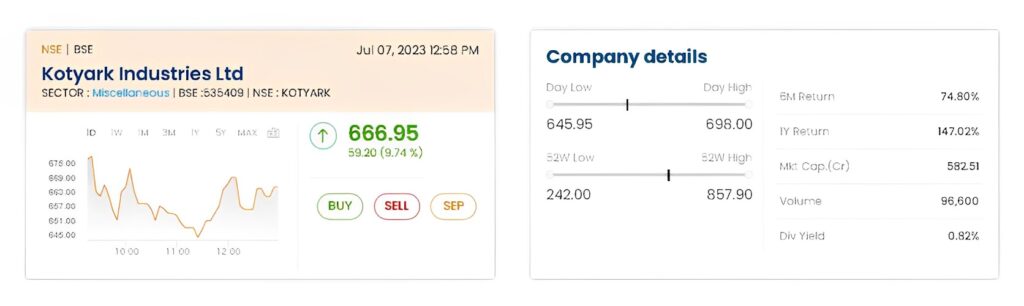
Kotyark Industries’ shares increased 14.84% to Rs 698 from its previous close of Rs 607.75 on the NSE; the firm is not listed on the BSE.

Kotyark Industries Limited, incorporated in 2016, is engaged in the manufacturing of biodiesel and its by-products, and is one of the key players across the state of Rajasthan in India.
Kotyark Industries’ shares have a beta of 1.2, suggesting extremely high volatility over the course of a year. The stock is trading above its five-day, twenty-day, fifty-day, hundred-day, and two-hundred-day moving averages.

INTRODUCTION

Kotyark Industries’ stock increased 14.84% to Rs 698 from its previous close of Rs 607.75 on the NSE. The company is not traded on the BSE.

Kotyark Industries’ stock has increased by 139.43% in a year and by 78.18% since the beginning of this year.

On the BSE today, 85,600 shares of the company changed hands for a total of Rs 5.59 crore. The company’s market capitalization increased to Rs 572 crore.

KOTYARK INDUSTRIES LTD SHARE PRICE

Kotyark Industries’ shares have a beta of 1.2, suggesting extremely high volatility over the course of a year. The stock is trading above its five-day, twenty-day, fifty-day, hundred-day, and two-hundred-day moving averages.

  • “In aggregate, we have received a total order for the procurement of biodiesel of 200,70 KL with an estimated order value of Rs 178.00 Crore (approx.) from IOC, HPCL, and BPCL together,” the business stated.
  • “An Allocation Sheet for Tender of Kotyark Industries Limited for procurement of biodiesel from Indian Oil Corporation Limited (IOC), Hindustan Petroleum Corporation Limited (HPCL), and Bharat Petroleum Corporation Limited (BPCL) for the period July 2023 to September 2023 for 17,381 KL with an estimated order value of Rs 154.00 crore approx.”)
  • Yamuna Bio Energy Private Limited (Amalgamating firm, a firm in the process of amalgamation with our company Kotyark Industries Limited) for the procurement of Biodiesel for 2,689 KL with an anticipated order value of Rs. 24.00 Cr.

The company focuses on green energy and the sustainable development of renewable resources (biofuel) through the application of ecologically friendly technology.

Kotyark Industries Limited, established in 2016, is a prominent operator in the manufacturing of biodiesel and its byproducts in the Indian state of Rajasthan.

CONCLUSION

FOR MORE INFO CLICK THIS SITE:https://learningsharks.in/

FOLLOW OUR PAGE:https://www.instagram.com/learningsharks/?hl=en
PE investment subdued in India in first quarter of FY24;

Private equity investors avoid the market in the June quarter with the exception of one sizable transaction involving GIC and Brookfield REIT.

After touching the $2-billion mark in April-June last year, private equity (PE) investments dipped marginally by 5 per cent year-on-year in Q1 FY24 to $1.9 billion.
There were no PE investments in well-known markets like Delhi-NCR and Bengaluru, which had recently been the centre of activity.

INTRODUCTION

Private equity (PE) investments fell slightly by 5% year over year to $1.9 billion in Q1 FY24 from $2 billion in April to June of the previous year. There is a catch, even though the decrease in investment capital was minimal.

  • A closer examination of the most recent data released by Anarock reveals that, save from one significant transaction, PE activity in India remained largely subdued.
  • There were no PE investments in well-known markets like Delhi-NCR and Bengaluru, which had recently been the centre of activity.
  • Mumbai, one of the top commercial markets, had some PE activity with acquisitions totaling more than $400 million, accounting for 22% of all PE investments made during the quarter.
  • 94% of the $1.9 billion total came from investments in equity, with the remaining 6% coming from debt.

74% of all PE investments made during the April–June quarter came from the $1.4 billion deal between Brookfield Asset Management’s PE fund and a group led by Brookfield India Real Estate Trust REIT and GIC. The average ticket amount increased 92 percent YoY to US$ 192 million in Q1FY24 as a result.

“Without this transaction, private equity activity remained muted because of the high interest rate environment and international uncertainty. In any case, foreign equity investments in office assets typically predominate in PE deals in Indian real estate.

CONCLUSION

FOR MORE INFO CLICK THIS SITE:https://learningsharks.in/

FOLLOW OUR PAGE:https://www.instagram.com/learningsharks/?hl=en

Understanding Fundamental Analysis for Successful Investing

fundamental analysis is a holistic approach to understanding and studying a business.
Fundamental Analysis

Introduction

Fundamental analysis (FA) determines the intrinsic value of a security by examining related economic and financial factors. Intrinsic value is the value of an investment based on the financial situation of the issuing company as well as current market and economic conditions.

Fundamental analysts research everything that has the potential to affect the value of a security, from macroeconomic factors like the state of the economy and industry conditions to microeconomic factors like the effectiveness of the company’s management.

The end goal is to arrive at a number that an investor can compare to the current price of a security to determine whether it is undervalued or overvalued by other investors.

What is Fundamental Analysis?

Fundamental analysis is a valuation technique that investors use to determine the intrinsic value of a company’s stock or financial asset. It entails assessing various aspects of the company’s financial performance, industry position, management team, competitive advantages, and economic outlook. Investors hope to identify undervalued or overvalued securities by scrutinizing these fundamental factors, allowing them to make well-informed investment decisions.

Key Elements of Fundamental Analysis

To conduct a thorough fundamental analysis, investors should consider several key elements:

  1. Financial Reports
    Financial statements, such as the income statement, balance sheet, and cash flow statement, contain critical information for assessing a company’s financial health. Investors can gain insights into a company’s profitability, liquidity, and solvency by examining revenue trends, profit margins, debt levels, and cash flow patterns.
  2. Advantage in the Market
    Evaluating a company’s competitive advantage is critical for determining its long-term viability and growth potential. Unique products or services, strong brand recognition, technological superiority, and economies of scale are all factors that can contribute to a long-term competitive advantage.
  3. Market Research
    Understanding the dynamics and trends of a particular industry is critical for assessing a company’s competitive position. To assess the company’s future success potential, consider factors such as market size, growth prospects, regulatory environment, and competitive landscape.
  4. Management Group
    The management team’s competence, experience, and integrity are critical to a company’s overall performance. Evaluating executives’ track record, strategic vision, and ability to navigate challenges can provide valuable insights into the company’s future prospects.

Implementing Fundamental Analysis

To effectively implement fundamental analysis, investors should take the following steps:

  1. Establish Investment Goals
    Investors must clearly define their investment objectives, including desired returns, risk tolerance, and investment horizon, before conducting any analysis. This step ensures that the fundamental analysis corresponds to the investor’s financial objectives.
  2. Locate Possible Investment Opportunities
    Investors can identify potential investment opportunities that align with their investment objectives by utilizing various research tools and resources. Screening for companies with strong fundamentals, solid financials, and promising growth prospects can aid in narrowing the list of potential investments.
  3. Conduct Extensive Research
    Once potential investment opportunities have been identified, in-depth research should be conducted to evaluate the fundamental factors of each company. This includes analyzing financial statements, researching industry reports, conducting competitive analysis, and evaluating the capabilities of the management team.
  4. Assessment
    Investors can calculate the intrinsic value of a company’s stock or asset based on the research findings. To arrive at a fair value estimate, various valuation techniques such as discounted cash flow (DCF) analysis, price-to-earnings (P/E) ratio, and price-to-book (P/B) ratio can be used.
  5. Risk Evaluation
    Assessing the risks of an investment is critical for mitigating potential downsides. To make informed decisions, factors such as industry risks, market volatility, regulatory changes, and company-specific risks should be carefully evaluated.
  6. Monitor and evaluate
    The process of fundamental analysis is ongoing. Investors should monitor their investments and review the fundamental factors on a regular basis to ensure they remain consistent with the initial investment thesis. This allows investors to adjust their portfolios in response to changing market conditions.

FOR MORE INFO CLICK THIS SITE:https://learningsharks.in/

FOLLOW OUR PAGE:https://www.instagram.com/learningsharks/?hl=en
What Is Technical Analysis?

Technical analysis attempts to predict future price movements, providing traders with the information needed to make a profit.
Technical Analysis

The study of historical market data, such as price and volume, is known as technical analysis. Technical analysts aim to predict future market behavior by using insights from market psychology, behavioral economics, and quantitative analysis. Chart patterns and technical (statistical) indicators are the two most common types of technical analysis.

KEY TAKEAWAYS

  • Technical analysis attempts to forecast future price movements, giving traders the information they need to profit.
  • Traders use technical analysis tools on charts to identify potential entry and exit points for trades.
  • The market has processed all available information, which is reflected in the price chart, which is an underlying assumption of technical analysis.

The Power of Candlestick Patterns

Candlestick patterns are one of the most effective technical analysis tools. These patterns can help identify potential trend reversals or continuations and provide valuable insights into market sentiment. Let’s look at some of the most important candlestick patterns:

  1. Engulfing Bullish Pattern
    When a small bearish candle is followed by a larger bullish candle that completely engulfs the previous candle’s range, the bullish engulfing pattern occurs. This pattern indicates a possible trend reversal from bearish to bullish and could indicate a buying opportunity.
  2. Harami Bearish Pattern
    When a large bullish candle is followed by a smaller bearish candle that is completely engulfed by the previous candle’s range, the bearish harami pattern is formed. This pattern suggests a possible trend reversal from bullish to bearish and may serve as a signal to sell or take profits.
  3. The Doji Pattern
    A candlestick pattern with a small body and long wicks on both ends is known as a doji. It represents market indecision and suggests that buyers and sellers are in equilibrium. A doji pattern can indicate a possible trend reversal, especially if it forms at critical support or resistance levels.

Trend Analysis and Moving Averages

Trend analysis is important in technical analysis because it helps traders determine the market’s direction. Moving averages are popular indicators for smoothing out price data and providing a more accurate picture of the underlying trend. Here are some examples of moving averages:

1. Simple Moving Average (SMA)

The simple moving average computes an asset’s average price over a given time period. The 50-day and 200-day moving averages are frequently used by traders to identify long-term trends. When the shorter-term moving average crosses above the longer-term moving average, a bullish signal is generated, indicating the possibility of an uptrend.

2. Exponential Moving Average (EMA)

The exponential moving average gives more weight to recent price data, making it more sensitive to market changes. Many traders prefer to use EMAs because they provide a more immediate indication of trend reversals. For short-term analysis, the 9-day and 21-day EMAs are commonly used.

Support and Resistance Levels

Technical analysis relies heavily on support and resistance levels. A price level at which buying pressure is strong enough to prevent the price from falling further is referred to as support. In contrast, resistance represents a price level where selling pressure is strong enough to prevent the price from rising further. Identifying these levels can assist traders in determining the best entry and exit points.

Using Technical Indicators

Technical indicators are calculated mathematically from price and volume data. They are used to gain more insight into market trends and to confirm or refute potential trading signals. Here are a few popular technical indicators:

  1. RSI (Relative Strength Index)
    The RSI is a momentum oscillator that measures price movement speed and change. It oscillates between 0 and 100, with values greater than 70 indicating overbought conditions and values less than 30 indicating oversold conditions. The RSI is frequently used by traders to identify potential trend reversals or divergences.
  2. MACD (Moving Average Convergence Divergence)
    The MACD is a momentum indicator that follows a trend and consists of two lines: the MACD line and the signal line. When the MACD line crosses above the signal line, a bullish signal is generated, indicating the possibility of an uptrend. When the MACD line crosses below the signal line, it generates a bearish signal, indicating the possibility of a downtrend.

Risk Management and Stop Loss Orders

Without proper risk management techniques, no trading strategy is complete. Stop loss orders can be used to limit potential losses and protect your capital. A stop loss order instructs the seller to sell a security when it reaches a predetermined price level. Set a stop loss to reduce the impact of unexpected market movements and protect your investment.

Conclusion

Finally, mastering the art of technical analysis is critical for profitable stock market trading. You can make better investment decisions if you understand candlestick patterns, trend analysis, support and resistance levels, technical indicators, and risk management techniques. Remember to practice and fine-tune your skills in real-world trading scenarios, as experience is essential in developing technical analysis proficiency.

FOR MORE INFO CLICK THIS SITE:https://learningsharks.in/

FOLLOW OUR PAGE:https://www.instagram.com/learningsharks/?hl=en